A Bitcoin Story
A 900-Pound Gorilla, the Financial Swamp, and the Untouchable Wind
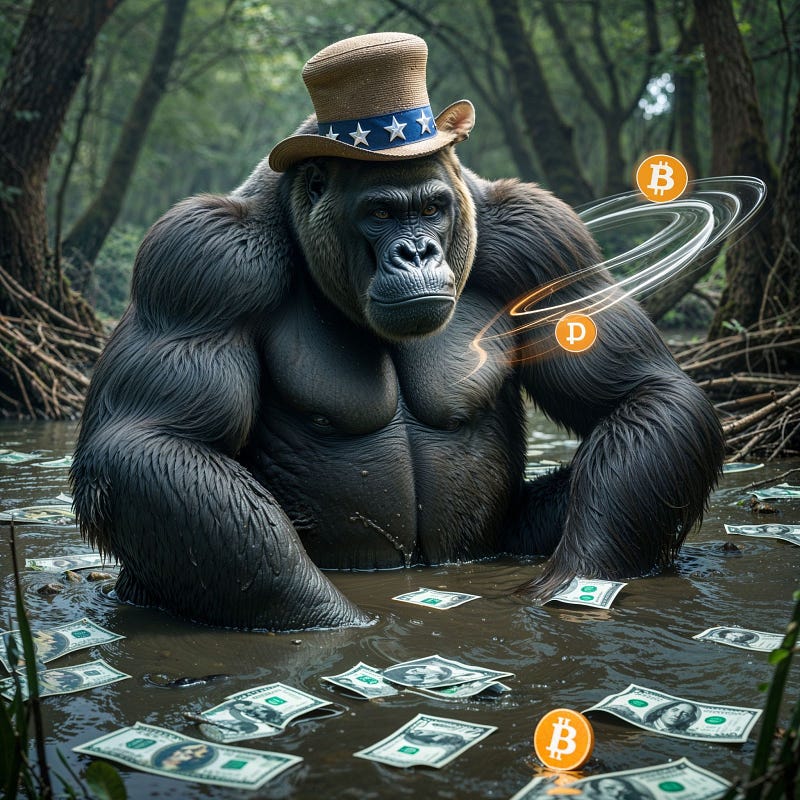
Welcome to the wildest financial fever dream you never knew was actually real life. Buckle up, buttercup, the monetary apocalypse has a sense of humor.
Picture this: A massive, aging gorilla, let’s call him Uncle Sam, has spent decades dominating a vast financial swamp. He’s strong, he’s imposing, and everyone in the swamp follows his rules (or else gets a friendly visit from his military-industrial silverbacks). There’s just one tiny problem: he’s slowly sinking, and the more he thrashes around, the deeper he goes. Those $35 trillion in quicksand debts? Totally fine. Nothing to see here, folks!
Meanwhile, a mysterious wind has appeared, invisible, borderless, and completely indifferent to the gorilla’s historic dominance. This wind doesn’t care about the gorilla’s muscles, his roars, or his impressive collection of regulatory bananas. It just keeps blowing, powered by the hot air of crypto Twitter and the cold, merciless logic of mathematics.
This isn’t just a strange zoo scenario I dreamed up after mixing NyQuil with Monster Energy. It’s actually the perfect metaphor for understanding the bizarre financial revolution happening right now between the U.S. dollar system and Bitcoin, a revolution that makes Game of Thrones power struggles look like a preschool playground dispute.
The Gorilla’s Dilemma: When Success Becomes the Problem
Our 900-pound gorilla (the United States) has a peculiar problem that economists call “Triffin’s Dilemma,” named after economist Robert Triffin who identified it back in the 1960s. Spoiler alert: We’ve spent 60+ years ignoring his warning while whistling through the financial graveyard. Here’s the absurd catch-22:
- The world loves using dollar bills for basically everything (because aircraft carriers are persuasive that way)
- To satisfy this demand, America must pump dollars into the global system (by buying more stuff than it sells)
- But doing this weakens the dollar’s credibility over time (oops!)
- Yet not doing it would starve the world of the dollars it needs (double oops!)
It’s like being the popular kid who has to keep throwing bigger and more expensive parties to maintain your status, while simultaneously trying to save money for college. Except in this case, “college” is “not having your entire financial system implode.” Good luck with that!
The result? A $35 trillion national debt that’s growing faster than your neighbor’s zucchini garden in July, your waistline during lockdown, and your aunt’s collection of ceramic cats COMBINED.
Operation Swamp Escape: Enter the Stablecoin
Recently, the gorilla’s smartest advisors (or at least the ones who figured out how to turn on their computers without calling IT) came up with a clever plan: “What if we create digital dollars that live on the internet? We could sneak our dollar dominance into any territory while generating fresh demand for our debt! It’s like financial colonialism, but with better PR!”
These digital dollars, stablecoins, would be to regular dollars what email was to postal mail: same basic purpose, dramatically new infrastructure, and an exciting new way for the government to read your messages.
The Treasury Department even calculated that these stablecoins could grow to a market of $2 trillion by 2028, with about $1 trillion of that backed by Treasury bills. That’s a trillion dollars of new buyers for government debt! The gorilla was practically salivating. “Finally,” he thought, “a way to keep this debt party going without selling Hawaii to China!”
There was just one tiny issue: Congress needed to pass something called the GENIUS Act to make it all nice and legal. The name alone should tell you everything. When legislators call something “GENIUS,” it’s like a restaurant advertising, “Definitely Not Rats In The Kitchen.” The bill failed because of concerns that the president’s family might personally profit from their own stablecoin venture.
Politics: making simple things impossible and accidentally preventing complex disasters since the dawn of civilization.
Bitcoin: The Wind That Can’t Be Caught
While the gorilla was busy designing elaborate escape mechanisms (and filling out the environmental impact assessment forms in triplicate), something entirely different was gaining momentum.
Bitcoin doesn’t care about:
- Your political party (both sides deluded into thinking they’ve “got it figured out”)
- Which regulatory agency is announcing new rules this week (spoiler: it’s always the SEC)
- Whether Congress gets its act together (narrator: “They won’t”)
- Who’s related to whom in Washington (though that family tree looks suspiciously like a wreath)
Bitcoin keeps producing a new block approximately every 10 minutes, with the cold indifference of mathematics. It doesn’t take weekends off, doesn’t need a government bailout, and definitely doesn’t stop for congressional hearings where octogenarians mispronounce “crypto” seventeen different ways.
It’s like gravity, you can hate it, ignore it, or write angry letters about it, but it’s going to keep doing its thing regardless. And let’s be honest, at this point, Elizabeth Warren has tried all three and failed yet again.
The wind, you see, cannot be grabbed by even the strongest gorilla hands. And boy, have those hands been grasping.
Why This Matters (Even If You Think Bitcoin Is Magic Internet Money for Basement-Dwelling Libertarians)
“OK, cool story,” you might be thinking, “but I’m just trying to pay for my oat milk latte and save for retirement without having to understand monetary policy. Why should I care about gorillas and wind WHEN I’VE GOT TICTOC DANCES TO LEARN?”
Fair question, you blissfully ignorant financial normie! Here’s why this bizarre financial fable matters to regular humans who think inflation is just what happens to your belly after Thanksgiving dinner:
Your Money Is Changing: The dollar in your wallet is caught in this evolutionary struggle. How it functions, how it maintains value, and how it compares to alternatives are all in flux. That retirement plan that seemed so solid? It’s basically written in disappearing ink at this point.
The Rules Are Being Rewritten: The financial system you’ll retire in likely won’t work like the one your parents retired in. The outcome of this gorilla vs. wind scenario will determine which assets are safe, which are risky, and which institutions you can trust. Spoiler alert: the institutions that tanked the global economy in 2008 and then got bailouts might not have your best interests at heart.
Power Is Shifting: Financial power has always been concentrated in institutions that wear impressive suits and have marble lobbies. Bitcoin represents the first serious challenge to that arrangement in centuries. It’s the financial equivalent of Napster, except instead of annoying Sony Music, it’s annoying every central bank.
What Happens Next?
Unlike most fairy tales, this one doesn’t have an ending yet. No fairy godmother is coming to fix the national debt, and Prince Charming isn’t going to kiss our monetary system back to the gold standard. Several possible futures await:
Reluctant Coexistence The gorilla accepts that the wind exists and tries to incorporate it into its strategies, much like your parents finally learning to text instead of leaving 10-minute voicemails. The U.S. adds Bitcoin to its strategic reserves while maintaining dollar dominance for global trade. Your future: you’ll use digital dollars for everyday purchases but store some wealth in Bitcoin as a hedge against the government’s money printer that goes “brrrrr.”
Parallel Financial Universes Two systems operate simultaneously, a regulated, surveillance-friendly stablecoin system for the compliant masses (“Would you like the government to know about THAT purchase? Use FedCoin!”), and Bitcoin for those seeking financial sovereignty. Your future: you’ll navigate both systems depending on your needs and risk tolerance, becoming the financial equivalent of a code-switcher who talks differently around grandma than with friends.
The Great Monetary Reset As debt burdens become unsustainable (shocking, I know), countries scramble to a new monetary system with both gold and Bitcoin playing roles in a post-dollar world. Your future: volatile, uncertain, but potentially revolutionary if you position correctly. Those who prepared will be fine; those who didn’t will be writing angry letters to the editor about how nobody warned them.
What Should You Do About It?
I’m not a financial advisor, and this isn’t financial advice. My legal team (Steve from accounting who once watched “Suits”) made me say that. But I am a curious observer of the strangest financial transformation of our lifetimes, and here’s what sensible people might consider:
Get Educated: Understand both systems, how the dollar works and how Bitcoin works. Knowledge is your best defense against uncertainty and against becoming that person at parties who says “It’s all backed by nothing!” while their 401(k) is invested in companies with negative earnings.
Diversify Thoughtfully: The old system isn’t dead, and the new one isn’t fully born. Keeping some assets in each might be the most pragmatic approach. Consider it like betting on both the Empire and the Rebellion in Star Wars, one is bigger and more established, but the other has the cool new technology and better memes.
Stay Flexible: The gorilla is powerful and won’t go quietly (have you SEEN how many aircraft carriers we have?). The wind is persistent but still young. This transition could take decades and won’t follow a straight line. It’ll be more like your drunk uncle trying to draw a straight line after Thanksgiving dinner.
The Punchline
The 900-pound gorilla is attempting to reengineer its way out of a financial swamp while the untouchable wind grows stronger each day. It’s like watching a nature documentary where David Attenborough whispers, “And here we see the mighty dollar, attempting an unprecedented monetary pivot while pretending everything is fine.”
It’s entirely possible that both the gorilla and the wind have roles to play in our financial future. The gorilla provides stability, familiarity, and military backing (never discount the persuasive power of nuclear ballistic submarines). The wind offers censorship resistance, mathematical scarcity, and freedom from third-party control (never discount the persuasive power of not having your account frozen because an algorithm thought you voted for a republican).
The next decade will determine whether they become fierce adversaries or reluctant dance partners in the next chapter of monetary history. Either way, I’m pretty sure it’s going to make “Game of Thrones” look like “Teletubbies” in terms of power struggles.
One thing’s certain: it will be one hell of a show. Grab your popcorn, or should I say, your non-fungible, blockchain-based digital popcorn tokens? Just be sure to buy them on a regulated exchange so the gorilla knows exactly how much butter you like.
Just kidding. Regular popcorn works fine. For now. Until the supply chain issues hit the popcorn industry, and we’re all trading microwavable kernels on the black market.
About the author: This article was written by a financial observer who believes that understanding monetary evolution is too important to be left only to economists (have you SEEN their track record?)…!