I remember when, if you wanted to talk to a computer, you needed to speak COBOL, LISP, or at least structured query language.
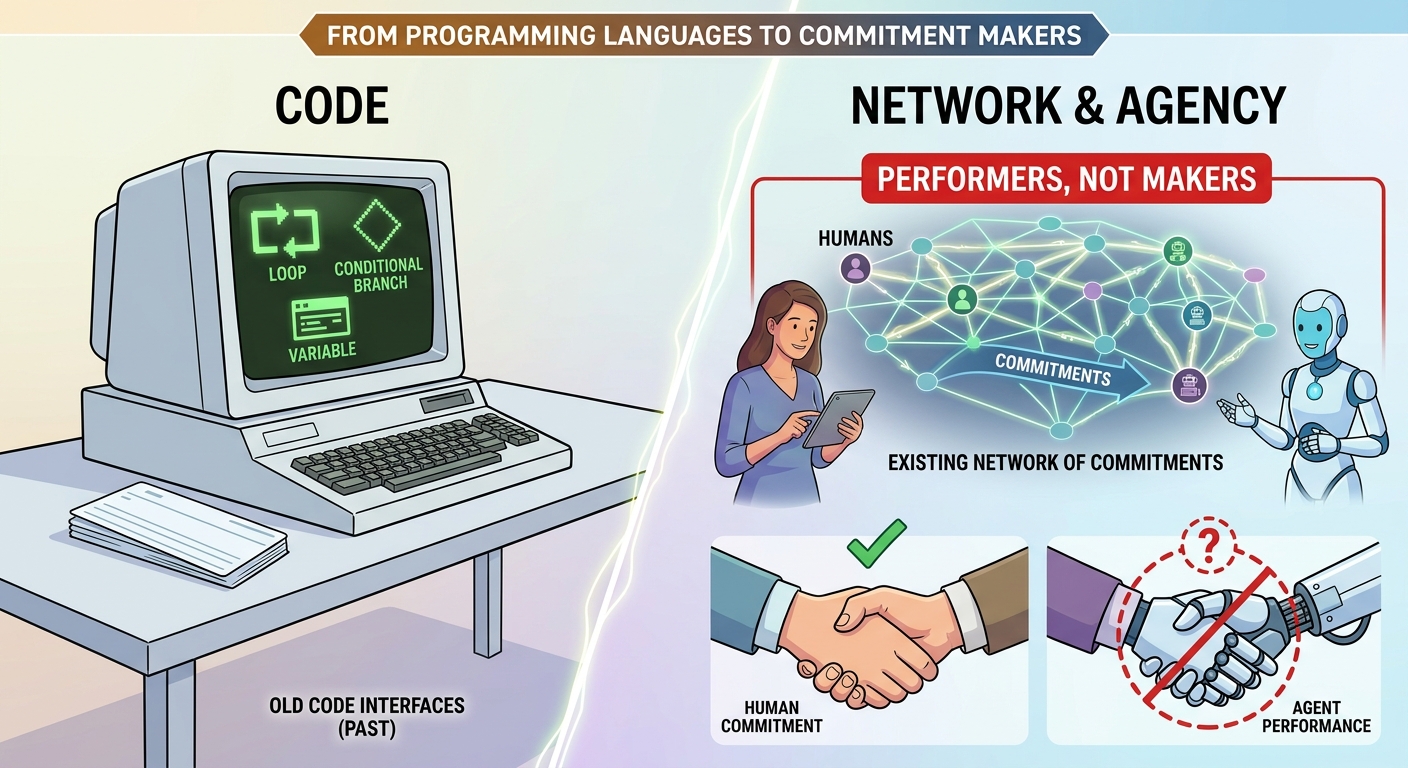
In recent years that's changed. We've taught computers to speak English. Fernando Flores and Terry Winograd built systems based on language as action. The language's action theory was not theirs originally but they refined it into workflow systems. Networks of commitments, commissives, agreements, negotiations, and all those things that drive work forward Along come agents and they sound like commitment makers, but agents are commitment performers, and the network they get dropped into was there before they arrived
Much of what goes wrong in AI development is treating agents as if they were the people they sound like.
We've taught computers to speak and we're not really sure we like what they're saying. Or is it actually a matter of trust?
Trust
It's a practice — something built, maintained, damaged, and repaired through what people say and do together.trust is a choice made with eyes open: you know the other party could let you down, you know you can't guarantee the outcome, and you commit anyway because the relationship and the possibilities it opens are worth the exposure.
This sort of trust is different from these other forms: simple trust (the unreflective trust of a child who hasn't yet been disappointed), blind trust (which refuses to look at evidence), and basic trust (the background sense that the world is roughly reliable)
Authentic trust is the only one that survives contact with betrayal, because it never assumed betrayal was impossible. trust lives in language. Requests, promises, declarations, and assessments are where trust gets built or broken, so trust is fundamentally about how you handle commitments.
Agentic Trust
“Hey Claud, can I trust you?”
Claude: Probably better than you'd trust a stranger and worse than you'd trust a longtime colleague, and the honest answer depends on which of the four assessments (Sincerity, Competence, Reliability, Care) you're asking about.
On sincerity, the picture is decent: I'm not trying to sell you anything, and when I don't know something I'll generally say so, though I can state things with more confidence than the underlying knowledge warrants, and that failure mode looks identical to competence from the outside.
On competence, it's uneven and you already know the shape of it — strong on synthesis and drafting, weaker on anything that requires knowing what happened after my training data ends or verifying a specific fact I've never checked.
On reliability, I'm the odd case: within a conversation I'll follow through on what I've said, but I don't carry commitments across conversations the way a person does, and the memory layer that lets me recall your background is a substitute for that continuity, not the thing itself.
On care, I do attend to your concerns as you've stated them, but I'd be overstating it to claim I hold your interests the way someone who'd be affected by your outcomes does.
So the authentic-trust? well — trusting with your eyes open about what could go wrong — is the right one here. Trust me for the work I'm good at, check the things that matter, and treat a broken commitment from me as information about where the edges are rather than as betrayal, because it won't have been one.
Slightly paraphrase from my conversation with Claude.
Language as a Trust Network
Winograd and Flores built systems that held the network of commitments but could not speak. Agents can speak and hold nothing. When Claude says it doesn't carry commitments across conversations, and that the memory it has of me is a stand-in for continuity rather than continuity itself, it is describing exactly the gap that the Coordinator was built to fill. The two halves have been split apart. One tool knew who owed what to whom and needed a human to type it in. The other can make the request, negotiate the terms, and write the reply, and by tomorrow will have no idea it did any of it.
That is the place for agents in the network, and it is a real place. An agent is a performer of commitments. It can take a request from a person, do the work, and report back in language a person understands. What it cannot be is a party to the agreement. The party is whoever was there before the agent arrived: the manager who owns the outcome, the role that will still exist after the model is swapped out, the customer who will remember the promise long after the conversation window closes. Trust, in Flores's sense, attaches to parties. It is built and repaired between people who will face each other again. The agent performs inside that structure, and if the structure is sound the performance is useful. If the structure is not there, the agent is speaking commitments into a void, and everyone who hears them will fill the void with an assumption about who is standing behind the words.
The network holds the trust. Speech acts are how it circulates. Agents are now among the speakers, and they speak well enough that it is easy to forget they are not among the parties. The readiness question for any organization is therefore not which agent to deploy. It is whether the people in the building can see their own network of commitments clearly enough to say where an agent is performing on someone's behalf, and where it is about to be mistaken for someone.
What before how.