Beyond Breaking Point
How AI and Bitcoin Are Killing Planned Obsolescence
Welcome to the twilight of corporate-mandated disposability. The economic model built on “make it cheap, make it break” is circling the drain and not a moment too soon. We stand at the threshold of an economic revolution that few can fully comprehend. The convergence of artificial intelligence, advanced robotics, decentralized finance through Bitcoin, and the inevitable collapse of unsustainable oligarchic monopolies creates the conditions for a radically different world. This isn’t merely an evolution of our current system; it’s a fundamental reimagining of how humans create, exchange, and preserve value.
Tech experts tell us Robots that can stock shelves and drive trucks are mere years away. Tariffs are about to turn the world economy into one large dumpster fire; GDP keeps climbing while life expectancy doesn’t. The Dow hits record highs while mental health hits record lows. Bitcoin is taking hold in places that only last year seemed impossible, bringing with it whole new economic dimensions, like it or not.
As extractive business models that prioritize short-term profits over long-term sustainability begin to fail under their own contradictions, a new paradigm is emerging: one that aligns technological innovation with resource conservation and human flourishing. Prepare yourself for an economy where built-in obsolescence is recognized not as good business but as a relic of a profoundly limited understanding of prosperity. When your grandfather’s hammer still works perfectly after 70 years while your particle-board IKEA bookshelf collapses under the weight of three paperbacks, maybe, just maybe we’ve been measuring value all wrong.
For decades, consumer economies have been driven by a simple formula: more consumption equals more economic growth. This model has been supercharged by the practice of planned obsolescence, the deliberate design of products to fail, become outdated, or otherwise require replacement after a relatively short period. From smartphones engineered to slow down after software updates to appliances built with parts that cannot be repaired, built-in obsolescence has become a cornerstone of modern capitalism. My iPhone has more computing power than NASA used to put people on the moon, yet it’s designed to become e-waste in 30 months. That’s not innovation; it’s an environmental crime scene with a marketing budget.
However, as we face increasing resource constraints and environmental challenges, this model is beginning to show its fundamental flaws. A convergence of technological innovations, alternative economic frameworks, and changing consumer attitudes is creating the potential for a radical shift away from built-in obsolescence toward an economy with an updated notion of value.
The Resource Imperative
The extraction of natural resources at ever-increasing rates is proving unsustainable. Mining operations for rare earth minerals used in electronics, petroleum extraction for plastics, and the energy required to manufacture and transport new products all contribute to resource depletion and environmental degradation. In a world with finite resources, an economic model predicated on endless production and disposal cycles cannot continue indefinitely.
This reality drives a fundamental reconsideration of how we design, produce, and consume goods. Rather than viewing natural resources as infinite inputs to be transformed into short-lived consumer products, forward-thinking businesses and policymakers are beginning to treat resources as precious assets to be conserved, cycled, and carefully managed. Despite cuts in Scientific Research, the EPA, While Unilever, Patagonia, Interface, IKEA, or Philips have not been directly affected by these cuts, the significant reduction in federal environmental programs, grants, and scientific research will likely have ripple effects throughout the circular economy ecosystem in the US.
But there are other factors at work that the chainsaw-wielding VP and his tariff dinosaur friend don’t see coming!
Technological Enablers of Durability — AI
Ironically, the very technologies that have enabled mass consumption are now creating pathways toward more sustainable alternatives. Two technological forces in particular artificial intelligence and advanced robotics are making durability and repairability economically viable once again.
AI-driven design processes can now optimize products for longevity, using advanced materials science and structural engineering to create goods that last decades rather than years. Predictive maintenance systems can identify potential failures before they occur, allowing for preventive interventions that extend product lifespans. And when repairs are needed, robots with precision capabilities beyond human hands can perform complex maintenance operations at costs lower than replacement.
These technologies are enabling a revival of craftsmanship at scale products built to last, but produced with the efficiency of modern manufacturing. The result is the potential for high-quality goods that don’t sacrifice affordability on the altar of durability.
Technology Driven Deflation — Some say Bitcoin?
While technology provides the means to end built-in obsolescence, a fundamental shift in economic thinking provides the motivation. Jeff Booth, in his influential book The Price of Tomorrow: Why Deflation is the Key to an Abundant Future, argues that technology is inherently deflationary; it drives prices down toward the marginal cost of production, enabling us to get more for less. https://medium.com/@brian_28605/bitcoin-backed-capital-4673c5ebfb8e
“The natural state of a free market is deflation,” Booth asserts, estimating that the natural rate of deflation in markets driven by technology would be approximately 5% per year, given recent technological advances. This natural deflation runs directly counter to our current economic systems, which are built on the assumption of perpetual inflation and endless growth.
In our current fiat currency system, inflation erodes the value of saved money over time, incentivizing immediate spending and consumption. This creates a bias toward shorter-term thinking and immediate gratification, aligning perfectly with planned obsolescence business models. Our monetary policies actively fight against the deflationary effects of technology, creating distortions throughout the economy.
Fixed-supply digital currencies like Bitcoin offer an alternative by allowing deflation to occur naturally. When purchasing power increases over time, unnecessary consumption becomes less attractive. As Booth demonstrates with a personal example, assets become cheaper when priced in Bitcoin: “The house I’m sitting in right now was $1.4m three and a half years ago. Now it’s $2.1m. It was 300 bitcoin three and a half years ago, and now it’s 40 bitcoin.”
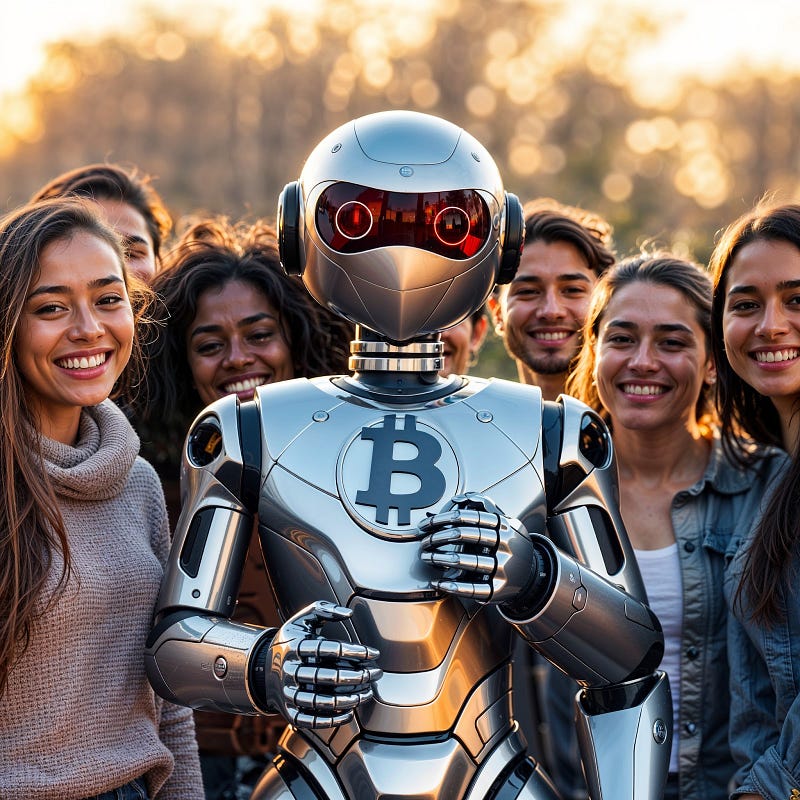
In a deflationary economy enabled by both technology and sound money, fears about automation and job losses would be mitigated because, as Booth explains, “in that world, when people lost their jobs to AI, prices would have already fallen,” meaning necessities would be more affordable even with changing employment patterns.
To illustrate this concept, Consider Maria, a medical billing specialist earning $60,000 annually. In today’s inflationary economy, when her job is automated by AI, she faces immediate financial pressure. Her monthly expenses $1,500 for rent, $600 for food, $400 for utilities, and $500 for healthcare remain constant or increase while her income disappears.
In a deflationary economy, however, the story changes dramatically. As AI and other technologies advance, they naturally drive down costs across all sectors. When Maria’s job is automated, her rent might have fallen to $900 through 3D-printed building materials and AI-optimized energy systems. Her food costs could drop to $300 monthly through automated vertical farming and precision agriculture. Utilities might cost just $150 due to renewable energy abundance and smart grid optimization. And healthcare expenses could decrease to $200 monthly through AI diagnostics and automated care systems.
With essentials now costing just $1,550 monthly instead of $3,000, Maria has more options. She might work fewer hours in a new role, focus on creative pursuits that automation can’t replace, or contribute to community projects. The deflationary effect of technology creates breathing room rather than desperation when employment patterns shift.
This economic transformation doesn’t mean consumption would disappear; instead, it would evolve. People would still purchase goods and services, but with greater discrimination and a preference for items that maintain utility and value over extended periods. As goods naturally become more affordable through technological advancement, the economic pressure to design for obsolescence would decrease. It’s our only shot at having an economy that doesn’t end with resource wars and luxury bunkers. The concept of stewardship, taking responsibility for the things you own rather than treating them like one-night stands with warranties, saves us from ourselves.
The New Production Paradigm
As these forces converge, we see concrete examples of a post-obsolescence production system emerging worldwide.
Right-to-Repair Gaining Legal Recognition: In 2022, New York passed the Digital Fair Repair Act, giving consumers and independent repairers the right to access manuals, diagrams, and original parts from manufacturers, according to recent legislative developments. Similar legislation has been implemented in Europe, where manufacturers are now legally required to supply spare parts for up to 10 years for certain appliances as part of broader regulatory efforts. In 2021, President Biden issued an executive order directing the FTC to enforce the right to repair, resulting in the FTC voting unanimously to address companies that limit repair options, marking a significant federal recognition of the issue.
Modular Design Implementation: Fairphone stands as a pioneering example of modular product design, with their Fairphone 4 allowing users to replace components including the battery, display, cameras, USB port, and speaker using nothing more than a screwdriver, demonstrating practical implementation of repairability principles. Even major manufacturers are beginning to adapt. Apple launched a self-service repair program in 2022 that offers over 200 components and tools, allowing users to repair the latest iPhones and iMacs, showing that major tech companies are responding to the right-to-repair movement.
New Business Models Emerging: The Product-as-a-Service (PaaS) model is gaining traction, where manufacturers retain ownership of products and sell their use as a service, fundamentally realigning incentives toward durability and repairability as companies realize the financial benefits of longer-lasting products. One business implementing this approach noted that while they initially sold “marginally fewer goods, we could sell them at a higher price because their resell value had shot up,” and they “introduced an entirely new revenue stream from selling modular inputs,” demonstrating the economic viability of this business model shift.
These examples show that the circular economy concept is moving from theory to practice, with real-world applications of designs for disassembly, material recovery, and extended product lifecycles. Digital product passports are also being developed in the EU to track materials throughout their life cycle, creating accountability for producers and transparency for consumers as part of broader regulatory efforts toward sustainability.
Wild concept, right? It’s almost like humans evolved in communities or something.
Perhaps most significantly, advanced robotics and AI enable localized, on-demand manufacturing that can be responsive to actual needs rather than speculative mass production. This reduces waste, shortens supply chains, and allows for more personalized products that serve their users better and longer.
From Possession to Disposable Dating
Cultural Shift?
Underlying these technological and economic changes is a cultural shift in our relationship with stuff happening. And it’s about damn time. We’ve been in a toxic relationship with our possessions for decades, treating everything from toasters to Teslas like Tinder dates: swipe right, enjoy briefly, discard when the newer model drops.
The concept of ownership is evolving from mindless accumulation to something resembling actual adulthood stewardship. That means taking responsibility for the things you own rather than treating them like Speed-dating your way through Best Buy. It’s a wild concept, I know.
This model isn’t just different from the corporate-friendly “you’ll own nothing and be happy” vision; it’s its mortal enemy. The oligarchs’ rental utopia would have you paying monthly subscriptions for the privilege of temporarily using items they permanently control. It’s feudalism with better branding and an app. Proper stewardship, by contrast, strengthens your ownership rights rather than eviscerating them. You maintain complete sovereignty over your possessions while accepting that maybe, just maybe, having your seventh smartphone in five years isn’t the pinnacle of human achievement.
In a stewardship model, high-quality, durable goods become actual investments rather than depreciating impulse purchases. An heirloom quality tool passed through generations represents true wealth in a way that a succession of poorly made, Chinese manufactured, rapidly obsolete alternatives never could. If your grandfather’s hammer still works perfectly after 70 years while your particle-board IKEA bookshelf collapsed under the weight of three paperbacks, we’ve been measuring value all wrong.
This perspective is already gaining traction among younger generations, who’ve figured out that collecting experiences delivers more happiness than collecting dust gathering gadgets. They’re flocking to repair cafés and maker spaces, developing actual skills beyond one click ordering and rediscovering the revolutionary concept that things should actually work for more than 14 months.
Social status is increasingly derived from conscious consumption rather than conspicuous consumption. Translation: Having the latest iPhone is less impressive than knowing how to repair one. It’s the difference between being the kid who buys their way into Harvard and the kid who belongs there.
What’s emerging isn’t some granola-crunching rejection of capitalism but a more sophisticated engagement with material culture, where we own fewer, better things and understand their origins, composition, and proper care. This shift isn’t about renouncing ownership but elevating it to something meaningful rather than mindless. And frankly, it’s our only shot at having an economy that doesn’t end with resource wars for Main Street and luxury bunkers in New Zealand for the Oligarchy.
A Human Centered Economy with Digital Money
The technological and economic shifts described above point toward what entrepreneur and thought leader Andrew Yang has called “human-centered capitalism,” an economic system that measures success not by whether Jeff Bezos can afford another superyacht but by metrics that actually matter to flesh-and-blood humans.
In a Yang-style human-centered economy, we’d measure “median income and wealth, quality-adjusted life expectancy, mental health, and childhood success rates” instead of obsessing over quarterly profits that mostly benefit the yacht-and-private-jet crowd. Applied to manufacturing, this means designing products that don’t self-destruct right after the warranty expires. It’s a revolutionary concept, I know.
The brutal irony is that the tech oligarchs selling us planned obsolescence are the same ones building bomb shelters in New Zealand for when the resource wars come. News flash: if your business model requires infinite resources on a finite planet, your MBA is essentially toilet paper with delusions of grandeur.
Want a litmus test for the absurdity of our current system? My iPhone has more computing power than NASA used to put people on the moon, yet it’s designed to become e-waste in 30 months. That’s not innovation; it’s an environmental crime scene with a marketing budget.
Yang’s vision features alternative value systems, including “time banking,” where people exchange skills directly. Imagine fixing your neighbor’s toilet in exchange for math tutoring for your kid instead of both of you grinding out extra hours at soul-crushing jobs to pay strangers for these services. Wild concept, right? It’s almost like humans evolved in communities or something. Hea! we could track that with a Satoshi!
A human-centered approach would also recognize the unmonetized value of activities like care work, environmental stewardship, and education you know, the stuff that actually keeps society from collapsing. The pandemic taught us that the “essential workers” are often the worst paid.
As Yang aptly noted, “if we’re going to lose a race to the machines, perhaps we should change the racetrack and measurements to something we can win and be happy about.” This is precisely why building products that last makes sense. When we eliminate planned obsolescence, we’re not just saving resources; we’re reclaiming our dignity from a system that treats us like credit cards with legs.
The choice between hyper-consumption and human flourishing isn’t a political question; it’s existential. And, spoiler alert: the planet has already cast its vote.
The Road Ahead: Choose Your Apocalypse
The end of built-in obsolescence isn’t coming because corporations suddenly discovered ethics in their quarterly reports. It’s coming because the physics of a finite planet are about to collide with the fantasy of infinite growth, and physics has a perfect winning record in that matchup.
Let’s be clear: The world’s wealthiest people aren’t building spaceships because they’ve always been passionate about astrophysics. They’re hedging their bets against a planet they helped trash. Meanwhile, the rest of us are stuck here wondering if our next smartphone will last until the car loan is paid off.
Here’s the inconvenient truth that no one at Davos will admit: we’re approaching the “find out” phase of “mess around and find out.” We’ve built an economic system that requires consumers to buy things they don’t need, with money they don’t have, to impress people they don’t like, and then throw it all away to repeat the cycle. It’s like a Ponzi scheme where the planet is the ultimate bag holder.
The good news? Necessity is already kickstarting innovation. Right-to-repair laws are gaining traction because even the most technologically illiterate legislators recognize that being unable to fix a $1,000 phone because of a proprietary screw is economic hostage-taking. Companies like Fairphone are proving you can build electronics that don’t self-destruct on schedule. Revolutionary, I know.
AI and automation are wildly accelerating this transformation. If an AI system can design a product that lasts 10 years instead of 2, while using 50% fewer resources, the math becomes irrefutable even to the most quarterly-focused CEO. The question isn’t whether capitalism can accommodate this shift; it’s whether capitalism will shift fast enough to avoid being replaced entirely by something else.
As for Bitcoin, it is forcing an uncomfortable conversation about the economic hallucination that infinite growth on a finite planet is possible. When your monetary system requires exponential expansion to function, you’ve built an economic doomsday machine with a timer that’s rapidly ticking down.
Ultimately, shifting away from planned obsolescence isn’t a hippie fantasy about saving the whales. It’s a cold, hard business reality about surviving the 21st century. Companies that don’t adapt will find themselves obsolete, an irony that would be delicious if the stakes weren’t so high.
The choice is clear: design for durability and regeneration, or design for your company’s tombstone. Either way, the age of throwaway everything is about to be thrown away.