Bitcoin has a lot of Jargon
I Spent 30 Years in Systems Architecture. Explaining complexity to people who had better things to do than decipher jargon.
In 2014, I bought my first Bitcoin. The company treasurer asked me about it as he saw an article mentioning Bitcoin from our accounting firm. I explained that the best way to learn about it was to own some, so I set him up with a Coinbase wallet and sent him $ 15worth of Bitcoin. The BTC-to-USD values those days were under $1,000. A week later, he stopped me in the hall and mentioned he bought a whole Bitcoin. It gave him something to talk about in those C-suite luncheons.
Three weeks later, Bitcoin broke out to north of $1500, and he was inundated with questions from other executives. He referred them to me. It got to the point that I could not go to the men’s room without someone stopping me and asking long, detailed questions about Bitcoin and crypto. For the sake of my bladder, I started an in-house newsletter, “The Crypto Gambler,” and when someone stopped me, I put them on the distribution list.
That was then; today it’s different. Bitcoin is no longer a curiosity for adventurous executives. It’s a $2 trillion asset class, and most people who own it still don’t actually control it.
IOU,
Or rather, They Owe You
So you bought Bitcoin because you were curious or because you were tired of your nephew nagging you about not being cool. Your wallet is on Coinbase, or you purchased some ETF shares in a fund that owns Bitcoin. The fund owns the keys. Coinbase (in most cases) holds custody. The investor has a paper claim — the same structure as every other financial product that Bitcoin was designed to replace.
The same is true for Bitcoin sitting on exchanges. Coinbase, Kraken, Gemini, these aren’t wallets. They’re IOUs. The company controls the keys. You control nothing but a login and a promise.
The phrase Bitcoiners use is “not your keys, not your coins.”
What the hell are “keys” anyway?
And don’t explain it to me using terms like UTXOs or hashing, please.
In the simplest of terms, when you own Bitcoin, you have, possibly, for the first time in your life, the opportunity really take full possession of something.
With that opportunity comes responsibility, something we were conditioned to push off onto third parties like banks and trading houses.
If you don’t control the “private keys” to your Bitcoin, you’re trusting a third party with your wealth. That third party can freeze your account, get hacked, go bankrupt, face regulatory seizure, or simply decide you’re no longer welcome.
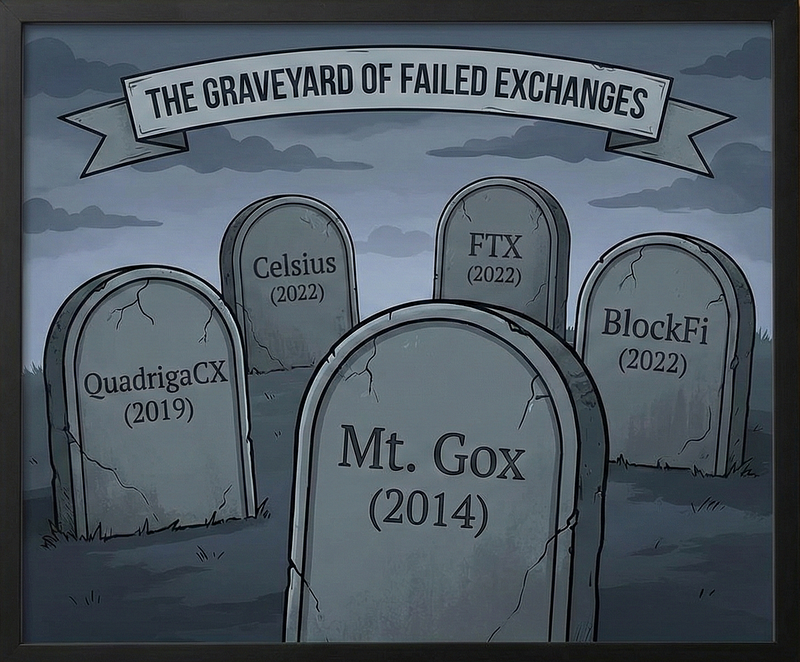
This isn’t theoretical. Mt. Gox customers learned it in 2014 when 850,000 Bitcoin vanished; many are still waiting for recovery a decade later. FTX customers learned it in 2022 when billions in deposits disappeared into Sam Bankman-Fried’s fraud. In both cases, people who thought they owned Bitcoin discovered they owned nothing but a claim in a bankruptcy proceeding.
For some people, third-party custody is an acceptable trade-off; for others, particularly those who came to Bitcoin precisely because they wanted something beyond the traditional financial system, it is not.
Ownership and Responsibility
So why doesn’t everyone just take custody of their own Bitcoin?
The process involves unfamiliar software, strange terminology (seed phrases, derivation paths, UTXOs), and the terrifying knowledge that a mistake could mean permanent loss. There’s no customer service number. No password reset. No FDIC insurance.
People freeze. They leave their coins on the exchange and tell themselves they’ll figure it out later.
Later often never comes.
I wrote a book to fix this.
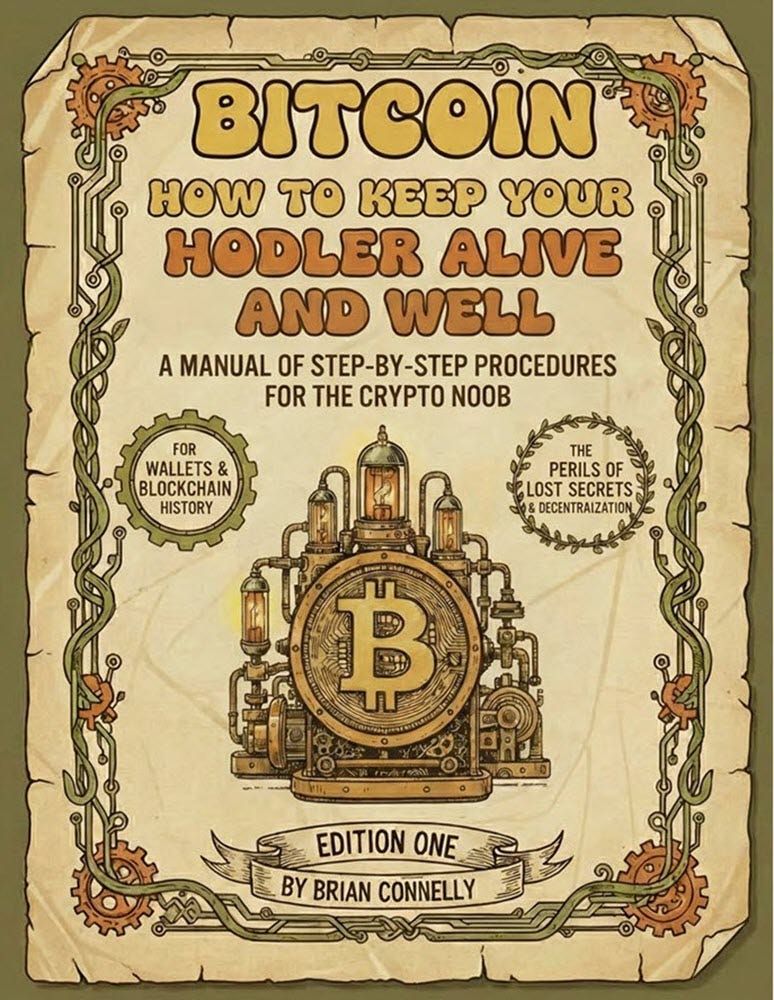
I spent three decades as a Systems Architect and Strategic Consultant for Fortune 500 companies, translating complex technical systems into operational reality for organizations that couldn’t afford to get it wrong. Before that, I worked in clinical social work, where I learned that how you communicate is often more important than what you’re communicating.
When I entered the Bitcoin space, I found brilliant technical resources written by engineers for engineers. I found philosophical treatises on monetary theory. What I didn’t find was a practical, step-by-step guide for someone who just wants to secure their Bitcoin without needing a computer science degree first.
So I wrote one.
The book is modeled after John Muir’s classic car repair guides, the ones that assumed you knew nothing about engines but were capable of reading, laughing, and learning if only someone could show you what to do.
But like Muir’s guides, it’s not just about mechanics. Understanding why you’re doing something makes you better at doing it. So while this book will walk you through the practical steps, what to buy, how to set it up, and how to verify it’s working, it also explains why self-custody matters. Why controlling your own keys is an act of sovereignty. This is not just about protecting your money, but about opting out of a system that requires you to trust institutions that haven’t earned it. Most importantly, it’s entertaining if you appreciate whimsical satire and a weird sense of humor.
Who is this for?
- Professionals who’ve bought Bitcoin but haven’t moved it off the exchange
- Retirees treating Bitcoin as a long-term store of value who need to ensure their heirs can access it
- Anyone who understands the concept of self-custody but hasn’t overcome the activation energy actually to do it
- Financial advisors whose clients are asking questions they can’t yet answer
- Anyone who prefers to learn about government from George Carlin
The cost of procrastination is asymmetric.
Every day your Bitcoin sits on an exchange, you’re betting that nothing will go wrong with that particular company on that particular day. Most days, you’ll be right. But the day you’re wrong could be catastrophic.
Self-custody isn’t complicated. It’s unfamiliar. Those are different problems, and unfamiliarity is solvable.
And if you haven’t bought Bitcoin but are getting curious, the book is an excellent segue into a world unlike anything you learned in school.