Bitcoin Nation State Adoption
Why the Next Reserve Currency Might Not Need a Flag
The 250-Year Currency Soap Opera You Didn’t Know You Were Living In
Let’s face it: most of us barely think about the cash in our wallets, let alone ponder its place in the grand scheme of history. But that green paper with dead presidents? It’s just one episode in a centuries-long drama of currencies rising and falling like empires or boy bands.
The chart that blew my mind recently shows something remarkable: every 80–100 years, the world’s dominant currency gets replaced. It’s like clockwork, except nobody hears the ticking until it’s too late.
The Original Finance Bro
When powdered wigs were fashionable and spices were worth their weight in gold, the Dutch ruled the financial seas. Their guilder was the Bitcoin of the 1600s; everybody wanted it and traded with it. The Dutch East India Company was the world’s first corporate superpower, making today’s tech giants look like little Becky’s lemonade stands.
But like all good things (including that milk you forgot about in your fridge), the Dutch financial dominance eventually expired.
Tea, Colonialism, and Cold Hard Cash
As the Dutch star faded, the British pound stepped into the spotlight. For nearly a century, the pound sterling was THE global currency. If you were doing international business in the 1800s, you did it in pounds. Britain ruled the waves, and their currency ruled global trade.
London became the financial capital of the world, a position they won’t let you forget about even today, despite what happened next.
From Upstart to Top Dog (With Strings Attached)
After World Wars and economic chaos rocked Europe, the dollar swooped in like America itself, young, confident, and ready to take charge. Since the 1944 Bretton Woods Agreement (a fancy meeting where countries agreed the dollar was the new cool kid), the greenback has been the world’s reserve currency.
Being the global reserve currency is like having a financial superpower. The U.S. can borrow money cheaply, impose sanctions that actually hurt, and generally make the rules for international finance.
The Strings
But here’s the twist nobody talks about at parties: it’s not all champagne and roses. There’s this thing called Triffin’s Dilemma (named after economist Robert Triffin, not a character from Harry Potter). As the reserve currency issuer, it means that America must supply the world with dollars by running trade deficits.
In plain English, we have to buy more stuff from other countries than they buy from us. Sound familiar? This creates jobs overseas while potentially hollowing out domestic manufacturing, transforming us from the arsenal of democracy to the world’s leading importer of plastic trinkets that break before you’ve finished removing the packaging.
Nothing says “superpower” quite like a living room full of cheap gadgets stamped with “Made Anywhere But Here,” am I right?
Bitcoin: The Digital Disruptor That’s Past the Tulip Stage
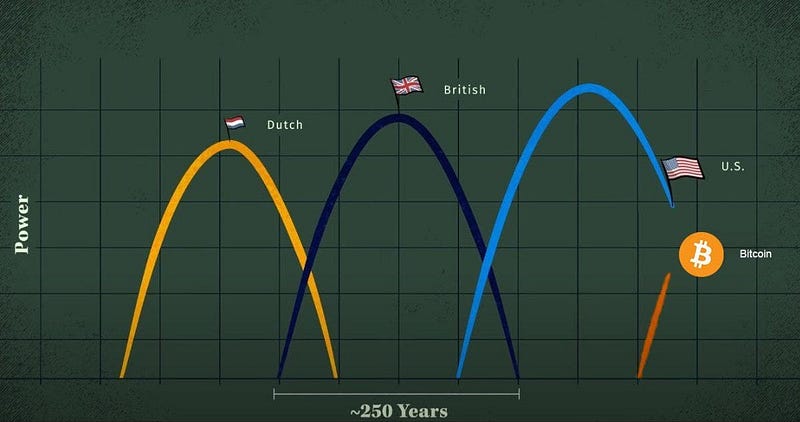
Now look at that orange line creeping up on the right side of the chart. That’s Bitcoin, the internet money your nephew won’t shut up about at Thanksgiving dinner. And before you dismiss it as a fad, even BlackRock, the world’s largest asset manager with a casual $9+ trillion under management, says we’re “past the tulips stage.” Translation: Bitcoin isn’t just digital tulip mania; and it aint going away.
A country or central bank doesn’t back Bitcoin, and that’s precisely the point. In a world where countries print trillions to solve problems, Bitcoin’s mathematical scarcity (only 21 million will ever exist) looks increasingly attractive to people worried about inflation eating their savings for breakfast.
Satoshis: Because Nobody Wants to Buy Coffee with 0.00025 BTC
Speaking of Bitcoin, let’s talk about how ridiculously small it can get. One Bitcoin is divisible into 100 million pieces called “satoshis” or “sats” for short, named after Bitcoin’s pseudonymous creator, Satoshi Nakamoto.
Consider satoshis as pennies, except there are many more per Bitcoin than pennies per dollar. This extreme divisibility means that even if one Bitcoin costs as much as a house, you can still use it to buy a cup of coffee, you’d just pay in satoshis.
So instead of saying, “This coffee costs 0.00025 BTC” (which is as user-friendly as assembling IKEA furniture blindfolded), you’d say, “This coffee costs 25,000 sats.” Much better, right? Don’t worry, you’ll get used to it.

The Three-Step Money Dance
For Bitcoin, or any currency, to go from niche to mainstream, it follows a predictable path:
- Store of Value: People start holding it because they think it will keep or increase its worth. Bitcoin’s largely here today, despite its notorious price roller coaster.
- Medium of Exchange: People are actually starting to use it to buy things. With Lightning Network making Bitcoin transactions nearly instant and basically free, we’re seeing progress here.
- Unit of Account: Prices are listed in it directly. We’re nowhere near seeing “This car costs 500,000,000 sats” instead of dollar prices, but Bitcoin enthusiasts are already “thinking in sats,” especially in countries with unstable currencies.
What This Means For Your Money
The decline of a reserve currency doesn’t happen overnight; it’s more like watching paint dry, if the paint took decades to dry and affected global geopolitics. The British pound didn’t disappear when it lost reserve status; it just became less globally significant.
Similarly, if Bitcoin continues its upward trajectory, it doesn’t mean dollars will vanish from your wallet next Tuesday. It means we might be witnessing another of history’s slow-motion currency shifts. Still, the first one without Triffin’s Dilemma attached since Bitcoin isn’t tied to any particular nation’s trade balance, or national debt!
Whether Bitcoin follows through to become the next global reserve currency or settles into a different role remains to be seen. But the next time someone dismisses Bitcoin outright, remember this chart. The only constant in the history of money is change itself.
After all, people in Amsterdam probably couldn’t imagine a world where their guilder wasn’t king. The Brits didn’t plan to hand the financial reins to those upstart Americans. And yet, here we are.
History doesn’t repeat, but it does rhyme, and right now, it’s composing a verse about digital money that is worth paying attention to, one satoshi at a time.
What do you think? Is Bitcoin destined for the financial history books, or will we all be counting our coffee in sats someday? Let me know in the comments!