Debanking America

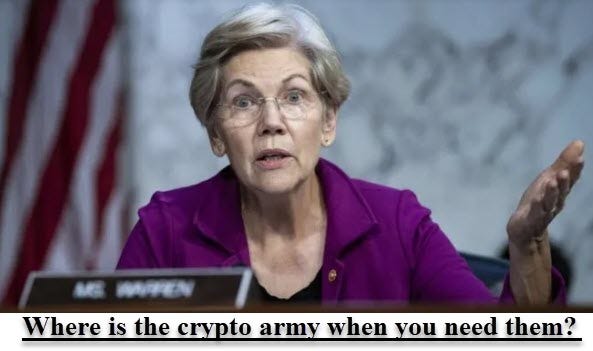
Warren is kissing up to the new administration while still avoiding the real issues around Money Laundering and corruption by Banks and the Government! While advocating parity between crypto and banks under AML rules, Warren avoids contrasting crypto’s laundering volume (estimated at $10–20B annually) with fiat’s scale ($2T+ globally).
Trump (Coin) Con, is it a superhighway to funnel money directly to the president to gain favor and bypass laws? Does it? Let’s call it “Strategic Ambiguity.” Senator Warren?
Commerce is not merely transactions; commerce is trust between individuals and institutions. This un-American overreach by regulators has destroyed trust in banking and government. Donald’s first term saw less than 25% of his signature promises becoming law; this time, he has adopted a position of “If you can’t beat ’em, destroy ‘em.” neither of these positions builds trust in government. DOGE and Musklaina are doing irreparable harm to people’s trust in Government. Will his Bitcoin promises see the light of day?
“The full faith and credit of the US Government” is becoming a meaningless phrase that will profoundly influence the US dollar. Fiscal mismanagement is a burning issue; no system can survive spending trillions of dollars when the income is far below that level.
Even with the efforts of Vice President Musk, there will be little recourse to correct the imbalance without running the money printer, jeopardizing the bond market, and stealing wealth from the middle class through inflation for the benefit of the 1% and their government shadows.
Once the proud champion of consumers, Warren is no longer trustworthy. As the face of Chokepoint 2.0, her association with Jamie Diamond and their attack on Bitcoin are designed to shore up a flawed system that is dangerously nearing total collapse.
Bitcoin holders understand that the real reason for holding Bitcoin is not to see dollars accumulate against their Bitcoin but to ensure that there is life after the corrupt government and banking systems of control and censorship inevitably collapse under its weight. The Bitcoin to USD metric does not reflect the value of Bitcoin as much as it represents the devaluing of the dollar.
Debanking is another way to weaponize money; similarly to the way we sanction Russia and other countries unfriendly to America, we have turned the guns of money on our citizens. When we peel back the layers to what makes this abuse possible, we see debt at the core of the problem. Treasuries prop up the dollar, and the US needs other countries to buy treasuries to pay the interest on our debt. Without those willing suckers, the whole dollar system fails, and if the dollar system fails, world commerce fails. Has it become a system that is too big to fail? BRICS countries who represent a larger GDP than the G7 think so.
Exit, Voice, and Loyalty
This idea recognizes that when faced with declining conditions in any system (government, company, relationship), people have three primary options:
- Voice — Actively trying to improve conditions by speaking up, voting, protesting, or advocating for change from within the system
- Exit — Leaving the system entirely to find or create a better alternative
- Loyalty — Remaining in the system despite dissatisfaction
Bitcoin fundamentally changes this dynamic by creating a viable exit option from national monetary systems. It provides:
- A borderless alternative monetary system
- One that any government can’t control
- With a fixed supply that can’t be inflated
- Self-custodied without intermediaries
- Real Value that can be transported anywhere or stored mentally
The power of this exit option is that it doesn’t require persuading politicians or winning political battles. It allows individuals to opt out directly, creating leverage that might ultimately force better governance of traditional currencies.
The Thinker Behind “Exit, Voice, and Loyalty”
Albert O. Hirschman (1915–2012) was an influential economist and social scientist known for his innovative thinking across disciplines. Born in Germany, he fled Nazi persecution, fought in the French resistance, and helped refugees escape Europe before coming to the United States.
Hirschman introduced this framework in his 1970 book Exit, Voice, and Loyalty. He was interested in how organizations and systems respond to decline, recognizing that the traditional economic focus on “exit” (simply leaving for competitors) was incomplete. He proposed that “voice” (attempting to repair or improve through communication) was equally important, with “loyalty” mediating between these options.
Hirschman was noted for challenging conventional economic thinking, working across disciplinary boundaries, emphasizing the practical over purely theoretical models, and focusing on how real people behave in complex systems.
Exit, not just a Bitcoin thing
As a child, I often found myself in a neighborhood swarm of other children engaged in kickball, dodgeball, or some other competitive game. If it became apparent, for whatever reason, that the game was unfair, we changed the rules. There was no financial incentive, just the well-being of the swarm; we wanted to have fun. If the rules don’t work, we exit them. The same is true today: don’t feel your vote counts; exit the system and vote Bitcoin; even a tiny vote gets their attention.
Changing the rules of the game
Digital Nomadism
Technology has enabled people to work remotely from anywhere, creating an exit option from local job markets, high-cost cities, and even citizenship-based taxation systems.
Alternative Education
Online learning platforms, coding boot camps, and self-directed education create exit options from traditional educational institutions and credentialing systems.
Decentralized Social Media
Platforms like Mastodon and others built on protocols like ActivityPub or Nostr offer exit options from centralized social media companies and their content moderation policies.
Privacy Technologies
Encryption, VPNs, and privacy-focused operating systems provide exit options from surveillance capitalism and state monitoring.
Decentralized Finance (DeFi)
Beyond just Bitcoin, DeFi creates exit options from traditional banking, allowing lending, borrowing, and trading without intermediaries.
Open Source Software
Creates exit options from proprietary software ecosystems and their restrictions.
DAOs (Decentralized Autonomous Organizations)
Offer exit options from traditional corporate structures and governance.
3D Printing and Local Manufacturing
Provides exit options from global supply chains and centralized manufacturing.
The profound implication is that these technologies don’t just create alternatives-they fundamentally change the dynamics of existing systems. When viable exit options exist, organizations must improve their treatment of users and citizens or risk losing them. This creates leverage for positive change, even for those who remain in traditional systems.
As Balaji Srinivasan argued in The Network State, these exit options create “the ability to peacefully exit” without geographical relocation, potentially forcing governments and institutions to compete for citizens in unprecedented ways. Your Bitcoin vote counts, and it pays dividends in the meantime.
The Game-Changing Impact of Viable Exit Options
The entire power dynamic between institutions and individuals fundamentally changes when viable exit options exist. This transformation operates through several mechanisms.
Competitive Pressure Without Direct Competition
Traditional organizations suddenly face competition even when they technically hold monopolies. For example, a central bank may have a legal monopoly on currency issuance, but Bitcoin creates an alternative that exerts competitive pressure. Public schools may be the only government-funded option, but online learning creates competitive pressure without directly competing for the same funding.
Improved Bargaining Position for “Voice”
Those who stay and advocate for change (using “voice”) gain substantially more leverage when an exit is viable. When employees can easily find remote work anywhere, their suggestions for workplace improvements carry more weight. When citizens can quickly move assets to Bitcoin, their political advocacy about monetary policy becomes more influential.
When users can easily migrate to alternative social platforms, their feedback about features or policies might be taken more seriously. We saw this in the 2024 election when Trump embraced the Bitcoin conference, and the Bitcoin community responded with tremendous support.
Market Discipline for Previously Unaccountable Institutions
Organizations that previously faced little accountability must now respond to market forces. Governments must consider how policies might drive citizens or their assets elsewhere; universities must justify their value proposition when alternatives exist, and financial institutions must improve services when people can self-custody assets.
Preference Revelation Through Exit Options
Exit options reveal strong preferences in ways that voice alone cannot. When people put money into Bitcoin despite volatility, it shows deep concerns about inflation and a vote against corrupt systems. When students choose coding boot camps or blue-collar apprenticeships over degrees, it reveals what the job market truly values. When users migrate to privacy-focused alternatives, it shows a genuine demand for privacy.
Network Effects in Reverse
As exit options gain adoption, they become more viable through network effects:
- The more people use Bitcoin, the more merchants accept it, creating a reinforcing cycle
- The more professionals recognize alternative credentials, the more valuable they become
- The more users join decentralized platforms, the more compelling they become to new users
This technological exit phenomenon represents a profound shift from the 20th century when most monopolistic governmental systems faced little effective competition. Even before mass adoption, the mere existence of these alternatives begins reshaping incumbent behavior, as incumbents must now earn loyalty rather than assume it by default. It’s a monopoly killer, regardless of whether that monopoly is represented by the browser you use or the money you use. With options available, the world gets smaller, and the borders and conflicts accompanying them are less relevant to everyday life.
Gradual then Suddenly
The impact isn’t an all-or-nothing choice. Partial exit options create positive effects. For example, a person might keep some funds in traditional banking but move a percentage to self-custody. A professional might maintain traditional credentials while building skills through alternative education. A citizen might remain in their country while moving some economic activity to borderless systems. Eventually, there will be a tipping point, and the system will flip. Everyone will have a smartphone, internet access, and no landlines or banks it’s called progress.
Originally published at https://brianpconnelly.substack.com.