Four Perspectives
Bitcoin and the Future of the Global Monetary System
Introduction
The global monetary system faces unprecedented challenges in the 21st century. The U.S. dollar’s dominance as the world’s reserve currency has created structural imbalances that many argue have hollowed out American manufacturing, exacerbated inequality, and created unsustainable debt levels. Meanwhile, technological advancement continues to accelerate, creating new possibilities and pressures on traditional financial structures.
In plain English? The money game is rigged, folks. The dollar being the world’s favorite currency sounds excellent on paper, like America winning the financial Super Bowl, but it’s actually screwing us six ways to Sunday. Here’s the deal: when everyone needs dollars, they send us cheap stuff to get them. Sweet, right? Except this killed off good factory jobs faster than a politician’s promise after election day. Now we’ve got hedge fund managers buying their fifth yacht while the rest of us wonder why our paychecks don’t stretch like they used to. We’re also borrowing money like there’s no tomorrow, which might be true if we don’t fix this mess. And just for kicks, technology is changing so fast that the financial bigwigs are sweating through their expensive suits, trying to keep up.
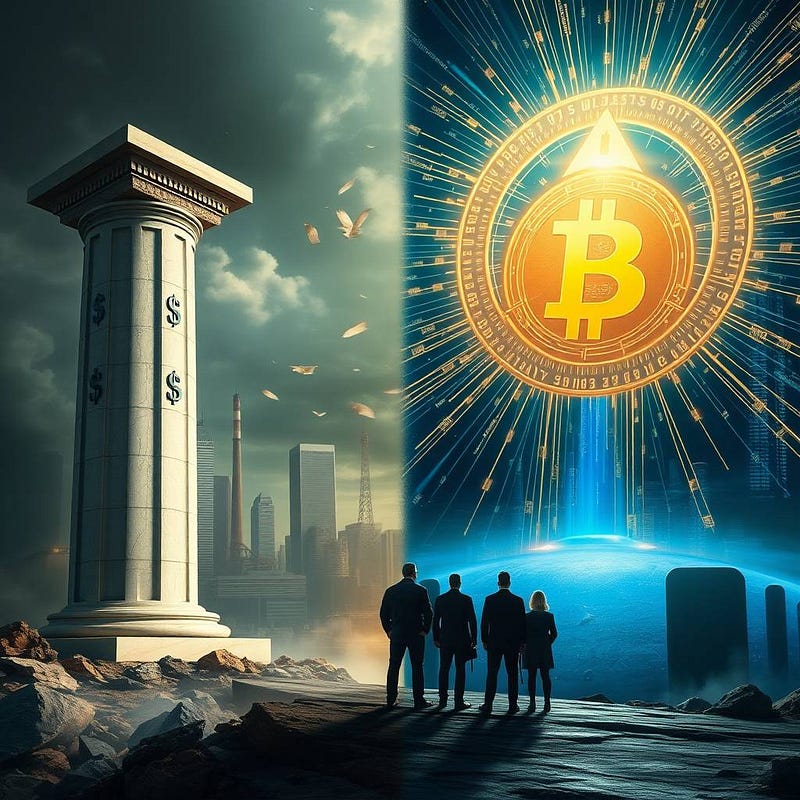
Against this backdrop, Bitcoin has emerged as a potential agent of systemic change. But what role might it play? Four distinct perspectives, from economist Stephen Miran, macro analyst Lyn Alden, Space Force officer Jason Lowery, and tech entrepreneur Jeff Booth, offer compelling and complementary frameworks for understanding Bitcoin’s potential significance in reshaping the global economic order.
Enter Bitcoin, the digital rebel with a cause, causing central bankers to lose sleep faster than a triple espresso at midnight. But is it just magic internet money or something bigger? We’ve rounded up four brainiacs who aren’t just blowing smoke; they’ve each got a piece of this puzzle.
You’ve got Miran the economist (think professional money nerd), Alden the macro analyst (who sees financial patterns like you spot that one weird guy at Walmart), Lowery the literal Space Force officer (yes, that’s a real job now, not just a Netflix show), and Jeff Booth the tech guru who built a multi-million dollar company while most of us were figuring out our Netflix password.
They don’t agree on everything, but together, they paint a picture of how Bitcoin might be the financial equivalent of the wheel, a game-changer that comes along once in a thousand years.
The Triffin Dilemma: Miran and Alden’s Macro Perspective
Both Stephen Miran and Lyn Alden anchor their analysis in what economists call the “Triffin dilemma,” named after Belgian economist Robert Triffin. This paradox highlights how a country whose currency serves as the global reserve currency must run persistent trade deficits to supply the world with its currency, ultimately undermining its own economic base.
In his paper “A User’s Guide to Restructuring the Global Trading System,” Miran explains that “the root of the economic imbalances lies in persistent dollar overvaluation that prevents the balancing of international trade, and this overvaluation is driven by inelastic demand for reserve assets.” As global GDP grows, it becomes increasingly burdensome for the United States to finance the provision of reserve assets through deficits.
Alden elaborates that this process creates a damaging cycle: “The trade deficit is often described as us sending out pieces of paper and getting goods and services, which sounds like a really good deal.” However, those foreign holders “take those slips of paper and then they buy our stocks, they buy our real estate, they buy our corporate bonds and government bonds and so they end up owning a larger and larger share of corporate America.”
This process has effectively hollowed out America’s industrial base while concentrating wealth in financial assets, creating what Alden describes as “taking economic vibrancy out of Michigan and Ohio and rural Pennsylvania where the steel mills were… causing it to become the rust belt, and then we’re stuffing it back into financial assets in New York and Silicon Valley.”
Miran suggests policy tools to address these imbalances, including tariffs and currency accords. He proposes a system that would intertwine trade and security policy, where countries that want to be under America’s security umbrella must also participate in fair trade practices. This approach aims to recapture some of the benefits that reserve currency status confers on other nations.
So now you get it? The scam nobody told you about: America’s stuck in what fancy-pants economists call the “Triffin dilemma”, basically a financial version of quicksand where the harder we struggle, the deeper we sink. It works like this: For the world to use our dollars (which they need like teenagers need smartphones), we have to ship those dollars overseas by buying foreign stuff instead of American-made.
That sounds sweet at first, we hand them paper, and they send us TVs and cars! But here’s the twist that would make any con artist proud: those foreigners take our dollars and buy up chunks of America like it’s a Monopoly fire sale. So while factory towns in the Midwest turned into something out of a zombie apocalypse movie, Wall Street and Silicon Valley got so rich they’re using $100 bills as toilet paper.
Miran and Alden aren’t just pointing fingers; they’ve got ideas to flip the script. Miran’s saying, “Hey world, you want our military protection? Then stop screwing us on trade.” It’s like telling your mooching brother-in-law he can’t crash on your couch unless he chips in for groceries, about damn time.
Softwar: Lowery’s National Security Perspective
Jason Lowery offers a radically different framework for understanding Bitcoin’s significance. Rather than viewing it primarily as a financial technology, Lowery, in his “Softwar” thesis, conceptualizes Bitcoin as a national security technology, specifically, a new form of “electro-cyber power projection.”
Lowery argues that Bitcoin’s proof-of-work mechanism represents a system where securing digital information requires imposing actual physical costs, similar to how military forces secure physical domains like land, sea, and air by imposing costs on potential aggressors. In this view, Bitcoin becomes a strategic tool for national defense in the digital realm.
This perspective recasts the security-currency connection in a novel way. While Miran and Alden describe how the US provides physical security in exchange for reserve currency benefits, Lowery suggests Bitcoin could transform this arrangement by creating a new security infrastructure for cyberspace, potentially reducing dependency on America’s unilateral military and financial power.
When Joe Biden met with Xi Jinping in San Francisco last week one of the many topics they discussed was AI and they…medium.com
Lowery’s thesis suggests that nations might consider strategic Bitcoin reserves not merely as financial assets but as critical components of national security infrastructure. This could potentially address some of the imbalances identified by Miran and Alden, as the security aspects of the global monetary system evolve alongside its financial functions.
Here comes Space Force Officer Lowery, dropping a mind-bomb that’ll make you spit out your coffee. Forget Bitcoin as magical internet money, he sees it as a digital weapon system. No joke! While everyone thinks “Lambos and moon,” this military guy thinks “national security.” His “Softwar” theory says that Bitcoin’s mining process, which burns enough electricity to power a small country, isn’t wasteful; it’s like having an electric fence around your property that zaps anyone trying to mess with it.
Like we park aircraft carriers in oceans to keep shipping lanes open (while flexing our military muscles), Bitcoin miners burn real-world energy to secure digital highways. It’s brilliant when you think about it, hackers and bad actors would need to outspend the entire network’s electricity bill to hijack it, which is like saying, “you want to rob this bank? First, buy the whole damn city.”
Lowery’s telling governments to stack Sats not just for their portfolios but as a matter of national security, like stockpiling digital tanks and jets. Your uncle might still think Bitcoin is some kind of video game token, but in the halls of national security, ignoring it would be like the military brass dismissing Billy Mitchell’s warnings about air power before Pearl Harbor, they court-martialed the guy for insubordination, only to watch Japanese planes sink their supposedly invincible battleships exactly as he predicted.
Technological Deflation: Booth’s Economic Evolution Perspective
Jeff Booth approaches the question from yet another angle, focusing on the fundamental conflict between technology’s naturally deflationary effects and our current inflation-dependent monetary system.
In “The Price of Tomorrow,” Booth argues that technological advancement naturally creates deflation, we get more for less as innovation continues. This directly conflicts with our debt-based monetary system, which requires inflation to function properly because inflation makes debt easier to service over time.
“Technology is deflation,” Booth states, highlighting how digital innovations drive prices down across sectors. Meanwhile, our monetary system must “drive prices up forever” because “if it allows deflation to happen, you can’t pay back, and the credit unwinds.”
Booth sees Bitcoin as the solution to this fundamental contradiction, a “digitally native currency that allows for deflation” and aligns with technological progress rather than fighting against it. In his view, Bitcoin isn’t just an investment or security tool but a necessary evolution of money for a technology-driven world.
Tech entrepreneur Booth is basically saying what every smartphone buyer already knows: technology gives us more bang for our buck every year. Remember when a decent TV cost a month’s salary, and now you can grab a better one for what you spend on beer in a week? That’s deflation in action, baby! But here’s the rub: our entire money system is like a shark that dies if it stops swimming forward. It needs constant inflation to keep the debt machine humming, because your mortgage is a lot easier to pay off when tomorrow’s dollars are worth less than today’s.
Booth points out these two forces, tech pushing prices down and the Fed desperately shoving them up, are like two freight trains headed for a collision. Enter Bitcoin, which Booth sees as the perfect compromise: a money that naturally gets more valuable over time (like your grandpa’s paid-off farm) rather than less (like that car loan underwater before you leave the dealership). It’s not just digital gold; it’s money that actually makes sense in a world where your fridge orders groceries and your car drives itself. Bitcoin isn’t fighting the future, it is the future, while the dollar’s still using a flip phone and paying for AOL by the hour.
Synthesizing the Perspectives
These four perspectives, while starting from different premises and emphasizing different aspects of Bitcoin, actually complement each other in revealing ways:
- Structural Economic Imbalances: Miran and Alden identify how the current reserve currency system creates unsustainable trade imbalances and industrial hollowing out in the U.S.
- National Security Dimension: Lowery highlights how digital security and monetary systems are deeply intertwined, suggesting that Bitcoin might represent a new paradigm in securing digital space.
- Technological-Monetary Misalignment: Booth pinpoints a fundamental conflict between technological progress and monetary design that the others don’t directly address.
Together, these perspectives suggest that Bitcoin might serve multiple complementary functions in a restructured global system:
- As a neutral reserve asset that helps rebalance global trade without requiring persistent American deficits (Miran/Alden)
- As a security mechanism for digital information and power projection in cyberspace (Lowery)
- As a monetary system aligned with technology’s deflationary nature (Booth)
Implications for Policy and Investment
If these perspectives have merit, several implications emerge for policymakers and investors:
- Reserve Diversification: Central banks might increasingly diversify reserves into Bitcoin alongside traditional assets like gold, as suggested in Miran’s paper.
- National Security Strategy: Governments might begin to view Bitcoin mining and network participation as strategic national assets rather than merely private-sector activities.
- Monetary Policy Rethinking: Central banks may need to reconsider their inflation targeting in a world where some technological deflation is inevitable and potentially beneficial.
- Industrial Policy: Nations might focus less on fighting deflationary forces through monetary policy and more on ensuring their industries remain competitive through innovation.
Conclusion
The dollar-based global monetary system that emerged after World War II faces unprecedented challenges from technological change, shifting geopolitics, and internal contradictions. Bitcoin, viewed through the complementary lenses offered by Miran, Alden, Lowery, and Booth, appears not merely as a speculative asset but as a potential solution to multiple systemic problems.
Whether as a neutral reserve asset that reduces global imbalances, a security mechanism for the digital realm, or a monetary system aligned with technology’s deflationary nature, Bitcoin might be helping to facilitate a transition to a more balanced, secure, and technologically aligned global economic order.
The perspectives offered by these four thinkers suggest that understanding Bitcoin requires moving beyond traditional financial analysis to consider geopolitics, security, and technological evolution. As Alden notes, “Bitcoin is catching on. You may want to get some.” But the implications go far beyond investment returns, they touch on the fundamental structure of our economic, security, and technological systems.
So what’s the bottom line here? The dollar’s been running the world’s money show since your grandpa was cruising in his Chevy, but that system is now shakier than a porta-potty at a chili cook-off. Bitcoin isn’t just some get-rich-quick scheme for tech bros; it might actually be the Swiss Army knife for fixing multiple dumpster fires at once.
These four smarty-pants experts are basically approaching the same elephant from different angles: Miran and Alden see Bitcoin fixing our broken trade system, Space Force Lowery sees it protecting our digital borders better than any firewall, and Booth sees it as money that actually plays nice with your iPhone instead of fighting it.
Put together, it’s like Bitcoin was designed to solve problems we’re only now figuring out we have. As Alden says, “Bitcoin is catching on. You may want to get some.” That’s like saying, “Oxygen is catching on; you might want to breathe some.”
This isn’t just about filling your digital wallet, it’s about rebuilding the entire engine of society while the car’s still running. The old money system is a VHS tape in a streaming world, and Bitcoin might just be the upgrade we didn’t know we needed.