From Protest to Protocol
The Evolution of Financial Resistance
The Awakening (Pre-2008) I was working on alternative SPAM protection for email systems when I came in contact with the cypherpunk movement . They had been quietly developing alternatives to state-controlled monopoly of money since the 1980s. Hayek’s “Denationalization of Money” provided an intellectual framework, while technologists like David Chaum explored the concept of digital cash. These weren’t mainstream concerns, they were niche academic and technical discussions about theoretical alternatives.
A Catalyst (2008 Financial Crisis) The financial system’s near-collapse exposed fundamental contradictions. Banks privatized gains while socializing losses. Quantitative easing began, a policy most economists would have called radical years earlier, now implemented with minimal public input. Main Street absorbed the pain while Wall Street received bailouts. The system’s priorities became impossible to ignore.
Bitcoin launched three months later with Satoshi’s genesis block explicitly referencing bank bailouts. This wasn’t coincidental timing.

The Street Response (Occupy Wall Street, 2011) Occupy represented traditional revolutionary energy, physical occupation, mass protests, demands for institutional reform. The “99% vs 1%” captured widespread frustration but against the prevailing political narrative it struggled to articulate realistic alternatives. The movement demanded accountability from the same institutions that had just demonstrated their inability to exercise accountability. Bonuses for destructive wild speculation was a slap in the face for the middle class who lost live changing savings.
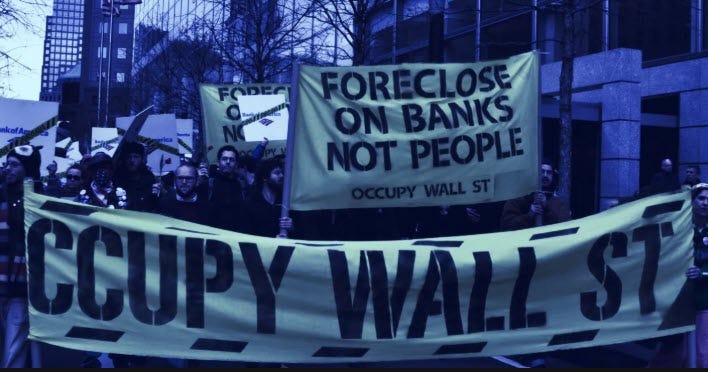
Occupy eventually dispersed, but the underlying energy didn’t disappear. It transformed. Bankers became as popular as politicians.
The Underground Evolution (2011–2017) While the self inforced blind media declared Occupy “dead,” its participants and sympathizers began exploring systematic alternatives. Some discovered Bitcoin. Others investigated permaculture, intentional communities, alternative currencies, and decentralized technologies. The energy shifted from confronting power to building parallel systems.
Bitcoin represented the most technically sophisticated alternative. Unlike local currencies or barter systems, it offered a global reach without the need for trusted intermediaries. The cypherpunk vision became practically viable, something that had never before existed in the history of man.
The Recognition Phase (2017–2020) Bitcoin’s price discovery cycles brought mainstream attention, but institutional response remained dismissive or hostile. “Rat poison,” “tulip bulbs,” “criminal funding”, the language revealed establishment fear disguised as contempt.
Meanwhile, countries like Venezuela , El Salvador and Lebanon provided real-world laboratories for Bitcoin adoption under monetary stress. People discovered Bitcoin’s practical utility when traditional systems failed them.
The Institutional Pivot — AKA Willie Sutton Logic (2020-Present) Suddenly, institutions that spent years attacking Bitcoin began adopting it. Corporate treasuries, pension funds, and ETFs, the same financial system Bitcoin was designed to circumvent, now claim it as an asset class.
This creates the current tension. Institutional adoption provides legitimacy and infrastructure, but threatens to domesticate Bitcoin’s revolutionary potential. Occupy Wall Street demanded reform from corrupted institutions. Bitcoin offers something different, an exit from those institutions entirely.

The values shift was not only profound but reflects the ethos of accepting individual responsibility rather than demanding accountability.
And:
- From protest to building alternatives
- From regulatory capture to fork-based governance
- From zero-sum wealth redistribution to positive-sum value creation
- From institutional dependency to individual sovereignty
- From short term rent seeking to long term future planning
The Current Moment Bitcoin now provides what every previous generation of dissidents lacked: a credible alternative to the old monetary system. Not reform, replacement. Not revolution through violence, revolution through voluntary adoption of superior technology.
Many have come to understand the journey from “fix the system” to “exit the system.” From demanding justice from captured institutions to building just institutions. From protest to protocol.
I may be connecting more dots across history than are actually connected. Do your own research. If I am right, the implications are profound. If I am wrong, I would still encourage individual agency, authentic leadership, voluntary cooperation, and truth over political narrative. Math does not lie!