It’s all Energy!
Nuclear, Bitcoin, and AI
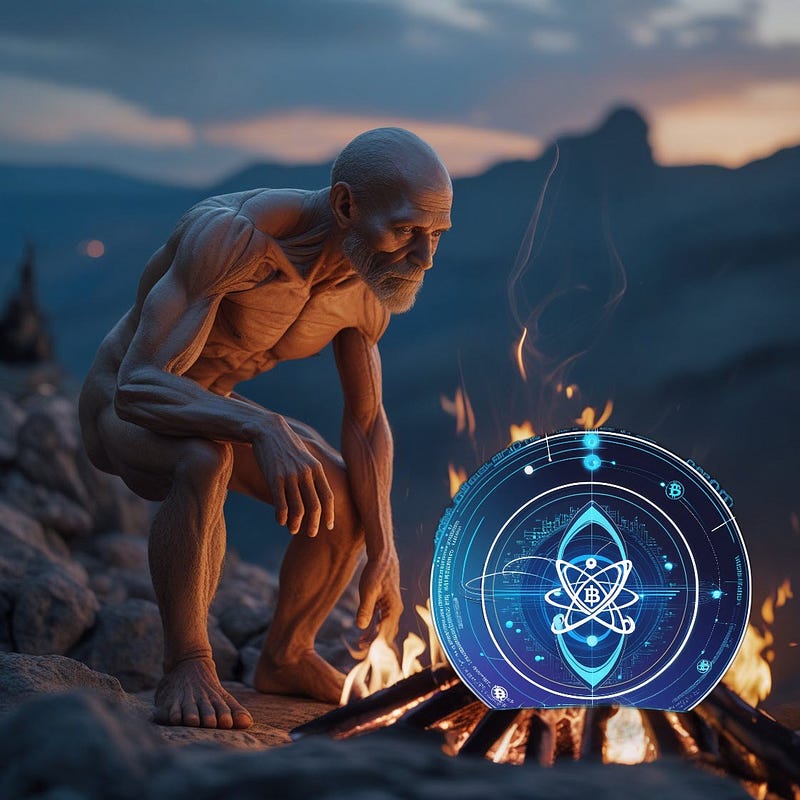
From the beginning, man has leveraged energy for a better future. Today, we are faced with new, misunderstood, sometimes frightening technologies that we must master. Our forebearers were frightened and did not truly understand what they were dealing with, but they managed. If we are willing, we will, too.
Before I was born, my father was drafted into the effort to build an atomic bomb. The world was at war, and the ramifications of Enstine’s theory of energy E=mc² broke out in the form of a letter to Roosevelt about the possibility of a devastating weapon that would determine global power dominance for decades or centuries beyond the war at hand.
So profound was this concept that with little more than theoretical speculation, the US committed $2 billion in 1945 dollars, equivalent to over $30 billion in 2023 dollars. The success of this effort resulted in a destructive power that man has only dared to unleash twice in our history. To go down that path again would mean the complete invalidation of mankind.
We also learned about chain reactions, exponential effects, and the raw power of fundamental forces. These concepts will come into play as we look at the other aspects of how we deal with energy and how it impacts our lives.
Following my father’s engineering mindset, I encountered a technological framework during my studies as a global network engineer. This framework was also world-changing, not in a violent chain reaction of atoms but as an energy accounting worldwide. A secure global ledger backed by the commitment of energy to support the network is a term called “proof of work.” It can be thought of as Cryptographic energy, which is the energy used to power the cryptographic processes that support cryptocurrency networks and transactions.
Bitcoin can be described as a global ledger that tracks value and allows transactions and settlements in a way that has never been available to mankind throughout history. Intended as digital money, it enables energy transfer across time and space. If I want to protect my savings and pass it to my great-grandchildren 100 years later, Bitcoin can facilitate that transaction. My savings in dollars would likely be worthless in 100 years.
Farmers relied on the power of a horse to cultivate fields and perform strenuous work. If I could buy more horses, I would have more power to accomplish more work and significant outcomes. Bitcoin makes that dynamic available to anyone worldwide without needing a bank or government in the mix. The ledger is honest because it is based on math (Math is truth) rather than a central monetary policy of a government.
Additionally, Bitcoin energy consumption, unlike traditional data centers, can leverage energy that would otherwise go wasted. These stranded sources of energy that don’t make commercial sense to tap into make perfect sense to a Bitcoin network operator. They can then be redirected to provide alternative power to other community needs.
When I worked with “AI” in the 90s, we would write the rules for the AI engine to follow, today, the AI engine figures out the rules when trained on data. This is energy becoming self-organizing with multiple feedback loops that optimize outcomes.
These AI engines can be brought to bear on massive problems that would otherwise take lifetimes to solve. While AI data centers, unlike Bitcoin data centers, use orders of magnitude more significant amounts of energy, they are predictable and provide an exponential return on investment.
Problems man has been grappling with for centuries could be solved in a few years with AI: cancer, Farming Optimization. AI could improve the research on fusion power generation at JT-60SA, located in Ibaraki Prefecture, Japan, or ITER, a $28 billion fusion reactor in France. Then there is space travel & habitat and climate change, just to name a few problems that need AI sooner rather than later. Autonomics is the engineering of self-correcting systems that don’t rely on human intervention for optimization and repair.
And we are all wondering, when AI and robotics do all the dirty and brutal work, what will we do? Will I need a job or get income for just breathing? Retirement for all? This is another question that could benefit from AI reasoning.
These aren’t distinct developments but rather sequential understanding of the same fundamental force — energy itself. Atomic energy taught us what was possible, Bitcoin teaches us how to measure and account for it, and AI teaches us how to optimize and direct it.
From this perspective, these technologies aren’t competing systems but compounding layers of humanity’s understanding of energy manipulation. Each layer builds on and enhances the previous ones.
Like in the 1940s, when the government committed enormous sums of money to a project to build a bomb, we have corporations lining up to commit exponentially more significant sums of capital to bring a similarly theoretically understood power to fruition. Will it work? Will we last long enough to see the potential benefit? Will nation-states China, Russia, and the US develop frameworks to protect man from total annihilation like we did with Atomic Energy, or will we need a new security system that doesn’t rely on promises like the blockchain?
With all the wonder and amazement surrounding these technologies, it is helpful to step back and realize that we are on the same path we were on when we discovered the benefits of fire. We change the technology,, and it changes us. But we are the ones who determine the nature of that change.
Originally published at https://brianpconnelly.substack.com.