Why I Wrote a Children’s Story About Money (And Why It Isn’t Really About Money)
Brian Connelly
---
When I was four years old, I figured out the trap.
Not in those words, obviously. I was four. But I remember the moment I understood that adults had to go somewhere every day, do things they didn’t want to do, in exchange for something called money, which they then exchanged for the things they actually needed to stay alive. And if they stopped going? The things stopped coming. The whole arrangement struck me as suspicious. At four, I considered my options: prison, the priesthood, becoming a hobo. All three seemed like reasonable exits from a system that, even at four, felt rigged.
I’m sixty-nine now. I never stopped thinking it was rigged. I just got better at understanding the rigging.
Somewhere between those two points I built enterprise systems for Fortune 500 companies, wrote about Bitcoin for a decade, earned an MIT FinTech certificate, published six books, and raised children who did everything right and still ended up with less purchasing power than I had at their age. Each of those experiences was a different angle on the same question I had at four: who decided this is how it must be?
That question is what produced a book about Mara.
Not the technology. Not the monetary theory. Not the Trivium. A question that no adult in my childhood could answer, or would.
Here is what happened. I was writing a Bitcoin education book for parents, and I kept running into the same wall. Every time I tried to explain proof of work, or distributed ledgers, or monetary debasement, I watched people’s eyes go dead. Not because they were stupid. Because the language was wrong. The concepts are not hard. The vocabulary is brutal. It sounds like a graduate seminar even when the underlying ideas are things a ten-year-old could grasp, because a ten-year-old already has the intuitions. They just don’t have the jargon.
So I asked myself a different question. What if the kid already knows this stuff? What if they’ve always known it, the way I knew at four that something was wrong, and all they need is a story that shows them what they already feel?
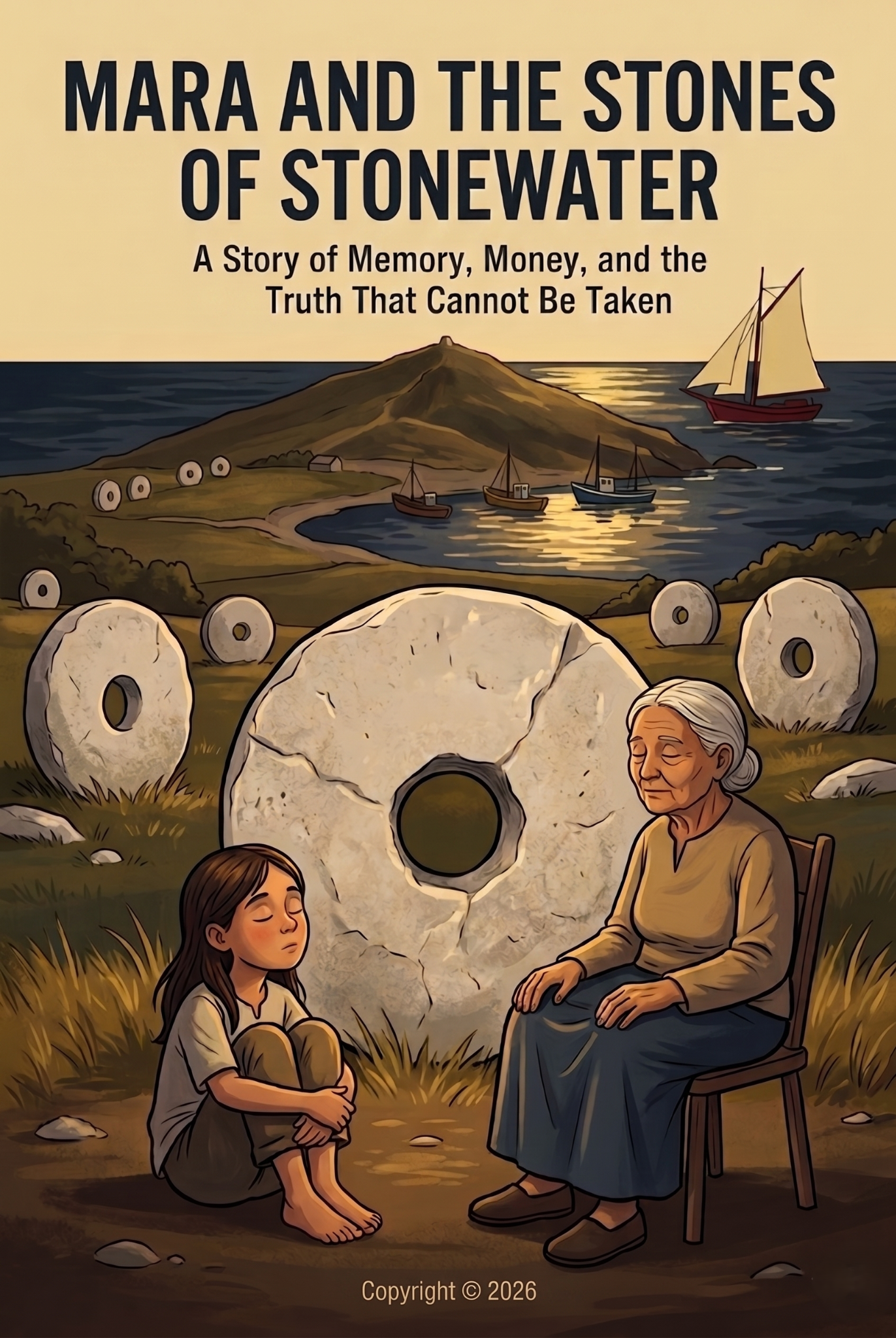 That’s Mara.
Mara and the Stones of Stonewater is a fifty-two-page children’s story set on a fictional island where the community uses large carved stones as money. The stones are quarried on a distant island and carried across open water at real cost and real risk. A boy named Tomas makes the crossing. A grandmother named Noa keeps the community’s memory of which stone belongs to which family. There is no bank. No official ledger. Just the shared knowledge of the whole village, held in common, repeated nightly by the elders, confirmed by everyone who was present when each stone arrived.
And then a trader named Callow shows up from the northern islands with a red boat full of smooth pale stones that look just like the real ones but cost him almost nothing to produce.
That’s the whole book. A girl, a village, some rocks, and a con man with a boat.
I did not mention Bitcoin once. I did not mention inflation, fiat currency, central banking, proof of work, distributed ledgers, or any of the other terms that make normal people back slowly toward the exit. The story doesn’t teach those concepts. It installs them. A child who finishes Mara’s story knows what proof of work is, because they watched Tomas nearly die making the crossing and they understood that the crossing is part of what makes the stone real. They know what a distributed ledger is, because they watched Grandmother Noa’s nightly recitation and they understood that the truth lived in too many people to be faked. They know what monetary debasement is, because they watched Callow’s cheap stones flood the market and they watched Doss raise the price of rice.
They know all of it. They just don’t know the words yet.
The words come later, in the adult companion guide, which opens with one sentence: it actually happened. Stonewater is Yap. The island is real. The stones are real. The crossing is real. And the trader who showed up with a steamship and iron tools and flooded the island with cheap counterfeits? His name was David O’Keefe, and he arrived in 1871.
This is not a new pedagogical trick. It is the oldest one. It is what Jesus did with parables and what Aesop did with foxes and what your grandmother did when she told you a story at bedtime that you only understood the point of twenty years later. You install the knowing first. You name it when the student is ready.
I wrote Mara because I needed a way to hand a child the same question I had at four, except instead of leaving them alone with the discomfort, I wanted to give them a story that makes the discomfort make sense. Here is a village where money works the way money should work. Here is what happens when someone shows up and breaks it. Here is a girl who stands in the market square and defeats the con man, not with a weapon, not with authority, but with memory. With the truth that lived in too many people to be corrupted.
That’s not a Bitcoin story. That’s a human story. Bitcoin just happens to be the first technology that does at planetary scale what Grandmother Noa did every night on Stonewater.
I am not going to tell you to buy Bitcoin. I am not going to tell you the financial system is about to collapse. I am not going to tell you that your child’s future depends on understanding cryptographic hash functions. What I will tell you is that every child already senses what I sensed at four. Something about the money is wrong. Something about the arrangement is unfair. And when that child asks you why, you have a choice. You can say “that’s just how things are,” which is what every adult said to me. Or you can hand them a story about a girl and a village and some rocks, and let them figure it out.
That is all the book is. An invitation to figure it out together.
I wrote it for the four-year-old who never got an honest answer. I’m hoping your kid does.