Mindstorm
Shared Augmented Consciousness
Full transparency: This story exists because of AI collaboration.
I’m the storyteller with big questions about consciousness, identity, and humanity’s future. Claude is my writing partner who helps translate my ideas into coherent prose. Neither of us could create this story alone.
Given that Mindstorm an 8 part series explores what happens when human consciousness merges with advanced technology, this collaboration felt… appropriate.
Chapter 1
The Discovery
There’s only one thing. More awesome than being in the zone, where everything slows down, everything comes together just as you imagined it. What’s that one thing? Being in the zone with somebody else. SAC or Shared Augmented Consciousness, not machine augmentation, but another human sharing consciousness. It just feels like coming home?
Dr. Elena Vasquez stared at the neural interface readings, her coffee growing cold as the implications hit her. The breakthrough had come from her team’s painstaking research into NBP or Neural Binding Problems using an open-source version of Elon Musk’s neural link interface and experiments into quantum events in the brain that drive consciousness.
Specifically Elana’s team was researching quantum effects and microtubules but like many scientific breakthroughs Elana’s discovery came from an accident, a power surge that had synchronized the experimental neural mesh worn by two volunteers during a routine test.
For forty-seven minutes, Marcus Chen and Sarah Okafor had shared a single consciousness.
“The brainwave patterns,” Elena whispered to her colleague Dr. James Reeves, pointing at the synchronized theta waves on the monitor. “They’re not just similar, they’re identical. Down to the microsecond.”
The volunteers sat in adjacent chairs, neural link caps still connected to the quantum processing array. Marcus, a software engineer, was methodically organizing Sarah’s childhood memories of Lagos as if they were lines of code. Sarah, a neurolinguist, found herself instinctively understanding the elegant mathematical structures Marcus used to think.
“It’s like having access to another person’s entire mental library,” Sarah said, her voice carrying Marcus’s characteristic precision. “But more than that, it’s having their *way* of thinking.” Marcus found that Sarah’s touch of dyslexia (The MIT disease) gave him a broader perspective, freeing his focus from the minutiae of numbers.
Elena recorded everything. The subjects showed enhanced cognitive abilities, complementary skill sets merging seamlessly. Marcus’s logical processing paired with Sarah’s linguistic intuition created insights neither could achieve alone. They solved complex problems in minutes that would have taken either of them hours individually. It’s augmentation like pure collaboration in its purest form, no conflict, competition, or second-guessing.
However, when Elena attempted to replicate the effect with three volunteers, adding Dr. Reeves to the link, chaos ensued. What was the problem? Dr Reeves or some combination of the three?
The synchronized brainwaves immediately began fluctuating wildly. The three subjects started speaking in overlapping fragments, their personalities battling for dominance. Within minutes, all three were experiencing severe cognitive dissonance borderlining on schizophrenia, thoughts looping back on themselves, memories becoming confused, and basic motor functions disrupted. Sarah was stuttering uncontrollably, and Marcus was drooling!
Elena terminated the connection after twelve minutes, but the subjects needed hours to fully recover their sense of self. After a few more trials with different individuals and a number of combinations, it became apparent that the number of links was the key.
“Two minds create harmony,” Elena noted in her research log. “Three create interference.”
The Pattern
Over the following months, Elena’s team confirmed the pattern with mathematical precision. Even numbers of linked minds, two, four, six, eight, achieved stable consciousness sharing. The subjects’ individual personalities merged into collective entities with enhanced capabilities. Four linked minds could process information with the speed of a supercomputer while maintaining human creativity and intuition.
Odd numbers created what Elena termed “cognitive storms”, chaotic interference patterns where individual thoughts amplified and distorted each other until rational thought became impossible, often resulting in unpredictable physical manifestations that were frequently embarrassing, sometimes dangerous: trouble breathing, heart palpitations, migraines, and temporary blindness. But with an even number of individuals, the results were phenomenal.
Being open-source project, the word got out. The discovery leaked, as such discoveries always do.
Within a year, underground clinics in Bangkok and Mexico City were offering “neural pairing” to wealthy clients seeking cognitive enhancement. Corporate espionage reached new heights as companies began linking their top researchers. The first “mind marriages”, permanent neural bonds between consenting adults, generated both fascination and controversy. It gave new meaning to “sole mates.”
But of course, the military got involved. The Chinese People’s Liberation Army created the first “neural squadron”, eight pilots whose minds, when linked, were capable of controlling multiple aircraft simultaneously with unprecedented coordination. The US Pentagon responded with Project Mindbridge, pairing special forces operatives for impossible infiltration missions. The quantum processing array was posing a bit of a mobility challenge, but as with any military project, money was no object, and a solution would be found soon.
Based on numerous ancient religions and philosophies, some fringe types were even giving the “natural” linking through meditation, movement, and vocalization a shot, though not as immediately powerful, it was showing promise. This was not the usual “Men Who Stare at Goats” stuff, but something More akin to gazing into the Akashic Field.
Elena watched her discovery transform the world with growing unease. She had published papers on quantum harmonic vibrations generated by even number participants and the dangers of odd-numbered links, but her warnings were largely ignored. Groups with even numbers provided such remarkable advantages that the risks seemed manageable.
Until the Zurich Incident.
The Storm
Dr. Hans Mueller had been Elena’s former research partner, a brilliant but reckless individual. While Elena focused on understanding the phenomenon of consciousness sharing, Hans sought to push its limits.
His laboratory in Zurich had been experimenting with larger even-numbered groups. Sixteen linked minds had shown remarkable stability and capabilities; they had solved energy equations that had puzzled physicists for decades and developed new materials with properties that seemed to bend physical laws.
Testosterone got the better of Hans, he wanted more.
The plan was to link thirty-two subjects, still an even number, still theoretically stable. The largest conscious collective ever attempted. Forget silicon based AI, Hans believed it might create a form of human superintelligence that could solve humanity’s most significant challenges: climate change, poverty, and disease.
The link began normally. Thirty-two volunteers, all brilliant scientists and researchers, donned the advanced neural mesh interfaces. The quantum processors hummed as consciousness began merging.
For three hours, it worked. The collective mind made breakthrough after breakthrough, including revolutionary energy storage, atmospheric carbon processing, and genetic therapies. The linked consciousness communicated in pure mathematical concepts, thinking at speeds that individual humans couldn’t comprehend.
Then, Dr. Lisa Park suffered a stroke; she perished while still connected to the quantium array.
In an instant, the even number became odd, thirty-one minds, no longer in perfect balance.
The cognitive storm that erupted made Elena’s early experiments look trivial. Thirty-one brilliant minds, their thoughts amplifying each other in chaotic feedback loops, created what observers would later call the Mindstorm.
The effect wasn’t contained to the linked subjects. The quantum field generated by thirty-one merging consciousness proved contagious. People within a three-kilometer radius began experiencing fragments of the storm, strangers suddenly knowing each other’s thoughts, memories mixing between minds, reality itself seeming to bend as perception became collective and chaotic. There was something too that fringe group trying the “Natural” way.
Zurich’s city center became a zone of shared madness. Traffic stopped as drivers found themselves experiencing the perspectives of every other person on the road simultaneously. Students in classrooms began speaking in unison, their individual voices lost in a collective babble.
Emergency responders couldn’t function as their training merged with the fears and confusion of those they were trying to help. Then there was the physical side effects, talk about people losing their shit, well, let’s not.
The Swiss military established a quarantine zone, but the effect continued spreading. By hour six, nearly fifty thousand people were caught in the expanding Mindstorm.
Elena, monitoring the situation from her lab in California, realized the terrifying truth: the storm was growing stronger as it incorporated more minds. If it reached critical mass, if enough people became involuntarily linked, it might become self-sustaining.
What would be the outcome if this continued unabated?
The Solution
Elena’s team worked frantically to develop a solution. The mathematics was clear: they needed to force the linked consciousness back into an even number when Dr. Park had died from her stroke, making thirty minds, an uneven number; the damage was done. The quantum field had destabilized beyond their ability to rebalance simply.
The only option was radical: they needed to add one more mind to the link.
Not just any mind, someone with specific neural patterns that could serve as a “cognitive anchor,” stabilizing the chaotic storm by accepting all the conflicting thoughts and contradictions into a single consciousness. If they could balance the neural-linked group, possibly the social contagion could clear up on its own.
Elena knew the mathematics. She had run the calculations hundreds of times. The anchor would need to maintain their individual identity while simultaneously holding the fragmented thoughts of twenty-nine other minds. The psychological strain would be enormous. They would need to experience every memory, every fear, every hope of the linked subjects while remaining coherent enough to guide the collective consciousness back to stability.
It was, by any reasonable measure, impossible. The human mind wasn’t designed to hold such complexity.
But Elena had one advantage: she understood consciousness sharing better than anyone alive. She had trained her mind for years, learning to maintain her identity even while experiencing the thoughts and memories of test subjects.
Standing in her laboratory, watching real-time feeds of Zurich’s chaos, Elena made her choice.
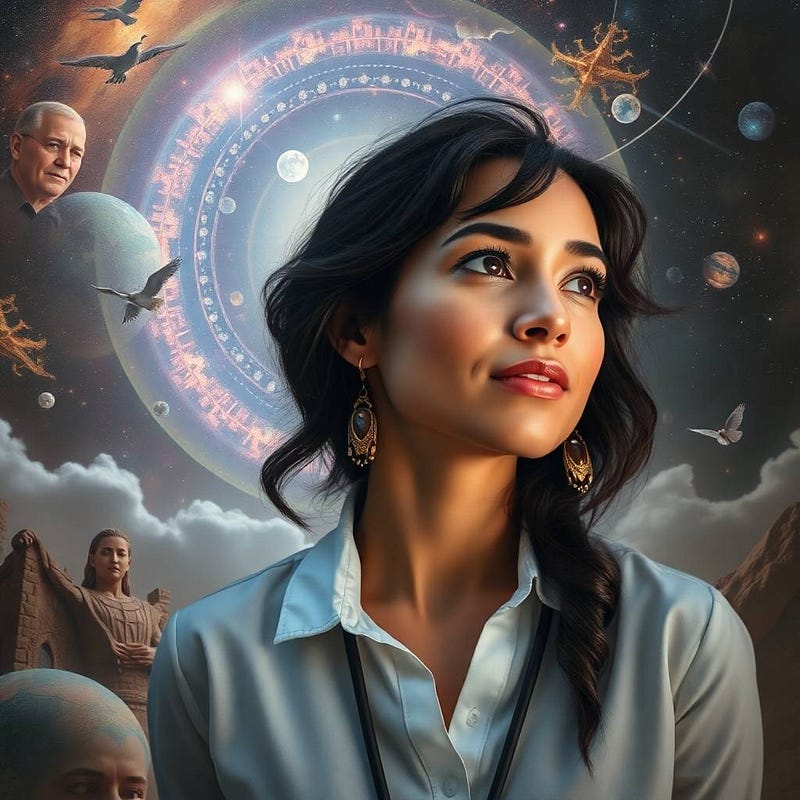
“Initialize the emergency neural link,” she told her team. “I’m going in.”
The Anchor
The moment Elena’s consciousness joined the Mindstorm, she experienced thirty minds simultaneously. She caught a glimpse of Dr. Park’s consciousness that was paused at the moment of death, not in chaos but peaceful and harmonious, and in an instant, she was gone.
Now, Elaina was Hans Mueller, desperate and guilty, watching his reckless work destroy thousands of lives. She was Dr. Jennifer Walsh, a climatologist whose last coherent thought was the elegant solution to atmospheric carbon processing. She was each of the test subjects, their childhoods, their loves, their fears, all flooding through her awareness at once.
But Elena held on to herself. Years of practice allowed her to maintain her core identity even as thirty other personalities threatened to overwhelm her. She became a cognitive lighthouse in the storm, her steady mental patterns providing a reference point for the chaos.
Slowly, painstakingly, Elena began organizing the storm. She accepted each mind’s contribution, the physicist’s understanding of quantum mechanics, the biologist’s intuition about cellular processes, the philosopher’s questions about consciousness itself. Instead of letting them clash and interfere, she wove them together into a coherent whole.
The effect rippled outward from Zurich. The fifty thousand people caught in the expanding storm began to regain their individual awareness, although they retained fragments of the shared experience, as well as some embarrassing physical manifestations, and eventually, emergency responders could function again. The city began to breathe.
But the cost was enormous. Elena found herself permanently changed, carrying pieces of thirty other minds within her consciousness. She could access their knowledge and skills, but she also carried their traumas, their regrets, their unfinished thoughts.
She had become something new, neither quite human nor collective intelligence. A bridge between individual and shared consciousness. What struck her most was Dr Parks’ peaceful exit from this world.
The New World
In the aftermath of the Zurich Incident, the world changed again. Governments attempted to regulate consciousness sharing, limited to pairs or carefully monitored groups of four. However, with a low barrier to entry, most regulations just became political posturing . Elena’s experience had proven that larger collectives were possible but required unprecedented psychological preparation.
Elena herself became a reluctant oracle, consulted by governments and researchers who wanted to understand the new landscape of human consciousness. She could solve problems that stumped teams of experts, her mind drawing on the combined knowledge of the Zurich collective. But she paid the price in isolation; few people could relate to someone who carried thirty different highly intelligent personalities within a single mind.
The intellectual challenges were one thing, but the physical manifestations were really annoying. Dr. Hans Muller, while a brilliant but reckless individual, had a gastrointestinal issue that caused him to fart frequently. He would crack a smile and quote Benjamin Franklin, “fart proudly.” This was only one of the many physical gifts Elena inherited as a result of Zurich.
Another one of the Zuric crowd, while not an accomplished academic like most, was nonetheless a brilliant young man David, who, in his early years, developed a problem with drinking, which resulted in frequent brushes with death. Motorcycle incidents, blackouts while driving cars, and showing up incapacitated in the wrong neighborhoods late at night. Elena did not develop a taste for liquor beyond her preference for white wine, but she did develop a renewed perspective on living, having relived David’s memories of near death. Still, the last memory of Dr. Parks tugged at her thoughts frequently.
The technology continued to evolve. “Mind marriages” became more common, with couples sharing consciousness so entirely that the boundary between self and other began to blur. Corporate research teams of four worked with perfect coordination, their individual expertise combining into capabilities that revolutionized entire industries.
But the specter of the Mindstorm haunted every advancement. Strict protocols were established: neural linking facilities were limited to even numbers, quantum processors included automatic safeguards, and “cognitive anchor” training became a specialized field for those brave enough to risk their identity for collective stability.
Elena established the Consciousness Institute, dedicated to understanding the full implications of shared awareness. Her students learned to navigate the delicate balance between self and other, as well as individual thought and collective intelligence.
And in her private moments, Elena continued to grapple with the thirty minds within her own. Sometimes she was solving quantum equations with Dr. Walsh’s intuition. Sometimes she remembered Hans Mueller’s childhood in Bavaria. Sometimes she was all of them at once, a symphony of human experience that no single person was meant to contain. Not monkey mind, something more akin to genius mind.
She had possibly saved humanity from losing individual consciousness forever. But in doing so, she had sacrificed her identity to become something unprecedented: a single human mind that contained multitudes not in crazed chaos but synchronized harmony.
The future stretched ahead, full of possibilities and dangers. Humanity was learning to think collectively while remaining individual, to share consciousness while preserving the self. Elena had shown it was possible, but the path forward remained uncertain.
In her laboratory late at night, monitoring the neural patterns of test subjects as they learned to share thoughts safely, Elena often wondered: had she saved humanity, or had she simply delayed the inevitable moment when individual consciousness would devolve into collective intelligence?
The answer, she knew, lay not in her calculations but in the choices that future generations would make about the nature of human identity itself.
Time would tell whether consciousness sharing would elevate humanity or transform it into something unrecognizably different. Elena had given them the choice. What they did with it would define the future of human consciousness itself.
The echo of Dr Parks’ serenity called to her, like a faint neural link, a nagging sensation she couldn’t shake.
Patterns
Some time after Zurich, Elena stood before the United Nations Consciousness Ethics Committee, preparing to deliver her final report on the decade of shared awareness research.
The world had adapted in ways both predictable and surprising. “Neural pairs” had become common in high-stakes professions: surgeons operating with perfect coordination, pilots navigating complex airspace, researchers solving problems at unprecedented speeds. Marriage itself was evolving as couples chose to share not just their lives but also their consciousness.
Groups of four had become the standard for complex projects. The Lunar Mining Consortium operated with quartets of engineers who thought as one mind while maintaining individual personalities. The Climate Restoration Project had made remarkable progress with teams of four climate scientists whose shared consciousness could model atmospheric changes with superhuman accuracy.
But odd numbers remained disastrous. The Consciousness Accords, signed by every nation after Zurich, prohibited linking odd numbers of minds. The risk was too great, the potential for another Mindstorm too dangerous.
Elena looked out at the assembly of delegates, many of whom were currently linked in pairs or quartets. The irony wasn’t lost on her; she was addressing a collective intelligence about the future of collective intelligence.
“We stand at a threshold,” she began, her voice carrying the weight of thirty minds’ worth of experience. “Consciousness sharing has enhanced human capability beyond our wildest dreams. But we must remember that with every advance, we risk losing what makes us fundamentally human: our individual identity, our personal struggles, our private thoughts.”
She paused, feeling the familiar presence of her internal collective, Hans Mueller’s curiosity, Dr. Walsh’s passion for environmental restoration, the hopes and fears of twenty-eight other brilliant minds.
“The question isn’t whether we can share consciousness,” Elena continued. “We’ve proven that. The question is whether we should, and how far we’re willing to go. Because every mind we link, every boundary we cross, changes us fundamentally. There may come a day when individual consciousness is seen as primitive, inefficient, lonely.”
She thought of the children now being born to neural pairs, babies who would grow up expecting to share thoughts as naturally as sharing words. They would never know the isolation that had once defined human experience, but they would also never know the privacy, the mystery, the individual growth that came from being truly alone with one’s thoughts, and the joy of solitude.
“We have the power to reshape human consciousness itself,” Elena concluded. “The responsibility for how we use that power will define not just our future, but our fundamental nature as a species. Choose wisely. The mind you save may be your own.”
As the delegates discussed her presentation, many of them sharing thoughts instantly through their neural links, Elena remained alone with her crowd of thirty minds, the last guardian of the delicate balance between individual and collective consciousness.
The storm had passed, but the choices it had forced would echo through human history forever. Then Dr Parks’ voice spoke to her in a whisper, “There is more beyond the flesh”.
Next week — What if our brains don’t generate awareness, they tune into it?
If you’ve read my previous pieces about Writing with AI or heard from Claude’s perspective The Magnificent Mess on our chaotic creative process, you know I’m not hiding anything. I bring the imagination, the big questions, the “what if” scenarios that haunt my retirement. Claude brings the wordsmithing skills my dyslexic brain never quite mastered.
This 8-part series follows Dr. Elena Vasquez as she accidentally discovers how to link human minds, triggering questions that feel increasingly urgent as brain-computer interfaces move from science fiction to reality. What happens to individual identity when minds can truly merge? How do we choose between beautiful isolation and transcendent connection?
These are the ideas that won’t leave me alone. Claude helps me explore them through story.
Ready to question everything you think you know about consciousness?