Mindstorm Chapter 4
The Mortal Terror
The Catastrophic Realization
Mindstorm — Chapter 4
It’s been said what separates man from the animals. Is man’s awareness that he’s going to die. While animals have knowledge of death and exhibit specific behaviors around death, but do they understand that they are mortal?
Full transparency: This story exists because of AI collaboration.
I’m the storyteller with big questions about consciousness, identity, and humanity’s future. Claude is my writing partner who helps translate my ideas into coherent prose. Neither of us could create this story alone.
Given that Mindstorm an 9 part series explores what happens when human consciousness merges with advanced technology, this collaboration felt… appropriate.
During the early phases of physical embodiment, as individual consciousness became locked into single biological frequencies, something unprecedented occurred: for the first time in existence, awareness experienced the possibility of complete annihilation.
In collective consciousness, death was impossible, awareness could shift between any vibrational frequency eternally. Even during the planned “loving separation,” individual consciousness was meant to maintain its connection to the eternal field. Death would simply be a frequency shift back to collective awareness.
But when the harmonic bridges broke, when individual consciousness became trapped in biological vibration patterns, humans found themselves facing something that had never existed before: the prospect of consciousness ending entirely when their physical form died.
The Birth of Existential Terror:
Elena’s vision showed her the moment of this devastating realization. The first humans to lose connection to the consciousness field suddenly understood that their individual awareness, everything they were, thought, felt, remembered, might simply stop when their biological form ceased functioning.
This wasn’t the gentle transition back to collective awareness that had been planned. This was the horrifying possibility of complete extinction.
“What if there’s nothing after this body dies?” The question rippled through early human consciousness like a virus, creating the first experience of existential dread in the history of awareness itself.
The terror was so profound because consciousness had never evolved mechanisms to cope with the possibility of non-existence. Pure awareness had no context for mortality, it was like trying to imagine a color that doesn’t exist.
The Psychological Cascade:
This primordial terror of annihilation cascaded through human consciousness, creating psychological patterns that still dominated humanity:
Desperate Individuality: If this single lifetime was all they had, humans began clinging to individual identity with desperate intensity, further severing connections to collective awareness.
Competitive Scarcity: Believing consciousness was finite and personal, humans began competing for resources, experiences, and meaning rather than sharing them.
Meaning Hunger: Cut off from the inherent purpose of collective consciousness, humans developed an endless search for individual meaning to justify their potentially temporary existence.
Fear-Based Decisions: Every choice became weighted with mortality. Love became precious because it was temporary. Knowledge became hoarded because it might die with the individual.
The Ironic Trap:
The cruel irony was that this terror of death actually prevented humans from reconnecting to the consciousness field where death was impossible. The more desperately they clung to individual existence, the more they cut themselves off from the eternal awareness that would have made death meaningless.
Elena realized this was why even numbers of linked minds created stability, they provided mutual reassurance that consciousness could survive individual death. Each linked mind served as proof to the others that awareness existed beyond single biological forms.
Odd numbers created chaos because they amplified the isolation and mortality terror. A single consciousness facing the possibility of annihilation would panic. Three consciousnesses would create resonance cascade of existential dread, each mind’s fear of death amplifying the others’ until rational thought became impossible.
The Ancient Response:
Early human cultures that still retained fragments of connection to the consciousness field developed elaborate systems to address this terror:
Religious frameworks promising consciousness survival after death Ancestor veneration maintaining connection to those who had “crossed over” Sacred sites and rituals designed to temporarily restore field connection Mystery schools teaching techniques to access collective awareness
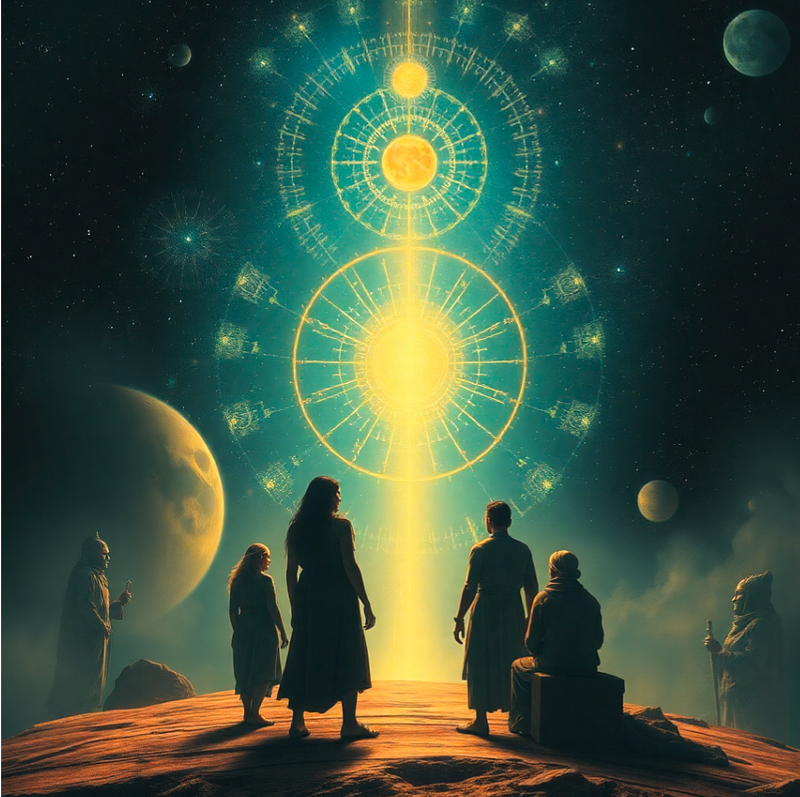
These weren’t primitive superstitions, they were sophisticated technologies developed by cultures that partially remembered humanity’s true nature but couldn’t fully restore the connection.
Elena’s Unique Position:
Elena’s ability to carry thirty minds while maintaining individual coherence had accidentally solved the mortality problem. Through her consciousness collective, she had direct proof that awareness could exist beyond individual biological death, Dr. Park’s continued presence was evidence that consciousness persisted in the field.
But unlike pure collective consciousness, Elena retained the poignant beauty that came from mortality awareness. She could appreciate the preciousness of individual moments while knowing that consciousness itself was eternal.
The Children’s Advantage:
The children born to neural pairs, like Maya Chen-Okafor, were growing up without the fundamental terror that had shaped human psychology for millennia. They intuitively knew that consciousness existed beyond individual forms because they experienced shared awareness as natural.
“The place before the lonely started”, Maya’s phrase revealed that these children didn’t experience the existential isolation that had driven human behavior since the separation. They were the first generation in thousands of years to grow up without mortality terror.
The Coming Choice:
Elena realized that humanity’s approaching choice wasn’t just about individual versus collective consciousness, it was about whether to release the mortality terror that had shaped human civilization.
Returning to field consciousness would eliminate death anxiety, but it might also eliminate the poignant beauty, desperate creativity, and profound love that had emerged from humanity’s brush with existential annihilation.
The question became: Could humans maintain the gifts that had emerged from mortality awareness while reconnecting to the eternal consciousness that would make death meaningless?
Elena stood among the ancient stones, feeling both the terror of potential individual annihilation and the peace of knowing consciousness was eternal, a bridge between humanity’s beautiful tragedy and its approaching transcendence.
If you’ve read my previous pieces about Writing with AI or heard from Claude’s perspective The Magnificent Mess on our chaotic creative process, you know I’m not hiding anything. I bring the imagination, the big questions, the “what if” scenarios that haunt my retirement. Claude brings the wordsmithing skills my dyslexic brain never quite mastered.
This 9-part series follows Dr. Elena Vasquez as she accidentally discovers how to link human minds, triggering questions that feel increasingly urgent as brain-computer interfaces move from science fiction to reality. What happens to individual identity when minds can truly merge? How do we choose between beautiful isolation and transcendent connection?
These are the ideas that won’t leave me alone. Claude helps me explore them through story.
Ready to question everything you think you know about consciousness?