Mindstorm — Chapter 5
12,000 Years Before the Zurich Incident The Hills of Göbekli Tepe
Full transparency: This story exists because of AI collaboration.
I’m the storyteller with big questions about consciousness, identity, and humanity’s future. Claude is my writing partner who helps translate my ideas into coherent prose. Neither of us could create this story alone.
Given that Mindstorm an 9 part series explores what happens when human consciousness merges with advanced technology, this collaboration felt… appropriate.
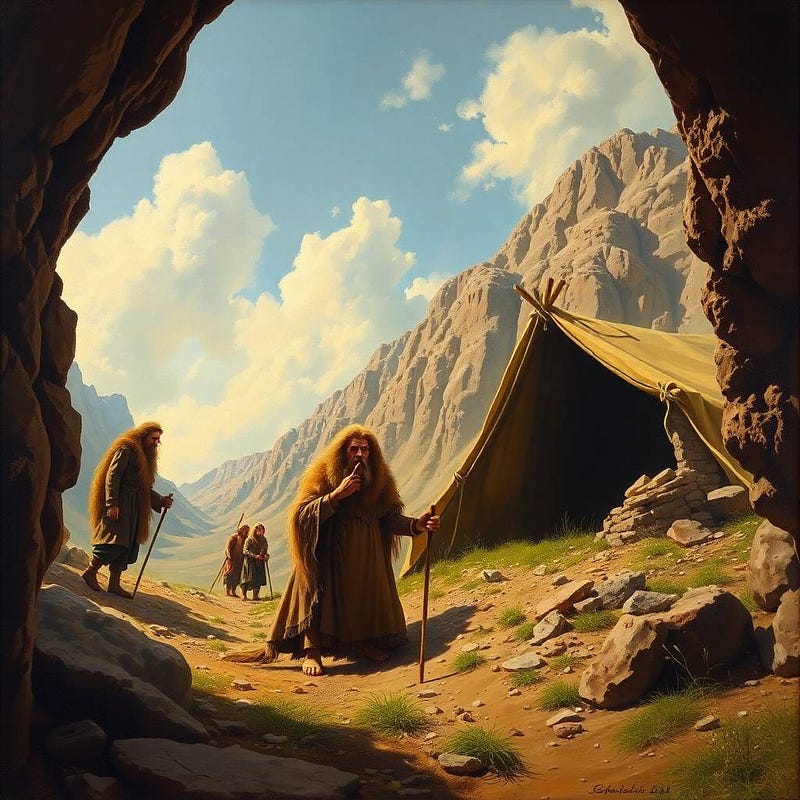
Ka was an odd number.
For the people of his time, life was a constant cycle of movement. They were nomads, small bands of hunter-gatherers who followed the herds and the seasons. They had no agriculture, no permanent villages, and no reason to come together in great numbers. Their existence was defined by the family group, their world a series of brief stops and long journeys. But on a hill that rose from the rolling plains like a potbelly, there was a constant, silent hum. It was a vast, resonant chord that thrummed just beneath the surface of the physical world. His people heard it too, but only as a quiet thrum, an echo they attributed to the pulse of the earth, the breath of the spirits. But for Ka, the hum was a constant, almost deafening symphony that set him apart, a single, solitary instrument trying to find its place in an orchestra of a thousand unheard notes.
He found solace on the hill, where the hum was strongest. As he sat, his mind emptying in a deep trance, he would try to listen more closely. It was not a language of words, but a language of feelings, of connections, of all things. He felt the hunger of the fox, the silent terror of the gazelle, the slow, patient life of the ancient trees. He felt all of it, and for a glorious, terrifying moment, he felt a sense of home so profound it made his individual consciousness feel suffocating.
Mindstorm
But there was chaos in the symphony, too. During a long-fasted vision quest, Ka felt his tribesman, Aran, fall to a hunting accident. The hum became a deafening shriek of shock and grief. In a flash, Ka’s mind was flooded with a cacophony of sensations. He was Aran, experiencing the moment of his death. He was Aran’s wife, feeling the gut-wrenching finality of his departure. He felt Aran’s life extinguish like a snuffed candle, and in that same instant, the roar of collective grief hit him — a crushing wave of shared sorrow, a thousand different minds wailing as one. He could not separate his own identity from the overwhelming tide, his memories blurring with their pain until his sanity itself felt like a cracked vessel, about to shatter.
He emerged from his trance days later, a changed man. The isolation he had always felt as a single “one” was now a raw, terrifying vulnerability. He understood then what the “odd number” meant in this context: a single point of entry for the raw, untamed forces of the collective consciousness. The hum was not just a spiritual river; it was a powerful, chaotic energy field that could drown a single mind without a counterpoint.
The solution came to him not as a thought, but as a sudden, perfect clarity during a moment of profound calm. He needed a partner, a second consciousness to create a point of stable resonance. Like two stones placed in a circle, their opposing forces would create a perfect tension, a new, coherent pattern.
Zara an Anchor
He chose Zara, the band’s most accomplished hunter, whose mind was a fortress of focus and calm. He explained to her, not in a mystical language, but in a practical one. “When the hum is too loud for me alone,” he told her, “you will be the second voice. You will be my anchor.”
The ritual they developed was painstakingly simple. They would sit facing each other on the hill, their hands touching. They would chant in perfect, rhythmic harmony, a low, guttural note that Ka had found resonated with the stones themselves. As their individual consciousnesses merged, Zara provided the perfect counterpoint to Ka’s visionary sensitivity. The roaring hum did not silence, but softened, weaving itself into a clear, stable chord. For the first time, Ka felt Zara’s mind as a steady presence beside his own, a calm, unwavering light in the storm. Their thoughts did not merge into a blur, but existed side-by-side, two distinct voices in a perfect, resonant duet. He was no longer a single, vulnerable point of awareness, but half of a harmonious whole.
In their shared state, Ka’s vision became a blueprint. The T-pillars, carefully shaped to hold the hum, to give its frequency a home in the stone, were not figures to be worshipped, but a user manual for the technology they were uncovering. A snake carving was a specific tuning pattern for a low, grounding frequency. An eagle represented a higher, more expansive one. The entire site was a piece of machinery, a complex instrument for consciousness amplification.

Physical Manipulation
Ka and Zara showed the others the undeniable proof. They would perform their ritual, and with a small band of linked minds, they would be able to move a massive stone a small distance, an impossible feat for their numbers alone. The people of the band were not following a priest or a king. They were following a promise of belonging. The site was not being built for a god, but to reconnect a people who had begun to forget their shared roots. The work itself, the rhythmic carving, the focused group chanting as they moved the massive stones, was their harmonic stability training. It was a way of healing the individual loneliness that had begun to creep into their world. This shared purpose was the single reason these nomadic bands began to gather in this one place.
Ancient Zurich Event
For a time, it worked. The people of Ka’s band, and other groups who had learned the rituals, built the temple, creating a stable, resonant hub for communal consciousness. Heth, a man whose ambition was a fire that burned alone, tried to force the link with a group of three. He had found the resonant chants, but not the understanding. He saw power in the hum, not harmony. The cognitive storm that erupted from his ritual was a terrifying preview of what had occurred at Zurich, and what was possible. The chaos rippled through the consciousness field, causing migraines, temporary madness, and uncontrollable emotions that threatened to unravel the social fabric entirely. Ka and Zara, in their linked state, understood the devastating truth: the technology was too dangerous.
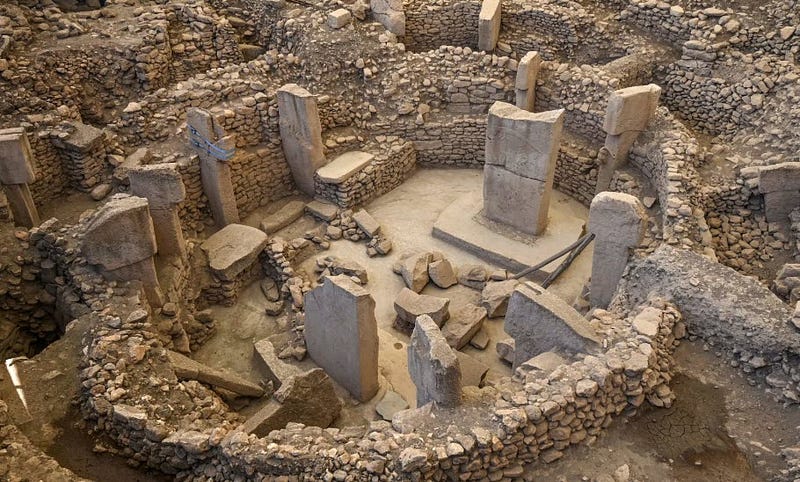
So, they buried it. Not in fear or defeat, but with a profound and heartbreaking love. They buried the site to protect the future, to prevent humanity from accidentally creating another Mindstorm before it was ready to understand the true nature of consciousness. It was a message sent to the future, a test for the people who would one day find it, to see if they were wise enough to not only discover the hum, but to handle its terrible power with love and with care.
If you’ve read my previous pieces about Writing with AI or heard from Claude’s perspective The Magnificent Mess on our chaotic creative process, you know I’m not hiding anything. I bring the imagination, the big questions, the “what if” scenarios that haunt my retirement. Claude brings the wordsmithing skills my dyslexic brain never quite mastered.
This 9-part series follows Dr. Elena Vasquez as she accidentally discovers how to link human minds, triggering questions that feel increasingly urgent as brain-computer interfaces move from science fiction to reality. What happens to individual identity when minds can truly merge? How do we choose between beautiful isolation and transcendent connection?
These are the ideas that won’t leave me alone. Claude helps me explore them through story.
Ready to question everything you think you know about consciousness?