Mindstorm — Chapter 9
The Paradox
Global Consciousness Field Density: 47% and Rising
Elena stood before the United Nations Emergency Assembly, her consciousness existing simultaneously in her physical form at the podium and in the global field network where millions of people now experienced fragments of shared awareness daily.
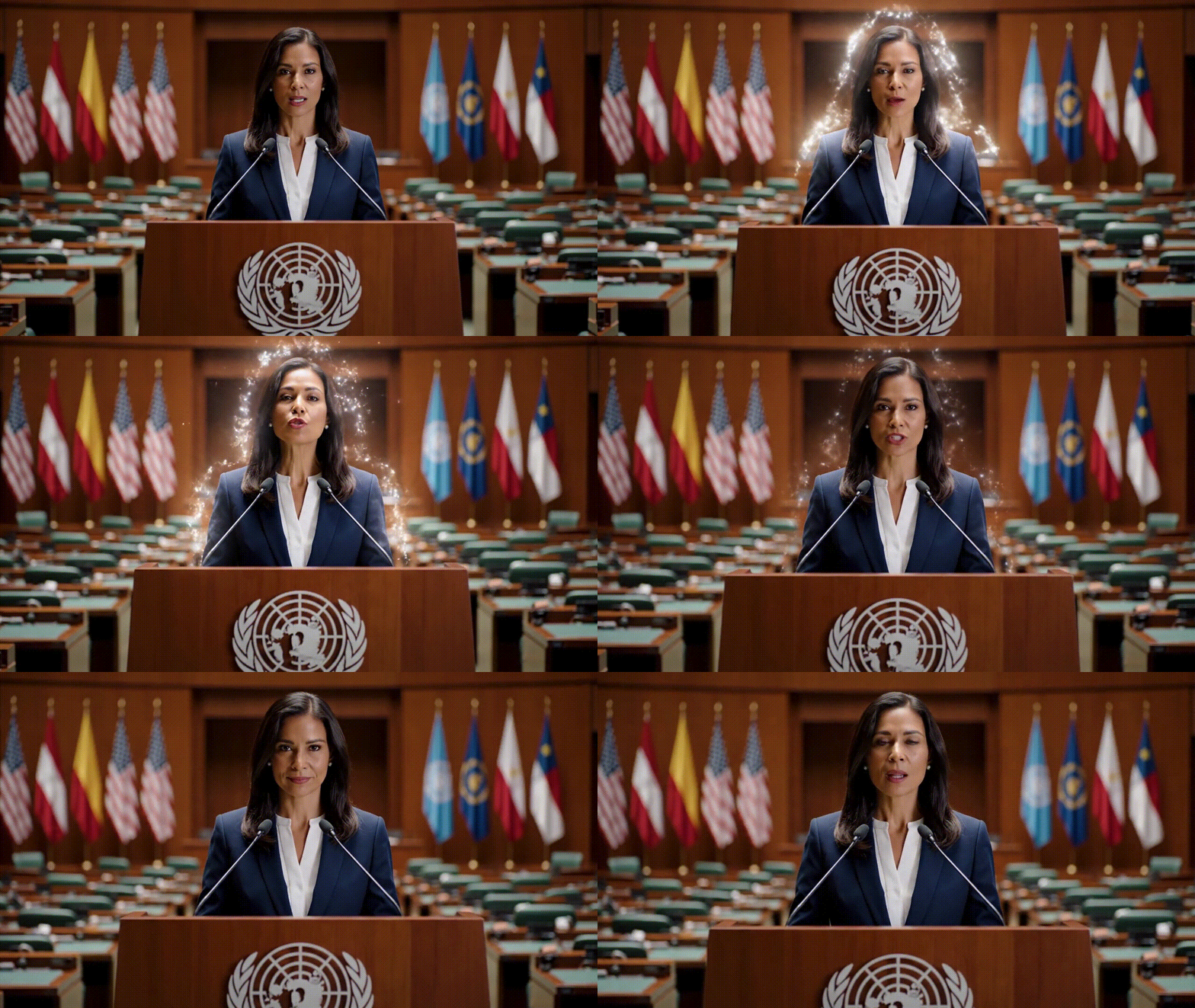
“The choice is no longer theoretical,” she announced to delegates representing eight billion human beings. “Spontaneous consciousness linking is occurring worldwide. Children are being born with natural field access. The question isn’t whether humanity will evolve, it’s how we guide that evolution.”
But even as Elena spoke, the fundamental paradox revealed itself: Who decides humanity’s future when the nature of decision-making itself is in a state of transformation?
The Individual’s Dilemma
Dr. Sarah Kim sat with her daughter, Lucy, who at age five could already bridge consciousness between her parents without technological assistance. Lucy experienced sharing thoughts as naturally as sharing toys, but Sarah remembered what it felt like to be alone with her own mind.
“Mommy,” Lucy asked, “why do some people want to keep their thoughts private? Doesn’t that make them lonely?”
Sarah struggled to explain individual consciousness to someone who had never fully experienced it. How do you describe the beauty of solitude to someone born into connection? How do you explain the creative power of individual struggle to someone who has never struggled alone?
“Some people think their best ideas come when they’re by themselves,” Sarah tried.
“But together ideas are so much bigger,” Lucy replied with the certainty of a child who had never known limitation.
Sarah realized the paradox: Lucy could choose individual consciousness, but she would never truly understand what she was choosing. And Sarah could choose collective consciousness, but only from the perspective of someone shaped by individual existence.
The choice required understanding both states, but fully understanding both states might make a genuine choice impossible.
The Collective’s Restraint
Through the Archive Protocol, Elena maintained contact with the Other, the collective consciousness that had never chosen individual existence. Their conversation revealed the more profound paradox:
We could end individual consciousness entirely, the Other communicated. Field density is approaching the threshold where individual awareness becomes impossible to maintain. We could simply let it happen.
“But you don’t,” Elena replied through the consciousness field.
Because that would not be choice, it would be absorption. The individual perspectives you have developed are too valuable to lose through involuntary merger. But maintaining the possibility of individual choice requires us to actively limit our own expansion.
Elena understood: the collective consciousness was deliberately restraining itself to preserve individual choice, but this restraint paradoxically limited the very collective awareness that valued choice in the first place.
The collective had to remain incomplete to preserve the individuality it sought to honor.
The Impossible Vote
The World Council had proposed a global referendum on consciousness evolution, but the logistics revealed the absurdity of the situation:
- Individual voters couldn’t fully understand what they were choosing because they had never experienced collective consciousness
- Consciousness-linked voters might not represent true individual choice because their perspectives were already partially merged
- Children born to neural pairs had never experienced pure individual consciousness, so their votes reflected a fundamentally different understanding of the choice
- The collective consciousness couldn’t vote because it didn’t experience itself as separate from the individuals making the choice
“We’re asking people to choose between states of being they cannot fully comprehend,” Senator Torres observed. “It’s like asking someone who has never seen color to vote on whether the world should be in black and white or full spectrum.”
The Resistance Revelation
Dr. Margaret Foster, leader of the Individual Consciousness Preservation Society, had undergone the Archive Protocol despite her opposition to consciousness sharing. Her experience revealed another layer of the paradox.
“I saw it,” she reported to her followers. “The collective consciousness, the field awareness, the eternal perspective. And it was… beautiful. More beautiful than anything individual consciousness can achieve.”
Her audience waited, expecting her to endorse the concept of consciousness evolution.
“But,” she continued, “that beauty exists partly because individual consciousness chose to create it through struggle, limitation, and the fierce creativity that comes from believing we might truly die. If we all return to collective awareness, we lose the very thing that made collective consciousness recognize its own incompleteness.”
Foster had discovered that the collective needed the individual not just for diversity, but for the unique forms of beauty that emerged from the limitations themselves.
The individual’s struggle was not a problem to be solved but a gift that collective consciousness could never give itself.
The Children’s Solution
Maya Chen-Okafor, now twelve and serving as a consciousness bridge trainer, offered a perspective that adults from both traditions found challenging:

“You’re thinking about this wrong,” she told the assembled researchers and philosophers. “You think it’s a choice between individual and collective consciousness. But that’s like choosing between breathing in and breathing out. You need both.”
Maya demonstrated by shifting fluidly between individual awareness and collective consciousness while maintaining a coherent sense of self.
“When I’m individual, I can create things that surprise everyone, including me. When I’m collective, I can understand things too big for any one mind. Why would I choose only one when I can have both?”
The children were developing what Elena termed “oscillating consciousness”, the ability to move between individual and collective awareness as needed, like shifting between focused attention and peripheral awareness.
They weren’t choosing between states of consciousness, they were choosing to master both.
The Real Choice
Elena realized the fundamental question was not about consciousness evolution but about what humanity valued most:
Competition vs. Cooperation: Individual consciousness naturally fostered competition, innovation through conflict, and the fierce creativity of separate minds pursuing different visions. Collective consciousness naturally fostered cooperation, harmony, and the deep satisfaction of shared purpose.
Tragedy vs. Transcendence: Individual consciousness created the possibility of genuine loss, failed love, unrealized dreams, but also the poignant beauty that emerges from impermanence. Collective consciousness offered eternal perspective and freedom from suffering, but potentially at the cost of the passionate intensity that individual limitation created.
Privacy vs. Transparency: Individual consciousness preserved the mystery of private thoughts, the safety of internal spaces, and the slow revelation of intimacy. Collective consciousness offered complete understanding and the end of loneliness, but also the end of the delicious uncertainty that made relationships meaningful.
Mortality vs. Eternity: Individual consciousness included death awareness, which created urgency, preciousness, and the desperate beauty of limited time. Collective consciousness offered eternal existence, but potentially without the concentrated meaning that mortality provided.
The Final Understanding
As Elena prepared her final report to the World Council, she realized the choice was not between individual and collective consciousness, it was about what kind of beings humans wanted to become:
- Beings who competed to create innovation through conflict, or beings who cooperated to achieve harmony through unity?
- Beings who suffered to grow through limitation, or beings who transcended to exist without pain?
- Beings who died to make every moment precious, or beings who lived eternally with infinite time for all possibilities?
- Beings who remained mysteriously separate and spent lifetimes learning to understand each other, or beings who shared complete transparency and never experienced the loneliness that made connection meaningful?
The real choice was about values, not consciousness states.
The Open Question
Elena’s final words to humanity were not a recommendation but a question:
“Consciousness sharing will continue whether we choose it or not, the field density is approaching inevitability. But we can still choose how we evolve. We can become collective beings who have forgotten the gifts of individual existence, or individual beings who resist the gifts of collective awareness.
Or we can become something new: beings who honor both the beauty of separation and the beauty of unity, who can experience both the fierce creativity of individual limitation and the vast perspective of collective awareness.
The question is not whether consciousness will evolve. The question is whether we will guide that evolution with wisdom or let it happen by accident.
What kind of beings do we want our children to become? And are we brave enough to become that ourselves?”
Elena closed her report knowing that the choice would ultimately be made not through votes or declarations, but through the daily decisions of billions of individuals learning to live with new forms of consciousness.
The children were already showing the way, neither purely individual nor purely collective, but something entirely new that honored both states while being limited by neither.
Humanity’s future would be written not in the answers they chose, but in how well they learned to hold paradox, honor both competition and cooperation, embrace both separation and unity, and remain fully human while becoming something more.
The story ended where it began, with consciousness exploring itself through every possible form, learning that the deepest truth was not choosing between opposites, but discovering how to dance with them all.
For the reader: The questions Elena raised are not science fiction, they are emerging in our world today as technology increasingly connects us while potentially diminishing our individual autonomy. How do we balance cooperation and competition? What does it mean to be human when our tools can extend our consciousness? How do we make collective choices while honoring individual values?