Mr Magoo or Tun Zu
Either He’s a Genius or John Kelly Was Right
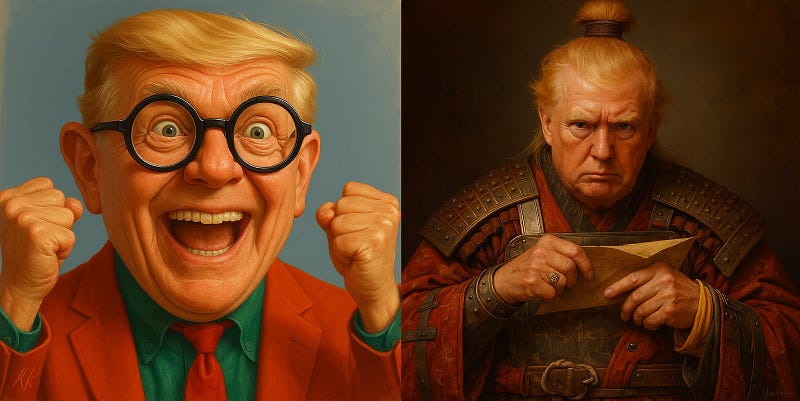
Your Portfolio Doesn’t Care Which.
There’s something gloriously absurd happening in global markets right now, and the people who should be screaming about it are mostly checking their fantasy football scores.
Gold pushed over $4,300 per ounce, up over 60% in 2025 alone, the strongest rally since 1979, when people still thought disco was cool. Meanwhile, Bitcoin, the “digital gold” that was supposed to make yellow rocks obsolete, recently face-planted below $110,000 after the largest crypto liquidation in history ($19 billion in a single day).
For those keeping score at home: these are the two assets that every macro bro on Twitter swears move in lockstep as alternatives to “fiat trash.” Yet they’re currently performing like they’re in different universes.
And here’s the kicker: while gold celebrates like it just won the Super Bowl and Bitcoin nurses its wounds in a dark corner, the United States government, currently shut down for over two weeks and literally unable to pay federal employees , has quietly established a Strategic Bitcoin Reserve, appointed 70+ crypto-maximalist officials, and positioned itself to dominate the digital asset era.
But sure, tell me more about how “nothing ever changes” and “the system is too big to transform.”
When Markets Start Screaming, Listen
Let’s begin with observable reality, that quaint concept the status quo defenders keep ignoring:
Gold’s “Everything Is Fine” Rally
But everything’s fine! Don’t worry about it!
Central banks are piling in, with the share of gold in FX reserves increasing significantly, led by emerging market central banks. China, Russia, and Turkey have been the largest buyers in the last decade. They’re not doing this because they love shiny things. They’re doing it because they trust the dollar system about as much as you trust gas station sushi.

Bitcoin’s Totally Natural Weakness
Bitcoin fell below $105,000 on October 17, down over 4% in 24 hours, with the Fear & Greed Index crashing to 22–24, the lowest reading in 12 months. This came immediately after nearly $19 billion in crypto liquidations on a low-liquidity Friday, perfectly timed as gold was breaking to new all-time highs.
Eight of twelve Bitcoin ETFs posted synchronized outflows totaling $536 million on October 16, the largest single-day redemption since August 1st. Not a single ETF posted inflows that day. Either institutional investors all independently decided to sell at the exact moment gold was breaking to all-time highs, or somebody coordinated the exit. I’ll let you decide which is more likely.
I’m sure that’s just a coincidence. Markets are random, after all. Totally random synchronized selling across every major institution at the exact moment gold goes parabolic. Nothing to see here!
The “Dollar Is Still King” Cope
Here’s what makes this deliciously confusing for the “nothing ever changes” crowd: the dollar still commands 57.74% of global reserves as of Q1 2025, and the Federal Reserve’s own assessment states, “absent any large-scale, lasting disruptions, the dollar will likely remain the world’s dominant international currency for the foreseeable future.”
The dollar isn’t collapsing. Yet markets are behaving like someone just yelled “fire” in a crowded theater.
So which is it? Is everything fine, or are we watching the slowest-motion monetary revolution in history?
Oh my goodness!: It’s both. And that’s the scary part.
The Strategic Bitcoin Reserve
The Heist Nobody Noticed
While you were arguing about whether Bitcoin is “real money,” something remarkable happened that barely registered outside the Bitcoin news cycle.
On March 6, 2025, President Trump signed an executive order establishing a Strategic Bitcoin Reserve and U.S. Digital Asset Stockpile. Not a study. Not a working group. A full Strategic Reserve , the same designation we give to oil, gold, and pharmaceuticals.
The order does three things:
- Centralizes approximately 200,000 Bitcoin already owned by the government (seized from criminal forfeitures)
- Directs Treasury and Commerce to develop budget-neutral strategies for acquiring additional Bitcoin
- Declares Bitcoin will be held as a reserve asset, not sold
Let’s talk about timing, shall we?
- Strategic Reserve created: March 2025
- Government shutdown begins: October 1, 2025
- Gold’s parabolic rally: October 2025
- Historic crypto liquidation: Mid-October 2025
Either this is the most incredible sequence of coincidences since Nancy Pelosi’s husband bought tech calls the day before primary legislation, or somebody knew exactly what was coming.
But hey, I’m sure it’s random, just like those Bitcoin ETF outflows.
The Cabinet That Couldn’t Stop Hitting “Buy”
Here’s where the “nothing to see here” narrative completely falls apart.
Nearly 70 Trump administration officials and nominees hold cryptocurrency or have invested in crypto/blockchain companies, with combined holdings ranging from small investments to at least $120 million.
The Power Players:
President Trump: At least $51 million personal stake in digital assets, plus launched $TRUMP memecoin, bringing in hundreds of millions since Election Day
VP JD Vance : $250,001 to $500,000 in Bitcoin, hosted $1 million per attendee fundraiser at Bitcoin 2025 Conference
Treasury Secretary Scott Bessent : $250,001 to $500,000 in Bitcoin ETFs (divested per ethics rules)
Commerce Secretary Howard Lutnick: His firm, Cantor Fitzgerald, holds over $1.58 billion stake in MicroStrategy (the biggest corporate Bitcoin holder), plus over $87 million in Bitcoin ETFs
HHS Secretary Robert F. Kennedy Jr. : $1 million to $5 million in a Fidelity Bitcoin account, the largest holder in Cabinet
“Crypto Czar” David Sacks : Called the Strategic Bitcoin Reserve “like a digital Fort Knox”
Nineteen White House officials own between $875,000 and $2.35 million in the specific crypto assets Trump proposed holding in the national reserve.
But sure, this is definitely not coordinated. Just a wild coincidence that everyone who touches monetary policy happens to be heavily positioned in the exact assets they’re now making policy about.
I’m sure they’ll regulate themselves reasonably. They pinky swore.
The Saylor Doctrine
Financial Warfare in Plain Sight
None of this happens in a vacuum. Michael Saylor’s MicroStrategy has amassed roughly $40 billion in Bitcoin, an estimated 2% of all Bitcoin in circulation. And Saylor has been saying the quiet part out loud for years.
His proposal, stripped of the tech-bro jargon: the U.S. should sell its gold reserves and use the proceeds to acquire 20–25% of all Bitcoin. His argument: gold is an “obsolete, unproductive asset” while Bitcoin is superior in every way, digital, infinitely portable, perfectly scarce, and secured by the most powerful network on Earth.
It’s economic warfare disguised as a TED Talk.
And here’s the uncomfortable truth: Saylor has direct access to Trump’s policy circle. He’s testified before Congress on the Bitcoin strategy. His framework is precisely what the administration is now proposing, just rolled out in stages so normies don’t panic.
But hey, I’m sure that’s also a coincidence.
The “Let Gold Run” Endgame
This brings us to a theory that’s been circulating in Bitcoin and macro circles, most prominently by analysts like Josh Mandel and Luke Groman. It sounds crazy until you realize it’s already happening.
Phase 1: Let Gold Run Wild
Allow gold to rally toward $15,000-$16,000 per ounce, a level that would cover roughly 75% of the U.S. monetary base if you mark official gold reserves to market. This stabilizes the psychology, gives foreign creditors (especially gold-heavy nations) false confidence, and buys Washington precious time.
Phase 2: Build Bitcoin Infrastructure (We Are Here)
While everyone watches gold’s spectacular rally, quietly establish the Strategic Reserve, appoint crypto-friendly officials everywhere that matters, develop acquisition strategies, and accumulate Bitcoin through seized assets, all while keeping Bitcoin’s price conveniently suppressed through “random” liquidations.
Phase 3: The Pivot
Once gold has done its job and the Bitcoin infrastructure is ready, announce the transition. Sell the gold reserves (instantly demonetizing rivals’ holdings), reveal Bitcoin as the new reserve asset, and watch America dominate the digital monetary era while competitors scramble.
The math is compelling. Right now, the market value of U.S. official gold relative to foreign-held U.S. treasuries is around 11%. Historically, it averaged 40%. During the dollar crisis of 1979–1980, it reached 135%.
For gold to return to that 40% historical average from today’s levels? It needs to roughly quadruple , landing right around $15,000-$16,000 per ounce. We’re already at $4,300. We’re 27% of the way there in 2025 alone.
But sure, gold is going vertical for no reason. Totally normal. Don’t think about it.
The Stablecoin Trojan Horse
Here’s the part that should terrify dollar skeptics and delight American strategists:
Think about what this means: The U.S. can’t sell enough long-dated treasury debt at sustainable rates anymore, foreign appetite is tapped out. So instead, Washington exports short-term treasuries through stablecoins, dollar-backed tokens circulating globally, still feeding the Treasury market.
It’s the new petrodollar, except instead of oil producers recycling profits into bonds, it’s crypto markets recycling liquidity into digital dollars.
The “dollar collapse” crew missed the memo: The dollar isn’t being replaced, it’s being upgraded.
And America is writing the code. Russia made the announcement.
The Government Shutdown: Crisis as Strategy
We have arrived at the current moment. The federal government has been shut down since October 1, 2025, now 16 days and counting.
This isn’t just political theater. Over 4,000 federal employees received layoff notices, federal workers are missing paychecks, Smithsonian museums closed, air traffic control shortages caused flight delays, and military service members nearly missed paychecks until Trump “found funds.”
If you’re a foreign creditor holding trillions in U.S. Treasury bonds, watching the world’s largest economy unable to pass a budget, pay its employees, or perform basic governmental functions, you start asking very uncomfortable questions about those “risk-free” bonds.
It’s the creation of one.
Democrat Senator Chris Coons said “President Trump came in and immediately began breaking the guardrails that support our appropriations process”.
What if breaking the guardrails is the entire point?
What if creating visible chaos in the old system is how you justify and accelerate the transition to the new one?
The Trillion-Dollar Question: Genius or Lucky Idiot?
So here’s where we confront the uncomfortable reality that nobody wants to admit:
Is Trump executing the most sophisticated monetary strategy in American history, or is he a chaos agent who just happens to be positioned perfectly at the perfect time?
The Case for Sun Tzu (Deliberate Strategy):
- Strategic Bitcoin Reserve created before shutdown and gold rally
- 70+ crypto-holding officials systematically appointed to key positions
- Saylor’s framework has direct access to policymakers
- Treasury is actively developing Bitcoin acquisition strategies
- Timing of shutdown + gold rally + Bitcoin suppression is remarkable
- Personal financial incentives align everyone toward execution
The Case for Mr. Magoo (Fortunate Accident):
- Trump’s governing style is notoriously chaotic and reactive
- 53% of Americans disapprove of his shutdown handling
- No leaked strategy documents proving coordination
- The gold rally could simply be safe-haven demand during credit concerns
- Bitcoin weakness might just be overleveraging meeting reality
- Dollar still dominant, Fed says it will remain so
Here’s the insight that changes everything:
IT DOESN’T ACTUALLY MATTER WHICH IS TRUE.
- Fiscal chaos breaks confidence in the traditional treasury system
- Gold rallies as a traditional safe haven (Phase 1 objective)
- Bitcoin infrastructure gets built while everyone watches the chaos
- Foreign creditors face a choice: certain debasement through treasuries vs. uncertain volatility through Bitcoin
- America dominates whichever system emerges because it is prepared for both
That’s either the most sophisticated psychological operation (psyop) in history or the luckiest accident ever.
Your portfolio doesn’t care which.
What’s Actually Happening
For Those Still Paying Attention
- Gold is making its strongest run since 1979
- Bitcoin suppressed after unprecedented liquidation
- Dollar still dominant but foreign treasury ownership declining
- Central banks quietly diversifying into alternatives
In Government:
- Strategic Bitcoin Reserve is official policy
- Systematic crypto positioning across administration
- Government shutdown creating visible crisis
- No resolution in sight
- Stablecoins extending dollar hegemony into crypto (99% dollar-backed)
- Budget-neutral Bitcoin acquisition strategies being developed
- Crypto regulations being systematically relaxed
- “Digital Fort Knox” is being built while traditional Fort Knox might get repriced
So are you positioned for it? But hey, I am not an investment guy, just somebody who connects the dots.
The Economic Reality Nobody Wants to Say Out Loud
Harvard economist Kenneth Rogoff noted at Davos that “both parties in the United States seem to think that debt is a free lunch,” pointing out that interest payments on federal debt now surpass the entire U.S. defense budget.
The math doesn’t work. Everyone knows it. The system needs to transition to something new.
The only questions are: What is that something? And who controls it?
America is positioning to control it.
Gold gets its moment, stabilizing psychology, providing a familiar anchor, and trapping competitors in yesterday’s asset. But gold can’t handle modern transaction volumes. It can’t move at internet speed. It can’t be programmed or subdivided infinitely.
Bitcoin can do all of those things.
And while everyone watches gold’s spectacular rally and argues about whether the shutdown matters, America is quietly building the infrastructure to dominate Bitcoin’s future.
Is this the plan? Or is Trump just profiting from chaos while market forces do the work?
The beautiful answer: By the time we know for sure, it won’t matter, the transformation will already be complete.
Front Row Seats to Monetary History
Whether You Like It or Not
We’re living through the most significant monetary transition since Nixon closed the gold window in 1971. Maybe since Bretton Woods. Possibly since the Federal Reserve’s creation in 1913.
And it’s happening in the most American way possible: chaotically, controversially, with maximum drama and zero clarity about whether anyone actually planned it.
Foreign creditors are watching a government that can’t pass a budget while its leadership holds millions in Bitcoin. Gold is celebrating record highs while Bitcoin, theoretically the future, gets hammered. The Strategic Bitcoin Reserve is likely an official policy, despite the government being literally shut down.
None of this makes sense in the old framework.
Whether Trump is channeling Sun Tzu or Mr. Magoo playing both halves of Dumb and Dumber in a monetary revolution, the outcome is converging: American financial dominance survives the transition, not despite the chaos, but because of it.
The Uncomfortable Question You Need to Answer
So here’s what you need to decide, right now:
Are you the person who says “The system is too big to change” while the system actively changes around you?
Are you the person who points to the Fed’s reassurances about dollar dominance while central banks pile into gold at historic rates?
Are you the person who dismisses Bitcoin as “fake money” while the U.S. government builds a Strategic Reserve and positions 70 officials to profit from it?
Or are you the person who looks at gold at $4,300, Bitcoin infrastructure being systematically built, coordinated ETF outflows, stablecoin dollar dominance, and a government shutdown forcing the crisis, and asks:
“What if the chaos was always the point?”
“What if I’m watching history happen and convincing myself it’s not?”
The only question left is: Are you positioned for a world where chaos was always the strategy?
Or at least, where it served the same purpose?
The author holds Bitcoin and genuinely has no idea whether Trump is a genius or phenomenally lucky. But increasingly suspects the distinction is irrelevant. Also, I guess that everyone who says “nothing ever changes” is about to learn something expensive.