Open Protocols and Decentralization
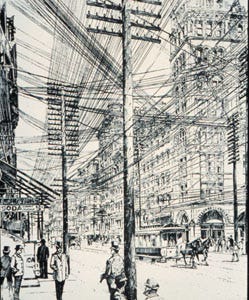
When people say, ‘Bitcoin reminds me of the early Internet,’ they often can’t articulate precisely why. It’s complicated to explain, but they are essentially saying, “I worked with technology when this stuff was being developed, and I see strong parallels between the evolution of the internet and Bitcoin.” I also worked with network systems during the Internet’s formative years, and I can tell you it’s all about open protocols and decentralization. Let’s go down this rabbit hole and I will explain for the non-technical why the “parallels” matter.
A protocol is a set of rules that governs how a network behaves. Telephone networks, which comprised telephone company copper lines, used protocols to enable voice-over copper lines.
Protocols of the modern internet were introduced in the 1980s; I was working for a consulting firm promoting IBM’s LU6.2 (logical Unit 6.2) network protocol at a time when TCP/IP (Transmission Control Protocol / Internet Protocol) was coming into prominence. The primary difference between LU6.2 and TCP/IP was ownership. One was owned by IBM and collected royalties for use; the other was known as “Open Source.” Open Source means the computer code (program) that makes up the software is open for anyone to use and modify at no cost.
Another one of the key features of TCP/IP is its distributed nature. Just like our highway system designed during the Cold War fears of nuclear attack, Arpanet was a government project with the objective of maintaining communication in the event of a nuclear attack on the communications network. If a communication channel is destroyed between the East and West Coast, the TCP/IP Protocol allows the data to find an alternative route to complete communication.
LU6.2 was like a carefully planned city where a single entity designed and controlled every road and intersection (IBM).
TCP/IP was like an organic transportation network where anyone could add new roads and paths, and travelers could dynamically find the best route. Dynamic vs. Centralized controls.
In the late 1990s, I formed a consulting group (WorkGroup Associates Inc.) focused on network communications. We were responsible for ensuring the reliability of a company’s messaging systems. This meant introducing several computers (servers) that did the same thing. If one failed, another was ready to jump in, ensuring seamless continuity and uptime for the network. This was called clustering, a distant cousin of fully decentralized networks. Just as Decentralization was a feature of TCP/IP rules, it could also be built into a system of network-connected servers, But I am getting ahead of myself. Well, I will drill down on that later.
This concept of open source would become one of the most challenging obstacles for companies seeking to build software monopolies. Microsoft, known as a very aggressive competitor, did not know how to counter the Open Source movement because there was no centralized point to attack. President of Microsoft Steve Balmer once described Open Source as cancer; today, Microsoft is one of the leading contributors to the Open Source initiative. In a world where competitive practice was extremely cutthroat, Open Source challenged the very core principles of revenue generation.
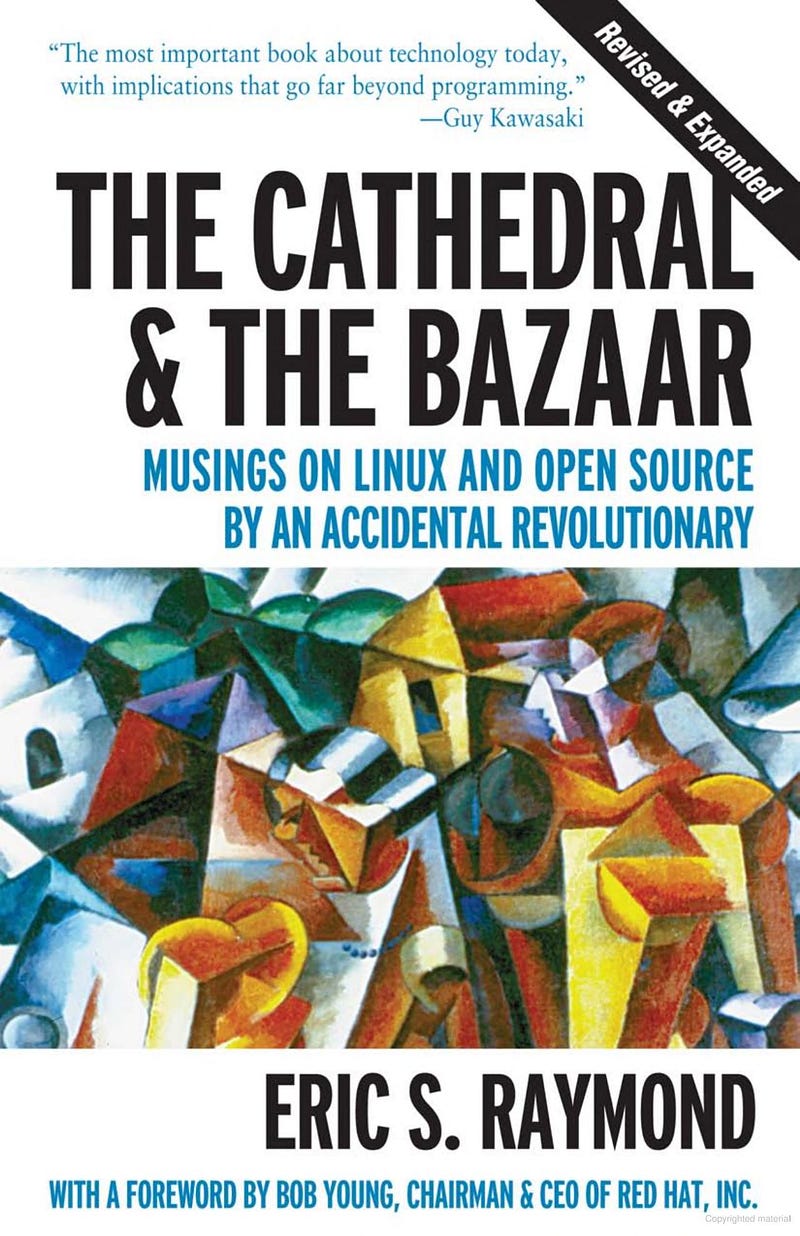
Eric Raymond wrote “The Cathedral and The Bazaar.” It articulated many of the core principles that continue to guide open-source development today.
The Cathedral model is a traditional, closed software development in which code is carefully crafted by an exclusive group of developers (like Microsoft) and has tightly controlled release (like building a cathedral).
The Bazaar model is open-source development in which code is developed publicly, with frequent releases and maximum engagement from the community (like a bustling bazaar).
The Open Source model pervades our daily lives. Linus Torvalds introduced Linux, a variation of the Unix operating system based on the open source model, which revolutionized software development. Today, most large commercial software development companies contribute to the Open Source movement in the spirit of” If you can’t beat ’em, join ‘em.” Most web servers are open source, and many of you are probably running a phone with Android, which is also open source.
The Internet and Bitcoin share fundamental similarities in how they work. Both created systems that anyone can join and use without needing permission from a central authority. Think of the Internet as millions of computers, all speaking the same language (TCP/IP) to share information. No company owns or controls this language; the network keeps running smoothly even if some computers stop working. The more computers that join, the stronger the network becomes.
Bitcoin works in a remarkably similar way, but instead of sharing information, it allows people to exchange value by maintaining one global ledger. Like no single company can shut down the Internet, no single entity can control or shut down the Bitcoin ledger. The rules for how Bitcoin works are built into the system itself, just like the rules that make the Internet function. And just as the Internet became more valuable as more people joined it, Bitcoin’s network became more secure and valuable as more people participated.
This shared design — a system that runs itself through agreed-upon rules rather than through a central authority — is what makes both the Internet and Bitcoin revolutionary technologies. Each represented a dramatic shift away from systems controlled by single organizations to ones that belong to everyone and no one at the same time.
Like TCP/IP, an Open Source protocol released into the public domain enabled the explosion that we call “the internet.” Bitcoin protocol (AKA a set of rules) enabled the explosion of what many call Digital Gold, like the internet skepticism and FUD similar misinformation pervades PR around Bitcoin. Traditional halls of banking and finance fear it because just as the printing press challenged the monopoly of the Catholic church and the internet challenged the monopoly of information providers in the 90s, Bitcoin is challenging the role of third-party managers of money, Banks.
When you drive down the road, you are (we all hope) in control of your car. The underlying systems you depend on to maintain your control are based on math and physics. Engineers have refined that technology since the early days of the Ford Model-T. Bitcoin has its roots in math and physics so that you can have complete control of your money. Death and taxes are two big things in our lives, so self-driving cars have not swept human drivers to the sidelines mainly because of a fear of dying; Bitcoin has not swept banks from the landscape. We have experienced losing money to banking, which is evident in the 2008 crash, and it continues today with other debt/inflation-related revelations.
You should have a choice with money, like you can drive your car or let some third party (human or robotic) drive it for you. With Bitcoin, you can get a digital wallet and have complete control of your transactions, or buy it on an exchange and let them hold it for you. It’s about who is in control.
Just as user-centric controls of TCP/IP usurped the central control of LU6.2, so will the central control of money by central banks be usurped by Bitcoin. In the end, it’s all about power and control. In contrast, centrally controlled systems with one decision maker, like China, Russia, and North Korea, have a short-lived advantage over the more cumbersome system where many voices collaborate; ultimately, distributed systems win out over centralized systems. Open Source has demonstrated that even in the face of aggressive competition by proprietary software companies, they today are players in the Open Source movement. Bitcoin will prevail as open-source money or freedom money because collaboration is better than control.
Originally published at https://brianpconnelly.substack.com.