Rage-Tweeting Into a Bitcoin Standard
The Impulsive President and the Perfect Storm
A thought experiment in monetary shock therapy
Picture this: It’s late 2025. Trump is meeting with Xi Jinping this week. First face-to-face since the election. Relations are tense. Tariff threats are flying back and forth like a dysfunctional family at Thanksgiving.
Then Xi makes an offhand comment about America’s “$37 trillion debt problem” and its “declining dollar.” You know, just casual small talk between world leaders.
Trump takes it personally. Of course he does.
Within 48 hours, in a move that would make the Nixon Shock look like careful deliberation, Trump announces on Truth Social: “AMERICA IS GOING BITCOIN. GREATEST FINANCIAL MOVE IN HISTORY. NOBODY’S EVER SEEN ANYTHING LIKE IT.”
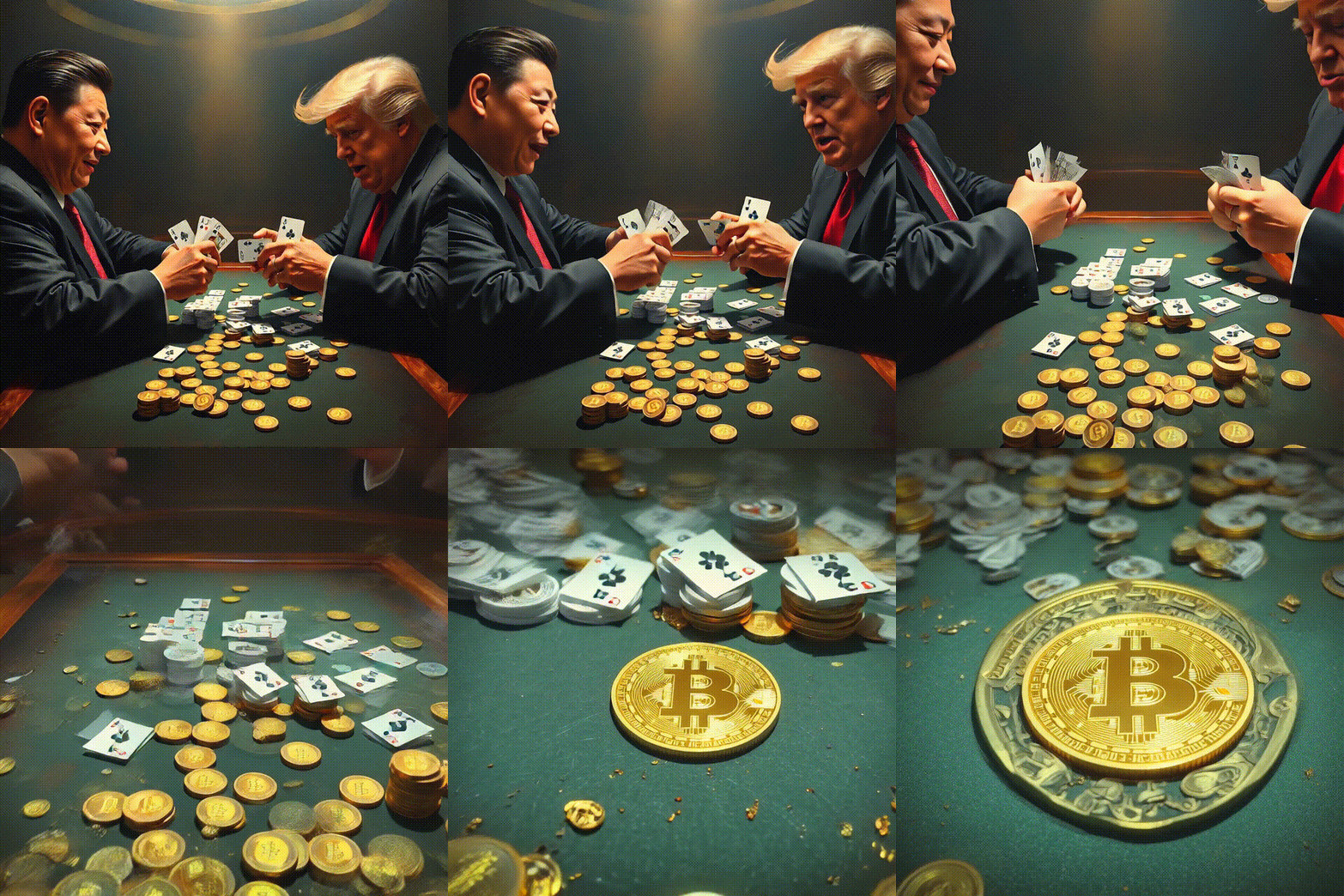
Markets panic. Cable news loses its mind. Your uncle starts texting you about the end of civilization.
But what if there was actually something brilliant buried beneath the chaos? What if impulsiveness accidentally unlocked the monetary reset America desperately needs but is too cautious to attempt?
Let’s game this out, not as a prediction, but as an imagination exercise. Sometimes you need to see the board from a completely different angle to understand which moves are actually possible.
The Gold Gambit
Here’s how it could actually work, and it starts with an accounting trick that sounds too simple to matter but isn’t.
The US government currently values its gold reserves at $43 per ounce. Yes, really. That’s the official book value from 1973, and nobody’s bothered updating it because, well, why would you? It’s just accounting, right?
Except accounting matters when you’re trying to flip the global monetary system.
So step one: Trump announces the US is revaluing its gold reserves to something closer to reality. Say $15,000 per ounce. With 8,100 tons of gold, this accounting move instantly creates $4.4 trillion in “paper wealth.” Trump announces this as the greatest balance sheet improvement in history. Technically, he’s not wrong.
Step two is where it gets spicy: Sell all of it.
Dump the entire 8,100 tons onto the global market over 12 to 18 months. That’s roughly four years of global gold mine production hitting the market at once. Gold prices don’t go to zero (it’s still shiny, still useful, still has 5,000 years of monetary history), but they drop hard. Maybe 30 to 50 percent.
Now, who holds massive gold reserves as a hedge against the dollar? China sits on over 2,000 tons. Russia has 2,300 tons. India holds 800 tons.
The strategic strike is already underway before a single Bitcoin is purchased.
The Accumulation Problem Nobody Talks About
This is where most Bitcoin standard fantasies fall apart like a house of cards in a wind tunnel.
You can’t just “buy $4 trillion in Bitcoin.” The market isn’t deep enough. You’d be bidding against yourself, pushing Bitcoin to half a million dollars before you’d accumulated even a fraction of what you wanted. It’s like trying to buy every house in Manhattan by showing up with a dump truck full of cash. Sure, you’ll get some houses, but the price of the last house will be approximately “your entire dump truck plus your firstborn child.”
But there’s a smarter play that solves this completely: Don’t buy the coins. Buy the companies that already spent years accumulating them.
MicroStrategy has roughly 190,000 Bitcoin. Marathon Digital holds about 40,000. Riot Platforms has another 17,000. Various other publicly traded companies hold another 50,000 or more combined. That’s around 300,000 Bitcoin already sitting in corporate treasuries.
Offer these companies a 50 to 100 percent premium to buy them outright. Total cost? Maybe $50 to $100 billion. That’s a rounding error compared to $4.4 trillion. More importantly, no market impact on Bitcoin’s price because the coins never actually move on-chain. They just change corporate ownership.
And suddenly the US government owns the infrastructure to continue accumulating slowly over time, using the same playbook these companies already perfected.
The irony is delicious: Michael Saylor would have spent years building what becomes America’s strategic Bitcoin reserve, essentially for free. He’d probably frame it as his plan all along.
Bitbonds: The Debt Solution That Actually Works
Here’s the piece that transforms this from “interesting chaos” to “financially viable strategy.”
The US needs to restructure its debt, and fast. Interest payments are approaching $1 trillion per year. The math doesn’t work anymore; everyone knows it, but nobody wants to say it out loud because saying it makes it more real.
Enter the Bitbond: a Bitcoin-linked Treasury Bond.
Here’s how a traditional Treasury works. You buy a $1,000 bond paying 4% annual yield. In 30 years, you get your $1,000 back plus interest. Boring, predictable, and increasingly unattractive because inflation might eat half your purchasing power.
Now imagine a Bitbond. Same $1,000 bond, but only 2% annual yield. Sounds worse, right? Except you also get a warrant for 0.01 Bitcoin (the ratio doesn’t matter, just the concept). If Bitcoin goes from $100,000 to $1 million over the life of the bond, that warrant becomes worth $10,000. You just turned a $1,000 bond into $11,000 plus interest.
For bondholders, this is compelling. Lower yield, sure, but massive upside potential. It hedges against dollar inflation automatically. If the dollar weakens, Bitcoin is likely to strengthen. You get downside protection from government backing, plus a lottery ticket upside from Bitcoin exposure. It’s like buying insurance that pays you to own it.
For the US government, this is transformative in ways that are hard to overstate.
Run the numbers: Issue $10 trillion in Bitbonds at 2% instead of normal Treasuries at 4%. You save $200 billion per year in interest payments. The cost? Give out warrants for maybe 100,000 Bitcoin total, worth roughly $10 billion at current prices. You’re cash flow positive within two months.
Even better, suddenly long-term bonds become attractive again. Nobody wants 30-year Treasuries at 4.5% when inflation might run higher than that. But a 30-year Bitbond with Bitcoin exposure? Now you’ve got patient capital willing to lock in for decades because they’re betting on Bitcoin’s long-term appreciation.
Preston Pysh has talked extensively about this mechanism on YouTube if you want to dive deeper. The Bitcoin Policy Institute has academic papers on the framework. This isn’t internet fever dream territory anymore. It’s being seriously discussed by people who understand bond markets.
The Three-Year Exchange Window
Shock therapy doesn’t mean chaos. It means controlled demolition instead of random collapse.
Trump announces a three-year voluntary exchange program. Anyone holding existing US Treasuries can swap them for new Bitbonds with Bitcoin kickers. The terms are graduated to create urgency without panic.
Exchange in year one and you get 0.012 Bitcoin warrants per $1,000 bond. Wait until year two and it drops to 0.010. Year three? You’re down to 0.008. Early adopters get rewarded. Late adopters get penalized. Nobody gets completely screwed, but there’s a clear incentive to move fast.
China holds $800 billion in US Treasuries. Japan holds $1.1 trillion. They face a choice: Exchange for Bitbonds and get Bitcoin exposure, or hold depreciating dollars while watching the system transition without them.
Most will take the exchange. Not because they love Bitcoin, but because the alternative is being the last one holding dollars at a party where everyone else switched to the new currency. You don’t need to believe in Bitcoin. You just need to believe everyone else will believe in Bitcoin, which is a much easier bet.
The genius here is that this isn’t a default. It’s a voluntary upgrade. Anyone who participates gets a bridge to the new system. Only those who stubbornly refuse get left behind, and they chose their fate. No lawsuits, no international incident, just economics doing what economics does.
Why China Can’t Follow (And Why That Matters)
This is the asymmetric advantage that turns financial engineering into a genuine strategy.
Bitcoin has a problem if you’re an authoritarian government: It’s freedom money. The core features that make Bitcoin valuable are fundamentally incompatible with centralized control. Self-custody means citizens can move money outside government oversight. Permissionless transactions mean you can’t stop “undesirables” from accessing the system. No kill switch means you can’t freeze accounts the way China can with digital yuan. The transparent blockchain makes it harder to hide both corruption and dissidents.
China faces an impossible choice: Adopt Bitcoin and lose monetary control over its population, or skip Bitcoin and miss the most significant reserve asset transition in 50 years.
Their own political system checkmates them.
Meanwhile, Western democracies don’t have this problem. The US, UK, EU, and allies already have property rights and the rule of law. Bitcoin’s “freedom features” aren’t threatening because citizens already have those freedoms. The countries that can adopt Bitcoin are those that don’t need to fear their citizens exercising financial sovereignty.
So while the US shifts to a Bitcoin standard, China doubles down on gold. Russia follows China because they’re in the same authoritarian boat. India probably hedges both. The world splits into competing monetary blocs: a Bitcoin bloc of democracies, a gold bloc of authoritarian states, and pragmatic countries running hybrid baskets of both.
This is actually more stable than dollar hegemony because it reduces resentment while maintaining US centrality. China isn’t destroyed, just locked out of one monetary club by its own governance model.
The Hegemony Paradox
Here’s the most counterintuitive part, and the part that requires really thinking through second and third-order effects.
By appearing to give up dollar dominance, the US actually maintains more control than trying to preserve it.
The current system has everyone trying to escape. BRICS nations are actively building alternatives. Every time the US weaponizes the dollar with sanctions, it creates more determined resistance. The tight grip is causing the dollar to slip through America’s fingers like trying to hold water.
But switch to a Bitcoin standard? The US appears to surrender control to “neutral, mathematical money that nobody controls.” Except the US positioned itself optimally before making the announcement. Largest Bitcoin reserves from buying all those companies. The largest economy is still creating trade demand. Financial infrastructure is already adapting.
Countries choose to participate rather than being coerced. It feels collaborative instead of imperial. But make no mistake about who’s sitting in the driver’s seat.
Think about the transition from the British Empire to American hegemony. Britain exhausted itself trying to maintain direct colonial control. The US took over by offering “partnership” instead of empire. Bretton Woods felt collaborative even though America clearly dominated-same playbook, different century.
The real power isn’t in controlling Bitcoin. The power lies in Bitcoin’s uncontrollability, and you have the most significant stake in an asset everyone needs.
Local Currencies Don’t Die, They Just Get Honest
One of the most elegant outcomes gets overlooked in all the Bitcoin maximalist rhetoric about hyperbitcoinization.
Local currencies don’t disappear. They just get pegged to something real instead of being backed by nothing but government promises and printer ink.
Take Argentina as an example. Instead of the peso that inflates 200% per year because the government can’t help itself, imagine a “new peso” where one peso equals 0.000001 Bitcoin. Argentina keeps its currency, maintains national pride and local control, but they can’t hyperinflate it anymore. The peg enforces discipline. Citizens trust the currency again because it’s actually backed by something that can’t be printed into oblivion.
Countries get to choose their pegs based on their values and constraints. Conservative nations might choose gold with its 5,000-year track record. Tech-forward countries might choose pure Bitcoin. Pragmatic hedgers might run a 60% Bitcoin, 40% gold basket.
But none of them can print unlimited currency and destroy their citizens’ savings anymore. That’s the constraint that makes the freedom meaningful.
This is sovereignty with accountability. You control your monetary policy, but physics and math keep you honest. It’s like having a credit card with an actual limit instead of one that just keeps going up whenever you want to buy something stupid.
Spreadsheets, Not Bullets
Here’s why timing matters and why shock therapy might beat slow decline.
The current system is breaking in slow motion. $37 trillion in debt, growing by over $2 trillion per year. Interest payments are approaching $1 trillion annually and accelerating. Regional bank failures. Unrealized losses everywhere in commercial real estate. De-dollarization is accelerating as BRICS expands. Geopolitical tensions are rising between the US and China, with a complete breakdown with Russia.
If this collapses naturally, chaos determines the outcome. Probably a military conflict somewhere. The US loses control and first-mover advantage.
But if Trump does shock therapy now? Everyone’s too busy restructuring balance sheets to load guns.
Think about what a transition of this magnitude creates. Every finance ministry is working overtime. Every central bank recalibrating models. Every bank either adapting or dying. Every business restructuring supply chains. Every country negotiating new currency pegs and trade agreements.
You’ve just created 20 years of work overnight. Positive sum work, mostly. Building new infrastructure. Creating efficiency. Unlocking trade that was previously too expensive because of currency friction.
The old saying goes “When goods don’t cross borders, soldiers will.” But when everyone’s frantically restructuring how goods cross borders? They’re too busy with spreadsheets to load bullets.
It’s like post-World War II reconstruction. Europe was too busy rebuilding to fight. Or China’s economic opening in the 1980s. Too busy getting rich to start wars. A massive financial restructuring absorbs competitive energy that would otherwise turn into conflict.
Who Wins and Who Deserves To Lose
Let’s be clear about the winners and losers because the distribution matters.
The US wins big. Maintains financial centrality, solves the debt crisis through Bitbonds, resets the game on favorable terms. Bitcoin holders obviously win as the asset goes to the moon from reserve status. Western democracies win by being able to adopt freedom money without threatening their political systems. Small countries win by getting a neutral standard instead of being whipsawed by US monetary policy spillover.
China takes a hit from gold devaluation but isn’t destroyed. They maintain sovereignty with a gold standard that fits their authoritarian model better anyway. Gold holders get hurt 30 to 50 percent but gold doesn’t go to zero. It still has industrial uses, jewelry demand, and 5,000 years of monetary history.
The real losers? Rent-seeking banks that provide zero value. Correspondent banks that take a cut for literally just passing messages. Foreign exchange middlemen extracting 2 to 5 percent spreads on currency trades. Securities settlement infrastructure charging fees for “trust” services that blockchain makes obsolete.
These institutions aren’t providing value. They’re extracting rent from information asymmetries that no longer exist, settlement delays that technology eliminated, and geographic barriers that the internet destroyed. They’re telegraph operators in the age of telephones. Blockbuster in the age of streaming.
And honestly? They deserve to die. They’ve had 16 years since Bitcoin launched to adapt. They have billions in profits they could have used to build new business models. Instead, they lobbied against change and prayed the future would go away.
The banks that survive will be the ones providing actual value. Underwriting and risk assessment. Custody with real added services. Credit creation for productive purposes. Financial advisory using expertise and judgment. These are real economic functions. They’ll adapt by offering Bitcoin custody plus services, underwriting Bitbonds, and providing Bitcoin-denominated credit.
The beautiful part of this transition is that it forces everyone to justify their existence. You can’t just say “we’re the middleman, pay us.” You have to actually provide something.
Could This Actually Happen?
The groundwork is already being laid in ways that would have seemed impossible five years ago.
Senator Cynthia Lummis proposed a Strategic Bitcoin Reserve bill. Trump appointed David Sacks as an “AI and Crypto Czar.” Preston Pysh makes the intellectual case on YouTube to millions of viewers. The Bitcoin Policy Institute develops policy frameworks and engages with legislators. The Overton window has shifted dramatically.
What seemed like internet crazy talk in 2020 is now being seriously discussed by serious people in policy circles.
The question isn’t whether this can happen. It’s whether US policymakers understand the opportunity and have the courage to execute shock therapy rather than waiting for chaotic collapse to force a worse outcome.
The Imagination Game
Look, this isn’t a prediction. Nobody knows what Trump will actually do, and thank god for that, because the entertainment value would drop significantly if he became predictable.
This is a thought experiment. An imagination exercise. A way of seeing the monetary system from a completely different angle to understand what’s actually possible versus what conventional wisdom says is possible.
Sometimes the value isn’t in predicting what will happen. It’s in seeing what could happen if someone with power made an impulsive decision that accidentally turned out to be strategically brilliant.
Trump’s impulsiveness is his wildcard. The tariff tantrums. The middle-of-the-night policy tweets. The personal vendettas that reshape international relations. Usually, it’s just chaos. But what if, just this once, the chaos unlocked a door everyone else was too cautious to open?
What if Xi insults American debt this week and Trump’s thin skin triggers the monetary reset of the century?
Stranger things have happened. And in a world where the current system is visibly breaking, where debt is mathematically unsustainable and conflict is rising, maybe a little controlled chaos is exactly what’s needed.
Better to jump ship while the getting is good than go down with a sinking vessel.
Better spreadsheets than bullets.
Better an impulsive reset than a slow-motion collapse into something worse.
The mechanics described here aren’t fantasy. Bitbonds are being seriously discussed. Company acquisitions solve the accumulation problem. Currency pegs to real assets work and have historical precedent. Graduated exchange windows create orderly transitions.
The question is just whether political will exists to execute before crisis forces a worse outcome.
So what do you think? Could Trump’s impulsiveness accidentally save the dollar by abandoning it? Is shock therapy better than slow collapse? And if Xi insults American debt this week, should we all just buckle up and enjoy the ride?
The monetary illiterate should start paying attention. Whether this specific scenario plays out or not, some version of monetary reset is coming. The math doesn’t work anymore, and everyone knows it.
The only question is whether it happens on our terms or on chaos’s terms.
Place your bets accordingly.