Satoshi’s Children
How Crypto Changed Everything

As I sit here in my solar-powered home office, watching a livestream of the first human settlement on Mars, it’s hard to believe it’s been only a decade since the world as we knew it changed forever.
It all started in 2024 with the surprise election of President Robert Kennedy Jr, a political outsider who ran on a platform of radical social, governmental, and economic reform. His first act in office sent shockwaves through the global financial system: the adoption of Bitcoin as a strategic reserve asset for the United States.
The immediate aftermath was chaos. Traditional financial markets plummeted. The U.S. dollar, long the world’s reserve currency, began a rapid decline. Banks faltered, and for a few terrifying months, it seemed like the entire global economic system might collapse.
But then, something remarkable happened. As faith in traditional currencies waned, people and then entire nations began turning to Bitcoin en masse. It wasn’t just about money anymore; it was a shift in how we thought about value, trust, and cooperation. It seems when you fix the money people give a shit about each other.
The transition wasn’t smooth by any means. I remember the protests, the political turmoil, the temporary shortages as supply chains reconfigured. Traditional power structures didn’t go quietly. There were toothless attempts at regulation, hoping to outlaw cryptocurrencies, even at creating government-controlled alternatives. But against the global decentralized nature of Bitcoin, well, pissing in the wind comes to mind.
By 2026, over half of the world’s nations had adopted Bitcoin as their primary reserve asset. The IMF and World Bank, unable to adapt, became obsolete almost overnight. In their place, new decentralized systems of global cooperation emerged. The Bitcoin Network Governance Protocol (BNGP) became the new forum for international cooperation, allowing for rapid, transparent decision-making on a global scale.
Corporate structures evolved too. Traditional corporations, their power base eroded, either adapted or faded away. New forms of organization emerged — Decentralized Autonomous Organizations (DAOs) became the norm, allowing for fluid, global collaboration on an unprecedented scale.
The energy sector saw the most dramatic shift. Bitcoin mining’s enormous energy appetite drove rapid innovation in renewable energy. By 2030, over 80% of the world’s energy came from renewable sources, with Bitcoin miners serving as the backbone of a new, decentralized global energy grid.
Education transformed as well. The old model of nationalized education systems gave way to global, open-source learning platforms. Skills became more valuable than degrees, and continuous learning became the norm in a rapidly evolving economy.
There are always bumps in a new road. New forms of inequality emerged between those who adopted Bitcoin early and those who came late to the game. Efforts to address this “crypto-divide” are still ongoing. Privacy concerns in an increasingly digital world remain a hot topic of debate on the BNGP.
Yet, despite these challenges, I can’t help but feel optimistic. The level of global cooperation we’re seeing now was unimaginable a decade ago. From the Mars colonization project to the Global Climate Restoration Initiative, we’re tackling problems on a scale that once seemed impossible.
As I look at my young daughter Lisa playing with her AI tutor, learning about quantum computing and space agriculture, I’m filled with hope. The world she’ll inherit isn’t perfect, but it’s one where borders matter less, where collaboration is the norm, and where a common digital economy unites us.
The Great Transition was painful, yes. But as we stand here in 2034, it’s clear that the adoption of Bitcoin was more than just a change in our monetary system. It catalyzed a fundamental reimagining of how we organize our world.
And we’re just getting started.
The Economic Revolution
The day President Kennedy announced the U.S. would adopt Bitcoin as a strategic reserve asset, Wall Street entered a frenzy. I remember watching the news feeds and seeing the panic in the eyes of traders as traditional markets plummeted. There was a rumor that Jammie Diamond had a heart attack. The U.S. Dollar Index fell by 30% in a matter of hours. It was financial chaos on a scale not seen since the Great Depression.
For weeks, ATMs ran dry as people rushed to withdraw their savings. Banks imposed withdrawal limits, which only fueled the panic. The Federal Reserve, that once-mighty institution, found itself powerless in the face of a decentralized currency it couldn’t control. Elizabeth Warren’s crypto army was AWOL.
But amidst the chaos, a new order was emerging. Tech-savvy individuals and companies like Microstrategies Inc. who had long held Bitcoin found themselves suddenly wealthy. More importantly, their wealth was insulated from the crash affecting traditional currencies. This created a new class of economic leaders, almost overnight.
As faith in fiat currencies waned, businesses began accepting Bitcoin out of necessity. What started as a trickle soon became a flood. By the end of 2025, major retailers, online platforms, and even local shops were preferring Bitcoin over fiat currencies.
International trade saw a radical shift. The complexities of daily 50 billion dollar forex markets and currency hedging became obsolete as Bitcoin provided a universal medium of exchange. Small nations, long at the mercy of more powerful economies, found themselves on more equal footing in global trade.
Perhaps the most profound change came in how we thought about economic policy. The idea of centralized monetary control, a cornerstone of 20th-century economics, now seemed more like punitive communism than liberty and freedom. Instead, algorithmic supply control and community governance became the new principles guiding our economic systems.
Inflation, that old specter that had haunted economies for centuries, was effectively neutralized. Bitcoin’s fixed supply meant that for the first time in modern history, people could save without fear of their money losing value over time. Seems like Jeff Booth and Lyn Alden had it right all along. (see end notes)
The transition wasn’t without its victims. Those who clung too long to the old system — retirees with dollar-denominated pensions, nations with large dollar reserves — faced significant hardships. Massive government interventions were needed to prevent widespread poverty among these groups.
Yet, by 2028, the new economy had stabilized. Global GDP, now commonly measured in Bitcoin, showed strong growth. Economic inequality, while still a challenge, had shifted. The divide was no longer between nations but between those who adapted quickly to the new system and those who didn’t.
As I look back now, it’s clear that those tumultuous years weren’t just an economic revolution. They were the birth pangs of a new global society, one where economic borders became meaningless, and where financial freedom became a fundamental right rather than a privilege. An era where people gave more energy to cooperation and collaboration than to competition and violence.
The children born in this new era will never know a world of fiat currencies, central banks, or economic nationalism. They are truly Satoshi’s Children, inheritors of a borderless, decentralized global economy that their parents and grandparents could scarcely have imagined.
Reimagining Energy and Environment
The Bitcoin revolution didn’t just reshape our economy; it fundamentally altered our relationship with energy and the environment. As Bitcoin mining’s energy appetite grew, it became clear that our old energy systems were unsustainable. This realization sparked a green revolution that would have made AOC’s head spin.
It began with a crisis. In 2025, as Bitcoin adoption soared, global energy consumption skyrocketed. Climate scientists warned we were accelerating towards environmental catastrophe. But then, something unexpected happened: Bitcoin became the catalyst for unprecedented innovation in renewable energy.
Mining operations, always in search of the cheapest energy, began investing heavily in renewable sources. An unprecedented number of solar farms sprouted in deserts, wind turbines appeared on coastlines, and geothermal plants tapped into the Earth’s heat. The insatiable demand for energy for what Mr Saylor termed “Bitcoin’s Gold Rush,” Bitcoin drove rapid advancements in these technologies, making them more efficient and cost-effective than ever before.
By 2027, over 85% of Bitcoin mining was powered by renewable energy. This shift had a ripple effect across all industries. As renewable technology improved, it became the go-to choice for all energy needs, not just crypto mining.
But the revolution didn’t stop there. Bitcoin miners, with their unique ability to monetize energy at the source, became key players in grid stabilization. In regions with excess solar or wind energy, miners soaked up the surplus, preventing waste. During peak demand, they could instantly shut down, diverting power back to the grid. This flexibility transformed our power systems, making them more resilient and efficient.
The concept of “stranded energy” became obsolete. Remote waterfalls, offshore wind, and even the excess heat from volcanoes became valuable energy sources, tapped by Bitcoin miners. This drove economic development in previously overlooked regions mostly in the global south and accelerated our transition away from fossil fuels.
Environmental cleanup efforts got an unexpected boost too. Innovative companies started using Bitcoin mining to power methane capture at landfills and abandoned coal mines, turning a potent ozone killer into a valuable resource.
As for carbon emissions, the Bitcoin network itself became a driving force for carbon capture technology. Mining pools voluntarily adopted a protocol that required a percentage of their profits to be invested in carbon capture projects. By 2030, the Bitcoin network had become carbon negative, actively removing more carbon from the atmosphere than it produced.
The old environmental movement, which often positioned itself against economic growth, was transformed. In this new paradigm, economic incentives aligned perfectly with environmental goals. Protecting the environment wasn’t just the right thing to do; it was the profitable thing to do.
Education shifted too. Schools began teaching “energy literacy” alongside computer science and economics. Children grew up understanding the intricate dance of energy production, consumption, and conservation that powered their digital world.
The path here wasn’t easy, and we still face challenges. But as we stand in 2034, our cities greener, our air cleaner, and our energy grids smarter and more resilient, it’s hard not to feel optimistic about the future. In solving Bitcoin’s energy problem, we solved so much more.
The New Face of Global Governance
The old world order, with its nation-states, international organizations, and power politics, didn’t disappear overnight. But as Bitcoin reshaped our economic realities, it inevitably led to a radical reimagining of how we govern ourselves on a global scale.

The first cracks appeared in 2026 when the International Monetary Fund (IMF) and the World Bank, unable to adapt to the new economic paradigm, became increasingly irrelevant. Their collapse left a vacuum in global economic coordination that needed to be filled.
Enter the Bitcoin Network Governance Protocol (BNGP), a decentralized system that emerged organically from the Bitcoin community. Initially created to manage protocol upgrades, it evolved into something much more significant. By 2028, the BNGP had become the de facto platform for global decision-making on economic matters.
This new form of governance proved remarkably effective at addressing global challenges. Climate change initiatives, for instance, no longer stalled due to national interests. Instead, global consensus could be reached quickly, with resources allocated efficiently through smart contracts.
The concept of national borders began to blur. As more people became “digital citizens” of the Bitcoin network, traditional notions of citizenship and nationality started to feel outdated. By 2030, we saw the emergence of “network states” — communities bound by shared values and economic interests rather than geography.
Traditional governments didn’t disappear, but their role changed dramatically. They became service providers competing in a global marketplace. Want better healthcare or education? You could “opt-in” to the services of any government willing to provide them, regardless of where you lived physically.
The United Nations, struggling to stay relevant, underwent a radical reformation. By 2032, it had transformed into the United Networks, a decentralized platform for global cooperation that worked in tandem with the BNGP. Its security council was replaced by a dynamic system of representation based on real-time network metrics rather than outdated notions of national power.
Privacy and individual rights took center stage in this new world order. The pseudonymous nature of Bitcoin transactions made old-style surveillance difficult, forcing a new approach to security based on consensus and community policing rather than centralized control.
All was not rainbows and unicorns. The digital divide became a pressing issue, as those without access to technology risked being left out of this new governance model. Massive efforts to provide global internet access and tech education became a top priority for the Bitcoin community.
As I reflect on these changes in 2034, I’m struck by how profoundly our concept of governance has shifted. My daughter, born into this new world, finds it perfectly natural to vote on global issues through her digital wallet or to access services from a government halfway across the world.
The old power centers — Washington, Brussels, Beijing — have lost their monopoly on global decision-making. In their place, we have a dynamic, responsive system of governance that transcends borders and puts power directly in the hands of individuals.
Satoshi’s children are growing up in a world where governance is no longer something done to them, but something they actively participate in every day. It’s a world of unprecedented individual empowerment, global cooperation, and rapid problem-solving. While challenges remain, the path forward is one of collective decision-making on a scale never before possible in human history.
Education in the Crypto Age
The Bitcoin revolution didn’t just change our economy and governance; it fundamentally altered how we approach learning and skills development. As the world rapidly digitized and decentralized, our education systems had to evolve just as quickly.

By 2026, it was clear that traditional educational institutions were struggling to keep pace with the changing world. Universities, once the gatekeepers of knowledge and credentials, found themselves outpaced by the rapid evolution of technology and the shifting demands of the job market.
The rise of Decentralized Autonomous Organizations (DAOs) and the gig economy meant that traditional degrees were no longer the golden tickets they once were. Instead, demonstrable skills and adaptability became the most valued attributes in the workforce.
This shift gave birth to a new educational paradigm: the Global Learning Network (GLN). Launched in 2027, the GLN was a decentralized platform that allowed anyone to learn, teach, and earn credentials. Built on blockchain technology, it provided verifiable, tamper-proof records of skills and achievements.
The concept of a four-year degree gave way to continuous, lifelong learning. People began accumulating “knowledge tokens” throughout their lives, representing specific skills and competencies. These tokens, backed by blockchain verification, became more valuable than traditional degrees in many fields.
Artificial Intelligence played a crucial role in this new system. AI tutors, personalized for each learner, could adapt in real-time to individual learning styles and paces. These AI tutors worked alongside human experts, who could beam into virtual classrooms from anywhere in the world.
The curriculum itself underwent a radical transformation. Coding became as fundamental as reading and writing. “Tokenomics” replaced traditional economics in importance. Courses on decentralized governance, digital privacy, and blockchain technology became standard.
But it wasn’t just about digital skills. The GLN also emphasized uniquely human attributes like creativity, emotional intelligence, and complex problem-solving — skills that AI couldn’t easily replicate. A renewed emphasis on asking questions was valued over having answers.
The finance model for education changed too. Instead of upfront tuition, many learners opted for Income Share Agreements, paying a percentage of their future earnings back into the educational DAOs that trained them. This aligned incentives and made quality education accessible to anyone with talent and drive, regardless of their initial financial situation.
Physical schools didn’t disappear, but their role changed. They became hubs for social interaction, hands-on learning, and community building — essential counterbalances to the increasingly digital world.
By 2030, the results of this educational revolution were clear. Global literacy rates soared, not just in reading and writing, but in digital and financial literacy as well. The pace of innovation accelerated as more minds from around the world gained access to quality education and the tools to contribute to the global knowledge economy.
There were also concerns about the loss of a shared cultural canon as education became more individualized. In response, programs emphasizing global citizenship and shared human values gained prominence.
As I watch my daughter navigate her personalized AI tutor, jumping from a lesson on quantum computing to a virtual field trip to ancient Rome, I’m amazed at the opportunities available to her. She’s growing up in a world where learning is not confined to childhood or classrooms, but is a lifelong journey of exploration and growth.
Satoshi’s children are entering a world where the boundaries between education, work, and play are blurred. They’re equipped with the tools to continually adapt, learn, and contribute to a rapidly evolving global society. While we can’t predict the challenges they’ll face, we can be confident that they’ll have the skills and knowledge to tackle them head-on.
In this new era, education has truly become the great equalizer, limited only by one’s curiosity and drive to learn. The future belongs to the perpetual learners, and thanks to the revolution sparked by Bitcoin, we’re all becoming lifelong students of this ever-changing world.
Redefining Work and Corporations
This bloodless revolution didn’t just change our money; it fundamentally altered the nature of work and the structure of organizations. As we stand in 2034, the way we collaborate, create value, and organize our productive efforts bears little resemblance to the corporate world of a decade ago.
The first domino to fall was the traditional company structure. By 2026, as Bitcoin and blockchain technology became ubiquitous, the inefficiencies of hierarchical corporations became glaringly apparent. The rise of Decentralized Autonomous Organizations (DAOs) marked the beginning of a new era in organizational design.
Micro Strategies, led by Michael Saylor, became focused on helping people, nations, and organizations make the most of this new economy.
The concept of a “job,” as we knew it, began to dissolve. Instead of being employed by a single company, individuals became free agents, contributing their skills to multiple projects across various DAOs. The gig economy, once a fringe element, became the norm. People now routinely juggle multiple roles, switching between organizations and projects with unprecedented fluidity.
Smart contracts revolutionized compensation. Gone were the days of bi-weekly paychecks. Instead, value exchange became continuous and automatic. Contribute to a project, get paid instantly. The line between work and investment blurred, as contributing labor to a DAO often meant receiving governance tokens, aligning individual incentives with the organization’s success.

Many in the old order were unable to make the leap of imagination to a better world because their framework for how the world worked was bound up in “The Principles of Accounting” and other methods that had outlived any possible usefulness in a world that moved at the speed of light rather than quarterly updates.
The Bitcoin-driven energy revolution we discussed earlier had profound implications for work as well. As energy became abundant and nearly free in many parts of the world, it unleashed a wave of automation. Routine tasks were increasingly handled by AI and robots, pushing human work towards more creative and strategic roles.
This shift required a massive reskilling effort. Continuous learning, as we explored in the education chapter, became not just beneficial but essential for remaining relevant in the job market. The most successful workers were those who could rapidly adapt, learning new skills as technology evolved.
Physical offices became largely obsolete. With work decentralized and teams distributed globally, the idea of commuting to a central location seemed quaint. Instead, we saw the rise of local co-working hubs, allowing for human interaction and collaboration while maintaining the flexibility of remote work.
Corporate ownership structures were turned on their head. The idea of a company being owned by a small group of shareholders gave way to broad-based ownership through tokenization. Many DAOs were effectively owned by their entire user base, blurring the lines between employees, customers, and shareholders.
This new paradigm wasn’t without challenges. The lack of job security and benefits associated with traditional employment led to the development of new social safety nets. Mutual aid DAOs emerged, providing decentralized insurance and support systems for workers in this fluid new economy.
It turns out Jeff Booth’s vision of 2035 was not far from the mark, technology is deflationary and many enjoyed a much higher standard of living on a much lower income.
Interestingly, as work became more decentralized, we saw a resurgence of craftsmanship and local production. With basic needs met through automation and abundant energy, many people turned to creative and artisanal pursuits, leading to a renaissance in small-scale, high-quality production.
Regulatory frameworks struggled to keep up with these changes. The concept of “employment law” had to be entirely rethought. By 2032, most nations had adopted new legal frameworks designed to protect workers’ rights in this decentralized, fluid work environment.
As I look at my daughter’s generation, I see young people who can’t conceive of the idea of a “career” as we once understood it. They’re growing up expecting to continuously learn, adapt, and contribute to multiple projects throughout their lives. They don’t see work as separate from life, but as an integral part of their personal growth and contribution to society.
Satoshi’s children are entering a work world that’s more flexible, more meritocratic, and more aligned with individual passions than ever before. While it can be uncertain and challenging at times, it’s also filled with unprecedented opportunities for innovation, creativity, and self-actualization.
I recall when the crypto bros rallying cry was “Price Go UP” and “Pump my Bags,” the Bitcoin revolution didn’t just give us new money; it gave us new ways of creating value, collaborating, and defining our contributions to society. In doing so, it has fundamentally reshaped our understanding of what it means to work in the 21st century.
The Bitcoin revolution didn’t just reshape our world; it propelled us beyond it. As we stand in 2034, humanity’s reach into space has advanced more in the past decade than in the half-century before it. The decentralization of finance and governance sparked by Bitcoin created a new paradigm for space exploration, one that was no longer constrained by national boundaries or centralized decision-making.
It began in 2026 when SpaceX, already a leader in private space flight, started accepting Bitcoin for its services. This move, initially seen as a publicity stunt, proved to be a game-changer. The borderless nature of Bitcoin allowed for unprecedented international collaboration in space projects, bypassing the complex web of international regulations and currency exchanges that had long hampered global space efforts.
By 2028, we saw the emergence of the first space-focused DAOs. These decentralized organizations pooled resources from millions of individuals worldwide, democratizing space exploration in a way never before possible. The Mars Colony DAO, launched in 2029, became the largest crowdfunded project in human history, with over 50 million contributors worldwide.
The tokenization of space assets revolutionized funding for cosmic ventures. Moon real estate tokens, backed by actual lunar land claims, became hot commodities. Asteroid mining companies issued tokens representing future mineral rights, allowing small investors to participate in the extraterrestrial resource boom.
Even though all but 1% of the Bitcoin has already been released and miners don’t anticipate large financial returns as in the early days. Bitcoin has become the foundation of many spinoff and knock-on systems that are integral to daily life. Network support by mining is a noble endeavor.
The decentralized nature of the new space economy solved many of the political challenges that had long plagued international space cooperation. Instead of nations competing for prestige, we saw collaborative efforts driven by shared economic incentives. The International Space Station, once a symbol of cooperation between a few wealthy nations, was dwarfed by the Lunar Orbital Ring, a massive space structure jointly developed by a consortium of DAOs and traditional space agencies.

AI and robotics, fields that had seen explosive growth alongside blockchain technology, became the workhorses of space exploration. Swarms of small, autonomous robots, each operating on its own blockchain, carried out complex construction and exploration tasks in the harsh environments of space.
Back on Earth, under RFK Jr’s uncle John the space industry became a major driver of technological innovation. Advances in materials science, propulsion technology, and life support systems, all spurred by the new space race, found myriad applications in everyday life. The dream of abundant clean energy came closer to reality with the successful test of the first orbital solar power station in 2032.
Education systems worldwide adapted to this new reality. “Space studies” became a standard part of school curricula, not just covering astronomy and physics, but also space law, ethics, and economics. Virtual reality allowed students to experience simulated space environments, inspiring a new generation of explorers and innovators.
However, this new space age also brought challenges. The potential militarization of space remained a concern, leading to the creation of the Space Peace DAO, a decentralized organization dedicated to ensuring the peaceful use of space resources. Environmental concerns about space debris and planetary protection sparked heated debates and led to the development of new, biodegradable satellite technologies.
As I watch my daughter play with her VR set, exploring a meticulously recreated Martian landscape, I’m struck by how different her relationship with space is compared to my generation’s. For us, space was a distant frontier. For her, it’s an extension of her world, a place of possibility and adventure.
Satoshi’s children are growing up in a world where space is not just for astronauts and scientists, but a realm open to everyone. They’re inheriting a multi-planetary economy, where the lines between Earth and space are increasingly blurred. While we can’t predict all the challenges they’ll face as they push further into the cosmos, we can be certain that the decentralized, collaborative spirit sparked by the Bitcoin revolution will be their guiding star.
This new technological revolution didn’t just change our world — it opened up the universe. As we stand on the brink of becoming a truly space-faring civilization, we can trace this incredible journey back to that mysterious whitepaper published by Satoshi Nakamoto all those years ago. In solving the problem of digital scarcity, Satoshi unknowingly laid the foundation for humanity’s greatest adventure yet.
Addressing the Crypto Divide
As revolutionary as this new era has been, it didn’t automatically solve all of society’s problems. In fact, in its early years, it threatened to create new forms of inequality. The challenge of the “crypto divide” — the gap between those who had access to and understanding of the new digital economy and those who didn’t — became one of the most pressing issues of the late 2020s.
The problem became glaringly apparent around 2026. While early adopters of Bitcoin and other cryptocurrencies had seen their wealth skyrocket, large segments of the population were being left behind. The digital nature of the new economy posed significant barriers for those without access to technology or the skills to navigate it.
However, the same decentralized ethos that drove the Bitcoin revolution also provided the tools to address this new form of inequality. In 2027, the Global Access DAO was formed with the mission of bridging the crypto divide. Funded by voluntary contributions from the crypto-wealthy led by the adopted daughter of Nayib Bukele (many of whom recognized that the health of the network and the world depended on broad participation), the DAO launched ambitious programs to spread access and education.
One of the first initiatives was the distribution of low-cost, high-functionality smartphones to underserved populations worldwide. These devices, dubbed “CryptoPhones,” came pre-loaded with user-friendly wallet software and educational apps. By 2029, over a billion CryptoPhones had been distributed, dramatically expanding access to the digital economy.
Education was the next frontier. Online learning platforms, powered by AI tutors, offered free courses in digital literacy, blockchain technology, and financial management. These weren’t just dry technical courses — they used gamification and virtual reality to make learning engaging and accessible to all ages and backgrounds.
Community crypto centers sprang up in towns and villages around the world. These centers provided free internet access, in-person support, and served as hubs for local economic activity in the new digital economy. They became particularly important in rural areas and developing nations, helping to integrate local economies into the global network.
The concept of Universal Basic Income (UBI), long discussed but rarely implemented in the fiat era, found new life in the crypto age. Several large DAOs implemented UBI systems for their members, providing a basic level of economic security. These systems, transparently managed on the blockchain, proved more efficient and divorce of corruption unlike earlier traditional government-run welfare programs.
Remittances, long a lifeline for many developing economies, were revolutionized. The high fees and long delays of the old system were replaced by near-instantaneous, low-cost Bitcoin transfers. This alone lifted millions out of poverty by allowing migrant workers to send more of their earnings back home.
However, challenges remained. The volatility of cryptocurrencies, while decreased from the early days, still posed risks for those living on the economic edge. This led to the development of new financial products, like algorithmically-stabilized “buffer tokens,” designed to provide stability for day-to-day transactions while still allowing participation in the broader crypto economy.
Privacy and security were ongoing concerns. As more of the world’s population came online and started using crypto, the need for robust, user-friendly security measures became paramount. Biometric authentication and decentralized identity solutions became standard, helping to protect even the least tech-savvy users from fraud and theft.
By 2032, the effects of these efforts were clear. Global poverty rates had fallen dramatically. Economic mobility increased as people from all backgrounds found new opportunities in the decentralized economy. The gender gap in financial inclusion, a persistent problem in the old economy, narrowed significantly as women gained independent access to financial services through crypto.
Satoshi’s children are growing up in a world where financial inclusion is the norm, not the exception. They’re inheriting a global economy that, while not perfect, offers more opportunities for participation and advancement than ever before. The crypto divide taught us an important lesson: that bloodless technological revolutions must be coupled with conscious efforts towards inclusivity and education to truly benefit humanity as a whole.
In addressing the crypto divide, we’ve not only expanded access to the new economy — we’ve created a more resilient, participatory global financial system. It’s a testament to the power of decentralized cooperation and a promising foundation for tackling the challenges that lie ahead.
The Future of Privacy and Identity
As we stand in 2034, the notions of privacy and identity have undergone a radical transformation. The Bitcoin revolution, which began as a way to transact freely and pseudonymously, sparked a global reassessment of what privacy means in a digital age and how we define and verify identity.
The answer came in the form of “Self-Sovereign Identity” (SSI), a concept that matured rapidly in the late 2020s. SSI allowed individuals to own and control their digital identities without relying on centralized authorities. Built on blockchain technology, these identities were cryptographically secure, fully portable, and under the complete control of the individual.
By 2028, most nation-states had recognized SSI as a valid form of identification. Physical passports and ID cards began to be phased out, replaced by decentralized digital identities that could be selectively disclosed. Want to prove you’re over 21 without revealing your exact age? Your SSI could do that. Need to demonstrate your qualifications for a job without exposing your entire work history? SSI made it possible.
Privacy, once feared lost in the digital age, has found new expression. Zero-knowledge proofs, a cryptographic method allowing one party to prove to another that they know a value without conveying any information apart from the fact that they know the value, became commonplace. This technology allowed for verification without violation of privacy, resolving many of the tensions between the need for accountability and the desire for confidentiality.
The financial privacy debate took an interesting turn. While Bitcoin transactions were pseudonymous, they were also permanently recorded on a public blockchain. This led to the development of privacy-focused layers built on top of Bitcoin, allowing for truly anonymous transactions when needed, while still maintaining the option for transparency.
But privacy wasn’t just about hiding — it was about choice and control. Data marketplaces emerged where individuals could choose to sell or lease their personal data, with smart contracts ensuring fair compensation and limited use. The old model of companies harvesting user data indiscriminately was replaced by a system where data was treated as a personal asset, controlled by the individual.
Advertisers and marketers had to adapt to this new paradigm. Instead of relying on surreptitiously collected data, they now had to explicitly request information, often offering tokens or other incentives in exchange. This led to more targeted, less intrusive advertising, and a rebalancing of power between consumers and concierge corporations, envisioned by Shoshana Zuboff an visionary educator now in her early 80's.
Governments, too, had to change their approach to surveillance and data collection. The decentralized nature of SSI and widespread use of encryption made mass surveillance technically challenging and politically unpalatable. Instead, we saw a move towards “privacy by design” in government services, with data minimization principles built into every system.
However, these advancements also brought new challenges. The right to be forgotten, once a novel concept, became a complex technical and ethical issue in a world of immutable blockchains. This led to the development of “identity decay” protocols, where certain types of information would automatically degrade over time unless actively renewed.
Education played a crucial role in this privacy revolution. Digital literacy programs now included extensive modules on privacy management, encryption, and the responsible use of anonymity tools. Children grew up with a nuanced understanding of privacy as a fundamental right and responsibility.
As I watch my daughter manage her digital identity, effortlessly proving her age to access an online service without revealing any other information, I’m struck by how different her relationship with privacy is compared to my generation’s. For us, privacy was something we struggled to maintain in the face of encroaching technology. For her, it’s an integral part of her digital existence, a right exercised daily.
Satoshi’s children are growing up in a world where privacy is not just possible, but expected. They have unprecedented control over their personal information and digital identities. Were not home free — particularly around the balance between privacy and public safety — the foundation has been laid for a future where individual privacy and digital progress coexist harmoniously.
The blockchain revolution didn’t just give us a new form of money; it sparked a fundamental reevaluation of privacy and identity in the digital age. In doing so, it has empowered individuals and reshaped the balance of power between citizens, corporations, and governments. As we look to the future, this new paradigm of privacy and identity stands as one of the most profound and far-reaching consequences of Satoshi’s invention.
The Era of Global Collaboration
As we reflect on the world of 2034, perhaps the most striking change brought about by the Bitcoin revolution is the unprecedented level of global collaboration we now see in addressing the world’s most pressing challenges. The decentralized, borderless nature of Bitcoin didn’t just change our financial systems; it fundamentally altered how we come together to solve problems on a global scale.
The shift began around 2027, as the Bitcoin network governance model started to influence other areas of global decision-making. The idea that millions of people could come to a consensus on complex issues without central authority sparked a reimagining of how we approach global challenges.
Climate change, long mired in national interests and bureaucratic deadlock, became one of the first beneficiaries of this new approach. The Global Climate DAO, launched in 2028, allowed individuals worldwide to directly participate in and fund climate initiatives. Using a combination of quadratic voting and prediction markets, the DAO could rapidly allocate resources to the most promising projects, bypassing traditional political bottlenecks.
The results were dramatic. By 2030, we saw a surge in innovative climate solutions, from large-scale carbon capture projects to radical new approaches in sustainable agriculture. The speed and efficiency of this decentralized approach put pressure on traditional governments to keep up, accelerating climate action across the board.
Global health saw similar transformations. The COVID-19 pandemic of the early 2020s had exposed the weaknesses in our global health systems. In response, the Decentralized Health Network (DHN) emerged. Built on blockchain technology, the DHN allowed for real-time global disease surveillance, rapid resource allocation, and collaborative research on an unprecedented scale.
When a new virus emerged in 2031, the response was a stark contrast to earlier pandemics. Within days, researchers worldwide were collaborating on a vaccine, sharing data securely through the DHN. Decentralized manufacturing networks rapidly produced and distributed medical supplies where they were most needed. The crisis was contained in weeks rather than months or years.
Education became truly global. The Global Learning Network, which we explored earlier, evolved into a vast, collaborative knowledge creation system. Experts and learners from around the world could contribute to and benefit from this shared pool of knowledge. Translation AIs broke down language barriers, allowing for truly global conversations on every topic imaginable.
Even conflict resolution found new avenues. The Decentralized Arbitration Network (DAN) emerged as a way to resolve disputes between individuals, organizations, and even nations. By leveraging smart contracts and a global pool of arbitrators, DAN could swiftly and fairly resolve conflicts that might have previously led to protracted legal battles or even armed conflicts.
Space exploration, as we discussed earlier, became a collaborative global effort. The Mars Colony project, far from being the domain of a single nation or company, was a truly global endeavor. Millions of people worldwide didn’t just fund the project; they actively participated in decision-making, from choosing landing sites to designing habitats.
You guessed it, not all was roses and sunshine. The speed of decision-making, while often beneficial, sometimes led to unintended consequences that needed to be rapidly addressed. There were also concerns about the “tyranny of the majority” in global decision-making, leading to the development of more nuanced voting systems that could protect minority interests.
Privacy and security in this highly connected world remained ongoing concerns. The balance between open collaboration and necessary confidentiality was a constant negotiation, leading to innovative new approaches in secure information sharing.
As I watch my daughter participate in a global brainstorming session on ocean plastics cleanup, (you would think that we would have completed that by now) seamlessly collaborating with peers from every continent, I’m struck by how different her worldview is from mine at her age. For her, global collaboration isn’t an aspiration — it’s the norm.
Satoshi’s children are growing up in a world where global problems are everyone’s problems, and where everyone can be part of the solution. They don’t see boundaries between nations as barriers but as arbitrary lines on a map. Their world is one of shared challenges and shared triumphs.
Bitcoin economics didn’t just give us a new way to transact; it gave us a new way to connect, collaborate, and solve problems on a global scale. As we face the challenges of the future, from climate change to space exploration, this new paradigm of global collaboration stands as our greatest asset. In creating a decentralized currency, Satoshi Nakamoto inadvertently laid the groundwork for a more united, collaborative world.
Redefining Humanity in the Bitcoin Age
As we stand in 2034, a decade into the Bitcoin revolution, we find ourselves not just in a new economic reality, but at the frontier of a profound philosophical shift. The Bitcoin revolution has forced us to reconsider fundamental concepts about the nature of value, trust, identity, and even what it means to be human in an increasingly digital world.
The concept of value, once tethered to physical assets or the backing of nation-states, has been radically redefined. In the Bitcoin age, we’ve come to understand value as a collective agreement, a shared belief encoded in mathematics and sustained by a global network. This shift has sparked intense philosophical debates about the nature of worth and the role of consensus in creating reality.
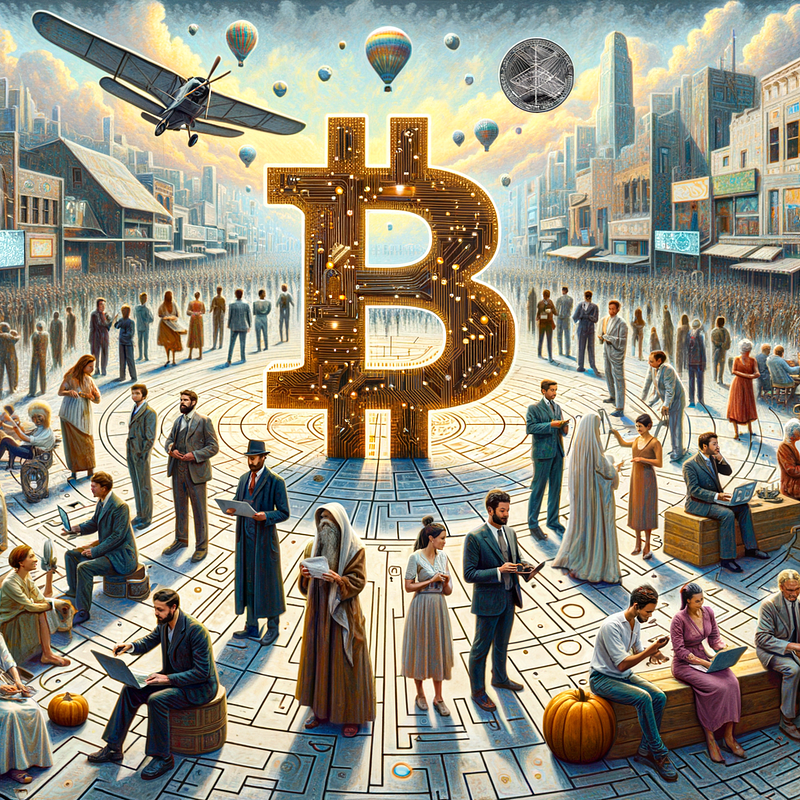
Trust, traditionally placed in centralized institutions, has found a new expression in cryptographic proof and distributed systems. This has led to a reimagining of social contracts. The phrase “Don’t trust, verify” has evolved from a crypto-anarchist slogan to a widely embraced philosophy, fostering a society that values transparency, individual verification and critical thinking over blind faith in authority.
The concept of governance has been upended. The success of decentralized decision-making in the Bitcoin network and subsequent DAOs has challenged centuries-old notions of hierarchy and central authority. Political philosophers are now exploring new models of democracy that blend direct participation with protection against the tyranny of the majority.
Time itself is viewed differently in the Bitcoin age. The blockchain’s immutable record has given us a new appreciation for the permanence of our digital actions. Simultaneously, the speed of innovation and decision-making in this new world has accelerated our collective sense of time, leading to new discussions about the nature of progress and the human experience of temporality.
The relationship between humans and technology has reached new levels of complexity. As AI and blockchain technology become more intertwined with our daily lives, the line between human and machine decision-making grows increasingly blurred. This has reignited age-old debates about free will and determinism in a digital context.
Environmental philosophy has found new expression in the Bitcoin age. The initial concerns about Bitcoin’s energy consumption have evolved into broader discussions about the value of securing a global, incorruptible network versus its environmental cost. This has led to new frameworks for considering the balance between technological progress and environmental stewardship.
The concept of work and purpose has been redefined. In a world where traditional jobs are increasingly automated and individuals can contribute to global projects from anywhere, we’re seeing a resurgence of existential questioning about the role of work in giving meaning to human life.
As I watch my daughter engage in a virtual philosophical debate about the ethics of AI governance in DAOs, I’m struck by the depth and complexity of the questions her generation grapples with. For Satoshi’s children, these aren’t abstract concepts, but lived realities that they must navigate daily.
The Bitcoin revolution has pushed us into uncharted philosophical territory. We’re questioning long-held assumptions about economics, governance, identity, and the nature of reality itself. As we stand at this frontier, we’re not just rebuilding our financial systems — we’re reimagining what it means to be human in a digital age.
This new philosophical landscape is both exciting and daunting. It offers unprecedented freedom and possibility, but also demands a level of responsibility and ethical consideration that humanity has never before faced on such a global scale.
As we look to the future, it’s clear that the true legacy of Bitcoin won’t just be measured in economic terms, but in how it has expanded our conception of what’s possible and pushed us to reconsider our place in an increasingly interconnected and digital world. Satoshi’s children aren’t just inheriting a new form of money — they’re inheriting a new worldview, a new philosophy, and the responsibility to shape the future of human thought in this brave new digital world.

I wrote this piece with the help of Anthropics Claude, don’t worry it’s more my hallucination than Claud’s It came out of a lengthy back and forth about how and ways Bitcoin could have a significant impact on our world. Regardless of your feelings about Bitcoin, RFK, or Micro Strategies, take a reality break and fly with us.
StarTrek painted a picture of Molecular Transporters, Warp-Drives and Antimatter. Followers began to ask questions that began “But how….? I hope you will do the same. Optimistic pictures of the future are not blueprints rather a vision to aspire to.
I appreciate your time and effort in reading. I will thank you for Claud; it doesn’t really care what you do.
Images generated by Imagine NaxosAI, developed by Naxos Digitals.
[1] The Price of Tomorrow — Jeff Booth and Broken Money — Lyn Alden
Originally published at http://docs.google.com.