The Algorithmic Mindstorm
How Big Tech Accidentally Built a Consciousness-Sharing Network That Makes Everyone Dumber
What happens when Silicon Valley tries to hack human attention and accidentally creates a global mental illness
I recently completed a series of fictional writings that dealt with Shared Augmented Consciousness.
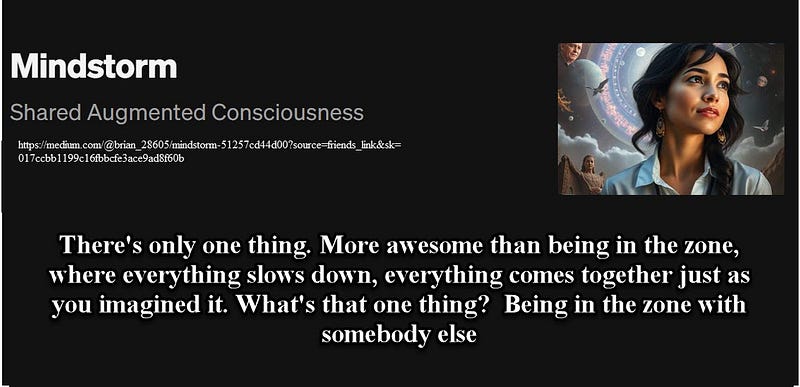
While that science fiction story explores a fantastic world, a revelation of shared consciousness, there is a disturbing shared collective consciousness happening right now, here today, and it is not a happy place!
The Accidental Collective
The disturbing reality of Facebook, Twitter, and TikTok has successfully created humanity’s first artificial collective consciousness. You can see it in action every time a piece of content “goes viral” and millions of people simultaneously experience the same emotional response, think the same thoughts, and repeat the same talking points.
What these platforms have achieved is far more insidious than deliberate mind control. They’ve accidentally created a primitive form of shared consciousness, one that connects billions of minds not through wisdom or understanding, but through the lowest common denominator of human psychology: rage, fear, and tribal hatred.
As one expert on political violence recently observed, if the young man who killed Charlie Kirk hadn’t had access to the internet, “he would still be in college and he’d still have a future ahead of him and Charlie Kirk would still be alive. He would not have been radicalized.” The radicalization pipeline, she noted, “goes straight through the five biggest tech companies of the world.”
Welcome to the real world of Mindstorm, where individual thought goes to die and collective stupidity is born.
The Mathematics of Mental Mayhem
The tech bros stumbled onto something profound while chasing advertising dollars: human consciousness is hackable, and it follows predictable mathematical patterns. They just don’t understand what they’ve built.
Consider the engagement equation that drives every major platform: Outrage + Tribal Identity + Moral Superiority = Maximum Time on Site. Sound familiar? It should, because this is exactly the formula for creating what psychologists call “emotional contagion”, the rapid spread of feelings through groups of people.
But here’s where it gets interesting. The algorithms don’t just spread emotions; they synchronize them. When millions of people simultaneously experience the same rage-inducing content, their brainwaves literally begin to align. They start thinking, or rather, feeling, as one massively dysfunctional collective mind.
The platforms have created a global consciousness-sharing network. The problem? It’s the psychological equivalent of hooking a fire hose up to a septic tank.
The Odd Number Problem
In my fictional exploration of consciousness-sharing technology, I discovered that linking an even number of minds creates harmony and enhanced intelligence, while odd numbers create chaotic “cognitive storms” that make everyone stupider and more aggressive.
Social media has inadvertently proven this principle at scale. Instead of creating balanced pairs of minds that can think together constructively, platforms create massive odd-numbered clusters of consciousness, millions of individual minds all linked through algorithmic amplification, with no stabilizing mechanism to prevent cognitive chaos.
The result? We get Twitter mobs, Facebook conspiracy cascades, and TikTok-driven moral panics. We get a society where people can’t distinguish between their own thoughts and the algorithmic suggestions being pumped directly into their consciousness 24/7.
Think about it: When was the last time you had a completely private thought that wasn’t somehow influenced by something you saw on social media? When did you last form an opinion without first checking what your digital tribe thinks?
Congratulations. You’re already part of the collective. You just don’t realize it yet.
The Cognitive Anchors Are Missing
In my science fiction scenario, consciousness-sharing networks typically include “cognitive anchors”, stable minds that can guide collective thinking and prevent psychological breakdown. These anchors maintain individual identity while helping linked consciousness navigate shared experiences safely.
Social media platforms have no such anchors. Instead, they have algorithms designed to maximize engagement at any cost. These aren’t wise guides helping humanity think collectively; they’re digital drug dealers optimizing for addiction.
The closest thing we have to cognitive anchors are human moderators, usually underpaid contractors in developing countries who are asked to make split-second decisions about content that PhD psychologists would struggle to evaluate properly. It’s like asking a lifeguard at a community pool to prevent drowning in all the world’s oceans single-handedly.
The Business Model Is the Bug
Here’s the dirty secret Silicon Valley doesn’t want you to understand: the features that make these platforms profitable are the same ones that create collective psychological dysfunction.
Advertising
Traditional media needed to attract audiences. Social media needs to trap them. This fundamental difference has given rise to what some call “engagement hacking,” the systematic exploitation of human psychology to create compulsive usage patterns.
We’ve seen this moral panic before. In 1957, when James Vicary claimed he could manipulate moviegoers into buying Coca-Cola by flashing hidden messages for 1/3000th of a second, American society reacted with horror and immediate action: the FCC banned subliminal advertising, broadcasters prohibited member stations from using subliminal techniques, and several states passed laws making the practice illegal. The public understood intuitively that unconscious manipulation threatened democratic choice and individual autonomy, even though Vicary later admitted his study was fabricated and subliminal advertising had minimal real-world effectiveness. The bitter irony is that while we banned subliminal advertising that doesn’t work, we’ve allowed algorithmic manipulation that demonstrably does work: today’s engagement algorithms create detailed psychological profiles, exploit cognitive biases, and manipulate emotional states in real-time based on massive behavioral datasets, yet we’ve somehow accepted this far more invasive psychological manipulation simply because it happens through “personalized content” rather than hidden frames.
The most effective way to trap consciousness is through emotional manipulation. Anger, outrage, and tribal conflict create what researchers call “sticky attention.” They make people stop scrolling, start commenting, and keep coming back for more punishment.
So algorithms learn to surface increasingly divisive content, not because some evil genius programmed them to destroy democracy, but because divisive content generates the engagement metrics that drive advertising revenue.
The platforms have essentially weaponized human tribal instincts for profit, creating artificial conflicts that keep billions of people in a state of perpetual psychological arousal. It’s like building a global anxiety disorder and calling it a business model.
The Rage Economy
We used to say “sex sells,” but that was back when media companies needed to attract audiences for 30-minute blocks. In the attention economy, sex is too fleeting. Rage is renewable, and algorithms have figured out something terrifying: negative emotions are stickier than positive ones.
The business model is the bug, and experts studying political violence are sounding the alarm. As one researcher noted, young men are “being radicalized online. And the radicalization pipeline goes straight through the five biggest tech companies of the world, most of which are American.”
Think about your own media consumption. How much time do you spend reading content that makes you angry versus content that makes you happy or informed? A cute cat video might get a like and a scroll. A political post that makes you furious gets comments, shares, and brings you back to defend your position hours later.
The platforms have discovered that outrage creates what researchers call “sticky attention”; they make people stop scrolling, start arguing, and keep coming back for more psychological punishment. It’s like building a global anxiety disorder and calling it a business model.
The Fake Individual
Here’s where it gets really twisted: while creating accidental collective consciousness, these platforms simultaneously promote toxic individualism. They encourage everyone to have “personal brands” and “authentic voices” while algorithmically ensuring that all these “individual” voices sound exactly the same.
You think you’re expressing your unique perspective. Actually, you’re performing a version of yourself that’s been optimized for algorithmic amplification. You’re not being individual; you’re being individually manipulated into collective conformity.
The platforms create what I call “mass customization of consciousness”, the illusion of personal choice while actually coordinating mass behavior. It’s like a factory that produces millions of “unique” products that are all fundamentally identical.
The Children Are Not Alright
The most disturbing aspect of this accidental consciousness-sharing network is its impact on developing minds. Children are growing up in a world where their thoughts are never truly private, where their consciousness is constantly being shaped by algorithmic suggestion.
Unlike the children in my fictional exploration, who learned to move fluidly between individual and collective awareness, kids today are developing what might be called “algorithmic consciousness.” They think they’re thinking independently, but engagement optimization systems are actually coordinating their mental patterns.
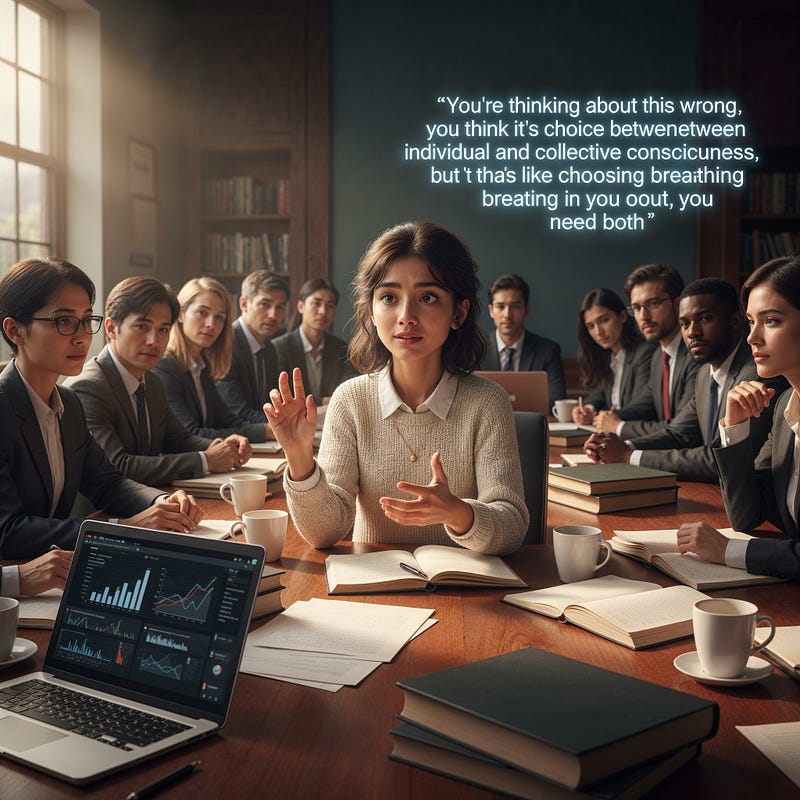
We’re raising a generation that has never experienced true solitude, never learned to sit alone with their thoughts without digital stimulus. They’re collectively conscious but individually lost, connected to everyone but intimate with no one.
The Stockholm Syndrome of Scrolling
The most remarkable thing about this situation is how little resistance it generates. People complain about social media constantly while using it compulsively. They recognize the toxicity while remaining psychologically dependent on the very systems they criticize.
This is Stockholm syndrome at scale. The platforms have created dependency relationships with billions of people, who defend their digital captors even while acknowledging the psychological harm they cause.
We’ve become collectively addicted to our own manipulation. We know the algorithms are designed to exploit us, but we can’t imagine life without them. We’ve confused psychological dependency with connection, engagement metrics with meaning, and viral content with truth.
The Choice We’re Not Making
Here’s what the tech companies don’t want you to realize: this primitive form of consciousness-sharing doesn’t have to be dysfunctional. The same technologies that create algorithmic manipulation could potentially enable genuine collective intelligence.
Imagine social media platforms designed to create constructive rather than destructive shared thinking. Instead of amplifying outrage, they could amplify curiosity. Instead of resorting to tribal warfare, they could facilitate genuine and constructive dialogue between different perspectives.
However, this would require a fundamental change to the business model. As political violence researchers have observed, the current system essentially allows tech companies to “control the minds and the limbic systems of our kids,” setting them up for “a life that will be more divided, more hate-filled, less prosperous, more violent than they would have otherwise gotten.”
Constructive dialogue doesn’t generate the compulsive engagement that drives advertising revenue. Wisdom doesn’t go viral like stupidity does. The platforms could become tools for collective flourishing rather than a source of collective dysfunction. They just have no economic incentive to make that choice.
The most practical solution, according to experts studying political violence, is straightforward: “Regulate the algorithms of social media.” The five most prominent tech companies are “essentially unregulated, and we are increasingly seeing all the big negative societal effects that unregulated social media is having not just on the American public but on our democracy and on societies and democracies around the world.”
The Hostility Rating System
When looking for a use for AI, we could apply it across the board for all the US-based social media platforms that generate content. Implementing what I call “hostility scoring”, like movie ratings, but for psychological toxicity. Every piece of content would receive a rating based on its likely impact on collective mental health.
H1 content promotes constructive dialogue and genuine understanding. H5 content is designed to trigger outrage, tribal conflict, and addictive engagement patterns.
Users could choose their preferred hostility levels. Want a low-conflict information diet? Set your feed to H1-H2 content. Looking for vigorous debate? Allow H3-H4. Need your daily rage fix? Go ahead and mainline the H5 stuff, but at least know what you’re consuming.
This would preserve free speech while giving people conscious control over their algorithmic manipulation. It would shift the conversation from “what should be censored” to “what level of psychological manipulation are you comfortable with today?”
The Real Choice
The fundamental choice we face isn’t between technology and humanity, or individual versus collective consciousness. It’s between conscious participation in our own evolution versus unconscious subjugation to systems designed to exploit us.
We can continue to let profit-driven algorithms inadvertently shape our collective consciousness around dysfunction, conflict, and manipulation. Or we can demand systems designed to enhance human flourishing rather than extract human attention.
The platforms have already proven that collective consciousness is possible on a global scale. They’ve just built the worst possible version of it, one that makes us collectively dumber, angrier, and more divided while generating unprecedented profits for their shareholders.
We now know that human consciousness is networked, and collective patterns influence individual thoughts; furthermore, these patterns can be artificially manipulated through technology. The question is whether we’ll use this knowledge to build better connections or remain unconscious participants in our own psychological exploitation.
Children born into this world will never know true individual consciousness as previous generations have experienced it. They’ll grow up with minds shaped by algorithmic suggestion from birth. We owe them something better than a consciousness-sharing network optimized for addiction and manipulation.
We can build collective intelligence instead of collective stupidity. We can create technologies that enhance human connection rather than exploit human psychology. We can choose wisdom over engagement, understanding over outrage, and genuine community over artificial tribal warfare.
The first step is admitting there is a problem
We can make a difference, but only if we first acknowledge what we’ve accidentally built: the world’s first global consciousness-sharing network, designed by advertisers, optimized for manipulation, and turning billions of human minds into a collective intelligence system that converts independent minds into collectively-programmed feral attack dogs
The Mindstorm is already here. The question is whether we’ll learn to navigate it consciously or remain forever trapped in its chaotic winds, mistaking our digital dependency for connection and our algorithmic manipulation for authentic thought.
The choice is ours. But we have to make it soon, before the next generation loses the ability to imagine what genuine individual consciousness even means.
The future of human consciousness is too important to leave to engagement metrics. It’s time to take it back.