The Chaos Is the Point
Why Bitcoin doesn’t need competent stewardship, it needs exactly what we have
I recently listened to Jeff Ross on the What Bitcoin Did podcast make the case for Bitcoin in 2026. His thesis was solid: manufacturing PMI inflection, depreciation incentives driving capex, global liquidity expansion as the Fed quietly resumes money printing under yet another euphemism (this time, “Reserve Management Operations”); they’re running out of names.
But woven through his analysis was something I couldn’t quite buy: faith in the current administration’s coherent strategic vision that they’re executing a deliberate pullback from empire. That Bessent is the CFO to Trump’s CEO in some competently managed America Inc.
I don’t see it. What I see is a broken clock that will occasionally be right.
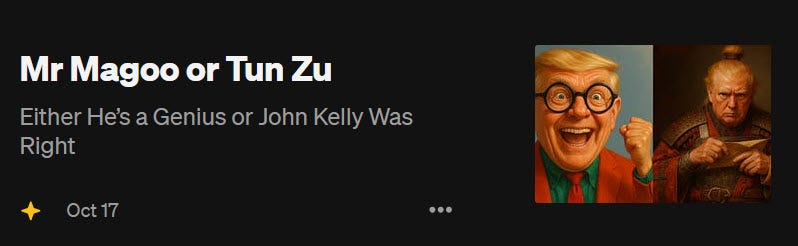
And here’s the thing: that doesn’t weaken the Bitcoin case. It strengthens it.
For years, I’ve watched smart people wait for validation. They want “serious people” to embrace Bitcoin. They want coherent policy frameworks. They want the adults in the room to give permission.
This misunderstands the thesis entirely.
If we had competent stewards capable of genuine fiscal discipline, we could fix the system. Balance the budget. Stop monetizing debt. Restore sound money principles through political will.
But we don’t have that. We haven’t had it for decades. And we’re not going to get it.
The current spectacle just makes the quiet truth louder.
Strip away the strategic attribution, and Ross’s mechanics hold up:
The US hasn’t had a free market economy for a long time. We have a centrally planned system that picks winners and losers through regulation, taxation, and targeted fiscal stimulus. The current administration hasn’t changed this; they’ve just stopped pretending otherwise.
Manufacturing has been in contraction since late 2022. Nearly three years below the 50 line on the ISM PMI, unprecedented in the post-war era. The “proof of work” economy, people actually making things, has been hollowed out while the financialized economy levitated on cheap money.
The fiscal math is inexorable. Deficits exceed two trillion. No coalition exists to cut spending. Entitlements are untouchable. The debt must be monetized because there aren’t enough buyers willing to hold it at rates the government can afford.
The outlet valve is the currency. It always has been.
QE. QE2. Operation Twist. Not QE. Reserve Management Operations.
Every few years, they rebrand the exact mechanism: the Federal Reserve creates money to buy government debt, allowing Congress to spend more than it collects in revenue. The purchasing power of your savings erodes. Wage earners and savers pay the tax that was never voted on.
Ross points out that they’ve committed to $40 billion per month through April 2026. His prediction: they’ll extend it and expand it. “Once you start QE, it’s tough to stop QE.”
He’s right. Not because of strategic vision. Because there’s no other option.
Here’s what I’ve come to understand after watching governments operate for five decades:
The Bitcoin case doesn’t require competent stewardship. It requires precisely what we have, a system that cannot stop debasing, run by people who can’t even pretend otherwise anymore.
When the magician starts explaining the trick mid-performance, the show is almost over.
Ross may be right about 2026. Manufacturing may fluctuate. The depreciation rules may trigger a surge in capex. Liquidity may flow into Bitcoin as the Fed expands its “not QE” operations.
But none of that requires believing the administration knows what it’s doing. The train is moving. The engineers are arguing about the dining car menu. The destination was set long ago. AKA: The train not stopping. Thank you, Lyn Alden, for your insights.

I stopped believing political participation could fix monetary policy sometime around my third decade of watching the same play performed by different actors.
The thesis isn’t that Bitcoin wins because the right people finally take charge. The thesis is that Bitcoin wins because no one can take charge of it. Because 21 million is 21 million regardless of who’s tweeting. Because the protocol doesn’t care about midterm elections, strategic pivots, or reserve management operations.
The chaos isn’t a bug in the Bitcoin thesis.
The chaos is the thesis.