The Cipher They Couldn’t Burn
Friday the 13th, 1307
Before dawn, the riders fanned out across France.
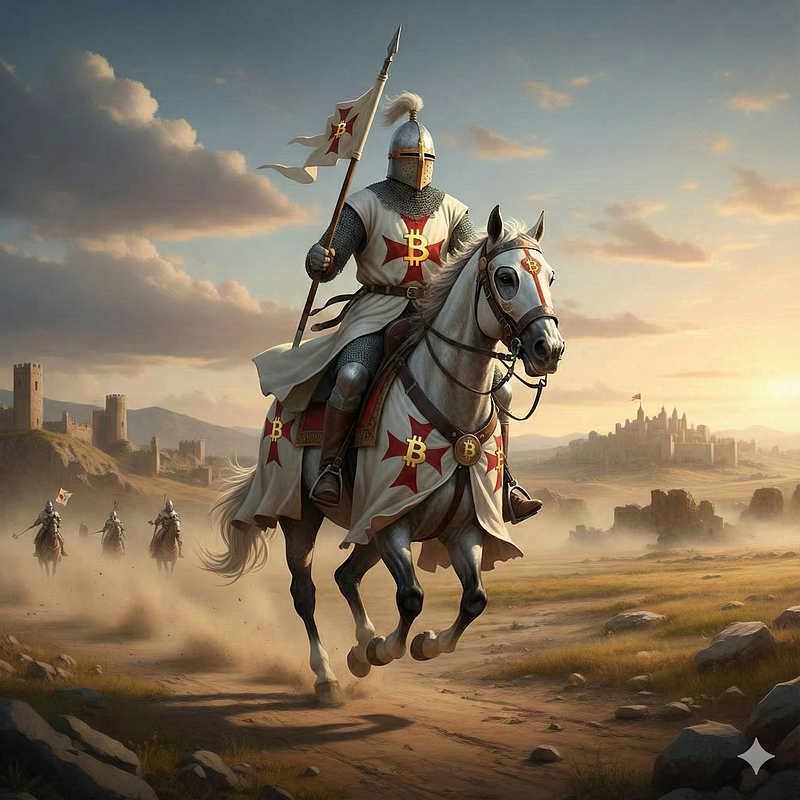
They carried sealed orders from King Philip IV-orders not to be opened until the appointed hour. At first light on Friday, October 13th, 1307, soldiers broke down doors from Paris to the Pyrenees. They dragged men from their beds, clapped them in irons, and seized everything that wasn’t nailed to the floor.
By nightfall, the Knights Templar-the most powerful financial network in medieval Europe-had ceased to exist.
The charges were heresy, blasphemy, obscene rituals. The truth was simpler: Philip was broke, and the Templars were his creditors. When you owe the bank a thousand livres, you have a problem. When you owe them the kingdom, the bank has a problem.
Philip’s solution was elegant in its brutality. Arrest the bankers. Seize the assets. Burn the Grand Master at the stake. Debts forgiven.
For seven centuries, this has been the template. When shadow money threatens sovereign power, the sovereign strikes. Find the leaders. Raid the headquarters. Burn the ledgers.
It has never worked. Not once. Not permanently.
The money always finds another way.
The Networks That Came Before
The Hawala Web
Long before the Templars built their first commandery, merchants along the Silk Road had solved a problem: how do you move value across hostile territory without moving gold?
Their answer was hawala -a network of brokers bound by nothing but reputation and code words. A trader in Damascus hands silver to a hawaladar and receives a cipher. Weeks later, a thousand miles away, his partner speaks that cipher to a stranger and receives equivalent gold. No caravan. No armed guards. No physical transfer at all.
Governments raged against it. They still do. The hawala network operates today, a thousand years later, in back rooms from Karachi to Brooklyn. It survived because there was never anything to arrest. No headquarters. No hierarchy. No ledger a king could burn.
The Templar Error
The Templars learned the hawala principle during the Crusades and saw its genius. A pilgrim could deposit funds in London and withdraw in Jerusalem-no gold crossing bandit country, no ransom opportunities for Saracens. The Templars had what the hawaladars lacked: military fortifications across two continents and the blessing of the Pope himself.
But they made a fatal miscalculation. They became visible .
They built commanderies-grand stone fortresses that announced their presence and their wealth. They appointed a Grand Master and a hierarchy that could be mapped, infiltrated, arrested. They grew so powerful that kings borrowed from them, and so proud that they forgot the first rule of shadow money: never become a target.
When Philip needed their gold, he knew exactly where to find it. When he needed to end his debts, he knew exactly whom to burn.
The Templars had built an institution. Institutions can be destroyed.
The Medici Lesson
In the ashes of the Templar era, a family of Florentine wool merchants learned a different lesson.
The Medici didn’t fight the state. They became the state.
Where the Templars had used secret ciphers to hide their operations, the Medici perfected double-entry bookkeeping-ledgers so clear and auditable that kings came to depend on them for managing their own treasuries. Where the Templars had defied papal authority, the Medici produced four popes from their own bloodline. Where the Templars accumulated power outside the system, the Medici accumulated power by making themselves indispensable to the system.
They didn’t protect themselves by hiding. They protected themselves by becoming the operating system of European finance. You couldn’t destroy the Medici without destroying yourself.
For five hundred years, this became the model. Shadow money survived not by remaining in shadows, but by capturing the institutions that cast them. The great banking families-Fugger, Rothschild, Morgan-all understood: the safest place to stand is behind the throne, whispering in the king’s ear.
Central banks are the final evolution of this insight. The shadow merged with the sovereign. The cipher-keepers became the state itself.
The Return of the Cipher
And then, in 2009, something unprecedented appeared.
A network with no headquarters to raid. No Grand Master to arrest. No ledger that existed on parchment or in any single location. A cipher that required no cipher-keeper.
The Templars had been destroyed because they were an institution . This new thing was not an institution. It was a protocol -a set of rules that existed everywhere and nowhere, maintained by thousands of computers scattered across the globe, owned by no one, controlled by no one.
For the first time in history, shadow money didn’t need to hide from the state or merge with it. It could be radically transparent -every transaction visible forever-while remaining utterly uncapturable. The ledger was public. The operators were anonymous. The rules were mathematics, not policy.
A king could outlaw it. A king could not un-invent it. A king could arrest anyone he caught using it. A king could not arrest the protocol itself.
The hawala network had survived by remaining invisible. The Medici had survived by becoming indispensable. This new network offered a third option: be visible and unstoppable at the same time.
The Curse of de Molay
There is a legend about Jacques de Molay, the last Grand Master of the Templars.
As the flames rose around him on that March day in 1314, he called out a curse. He summoned King Philip and Pope Clement to meet him before God’s tribunal within the year, to answer for what they had done.
Pope Clement died thirty-three days later. King Philip died within eight months.
We may doubt the supernatural. But the underlying truth of the legend is unassailable: destroying the network did not solve the problem the network had addressed.
Philip’s debts did not burn with de Molay. The structural weakness of the French crown remained. Within a generation, France was consumed by the catastrophe of the Hundred Years’ War-a conflict fueled, in part, by the fiscal chaos Philip’s desperate measures had created.
He had eliminated the creditors. He had not eliminated the debt.
Questions for a Burning World
Today, sovereigns face a familiar problem.
The debts are larger than any Templar treasury could satisfy. The unfunded promises-pensions, entitlements, obligations stretching decades into the future-are mathematically impossible to honor. The currency is debased not by shaving coins but by conjuring digits, trillions upon trillions, each one diluting the last.
And once again, a shadow network operates beyond their reach. Once again, value moves through ciphers that they cannot crack. Once again, desperate councils convene to discuss what must be done.
They can regulate the on-ramps-but Prohibition taught us what happens when you ban what people want. They can threaten the institutions that touch it, but the protocol does not require institutions. They can denounce it, restrict it, wage informational war against it.
They cannot arrest it. There is no Grand Master. There are no commanderies. There is no parchment to burn.
So we are left with questions:
If a network cannot be destroyed, can it be co-opted? The Medici strategy-embrace what you cannot defeat, merge with it until you control it. But what happens when the network has no leadership to corrupt, no hierarchy to infiltrate, no ambition to be whispered to? Can you co-opt mathematics?
If fiat fails, what emerges from the ashes? Every previous monetary collapse produced a new arrangement of trusted intermediaries -new bankers, new central authorities, new keepers of the ledger. But what if the next system requires no trust at all? What if the cipher finally doesn’t need a cipher-keeper?
What is the curse of de Molay in our age? When the smoke clears from whatever desperate measures the sovereigns attempt, will the debts have burned with them? Or will the debts remain-inescapable now, because the exit has been forbidden?
Philip IV destroyed the most powerful financial network of his era. Within a generation, the Medici were more powerful than the Templars had ever been. The throne’s victory was its own undoing.
Seven hundred years later, another Friday the 13th approaches-not a date on a calendar, but a decision point in history.
The riders are saddling their ATVs.
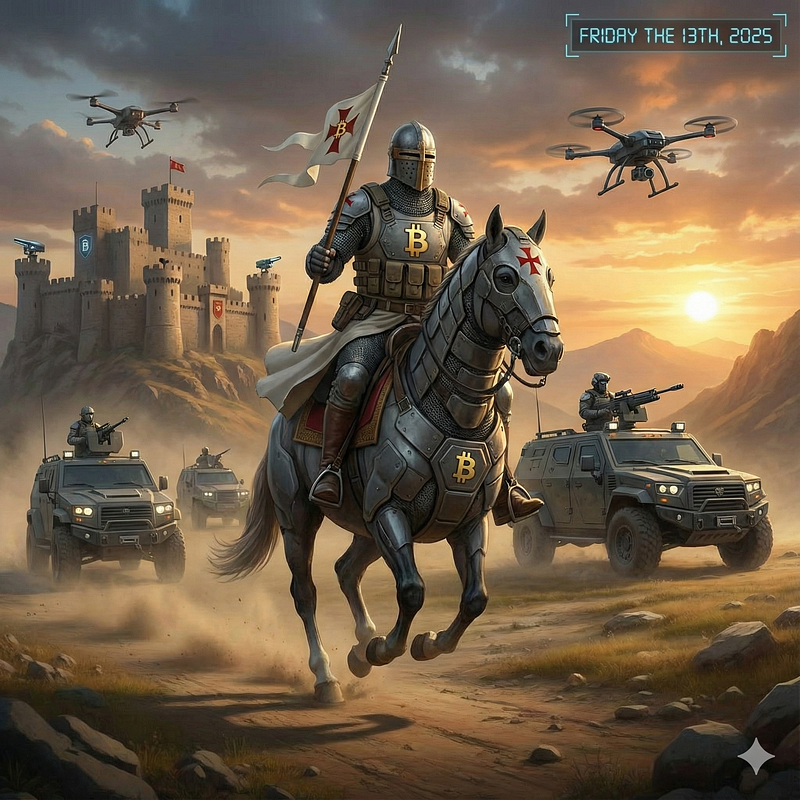
The question, is there anyone left to arrest?