The Great Monetary Shuffle
Dalio’s Perfect Storm Meets America’s Bitcoin Gambit
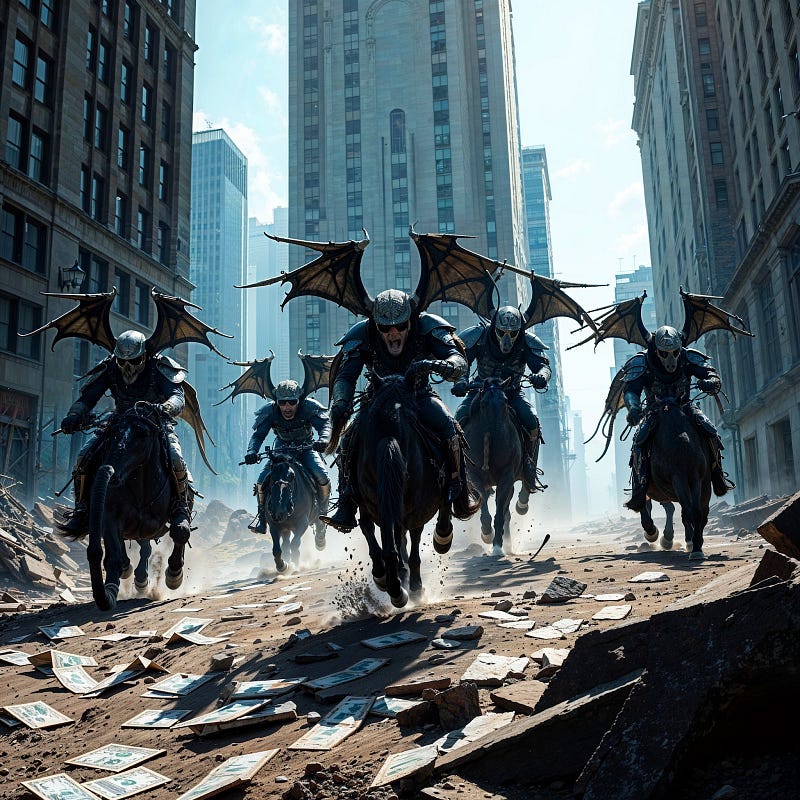
Ray Dalio’s Five Horsemen of the Economic Apocalypse
Ray Dalio, billionaire, hedge fund philosopher-king, and the man who never met a historical cycle he couldn’t chart, believes we’re staring down something “much more profound than a recession.” How refreshing! Just when you thought the Trump tariff nightmare might be the worst of your worries.
According to Dalio, we’re witnessing the convergence of five cyclical forces that have historically rearranged the global chessboard:
- The Debt Party’s Hangover: A debt cycle reaching its inevitable breaking point, with government IOUs piling up like empties after a frat party.
- Political Polarization: Left versus right, locked in a cage match that’s reshaping our political order. Nothing says “functional democracy” like treating the opposition as a mortal enemy.
- Global Power Shifts: The established superpower (that would be America, for those not keeping score) is facing challengers in a world increasingly fractured into competing blocs. Multilateralism is so last century.
- Acts of Nature: Pandemics, climate disasters, and other inconvenient reminders that humans aren’t actually in charge.
- Technological Disruption: Innovation moving at warp speed, reshaping societies faster than institutions can adapt.
At the heart of this five-ring circus? The breakdown of the monetary order, a polite way of saying our financial system is held together with duct tape and optimistic spreadsheets.
Enter America’s Bitcoin Gambit
While Dalio warns of collapse, Team Bessett appears to be drafting a playbook straight from “Monetary Chaos: The Opportunist’s Guide.”
Bo Hines, Executive Director of the President’s Council of Advisers on Digital Assets (yes, that’s a real title now), has been cheerfully announcing plans to make America “the Bitcoin superpower of the world.” The administration’s shopping list? “As much [Bitcoin] as we can accumulate.” Nothing says subtle like broadcasting your hoarding intentions to the entire planet.
One particularly delicious strategy involves the gold certificate revaluation scheme. Currently, the Treasury values its gold at the laughably outdated price of $43 per ounce. By marking this to market ($3,100+ per ounce), the U.S. could manufacture a massive accounting gain out of thin air.
The Ultimate Rug Pull
Not part of the US official plan (assuming there is one), imagine combining these elements into what could be the greatest financial judo move in history. If you’re having trouble, Michael Saylor, the financial engineering wizard of our time, can help. He articulated an evil plan for world domination.
- The U.S. revalues its gold certificates, dramatically boosting gold’s profile on the global stage.
- China, ever suspicious of the dollar and eager for hard assets, accelerates its gold buying program, paying premium prices to build its reserves.
- Meanwhile, America abruptly sells gold and acquires Bitcoin, the more complex, scarcer, more portable, more divisible, and more censorship-resistant cousin of gold, devaluing gold.
- Once positioned, the U.S. executes the rug pull, dumping gold onto the market while Bitcoin ascends to prominence in the new monetary order.
China is left holding mountains of shiny metal while America corners the market on digital gold. As a bonus, Bitcoin’s inherent resistance to surveillance and control creates an existential challenge to China’s authoritarian model.
The Debt Endgame
As for that pesky $34 trillion national debt? There’s nothing like a controlled demolition of the old system to clear the books. Whether through inflationary devaluation or a more dramatic restructuring, America’s Bitcoin position would provide a convenient safety net while the dollar undergoes its transition.
More Likely A Bridge to the New Order

While our analysis has focused on the more dramatic “gold revaluation to Bitcoin” strategy, there’s a more nuanced scenario that may play out first: the relief rally.
As James Thorne suggests, we may see a short-term deal between the U.S. and China, “putting lipstick on a pig” that doesn’t solve structural issues but provides temporary market stability. This relief rally would likely feature:
- Gold continuing its ascent (though perhaps not immediately to the $7,000–12,000 range that would fully collateralize foreign debt)
- The dollar declining to the 70s on the DXY index, creating what Luke Gorman calls a “tidal wave of liquidity”
- Negative real interest rates (with inflation exceeding nominal rates) to gradually erode the debt burden
- Bitcoin positioning as part of a new monetary structure alongside gold and stablecoins
This interim period would give institutional investors and financial systems time to adapt to the profound changes underway. The Federal Reserve would likely cut rates aggressively, creating the liquidity conditions for risk assets to rally despite the underlying structural challenges.
In this scenario, the dramatic gold/Bitcoin strategy still looms on the horizon, but implementation would be more gradual and telegraphed, allowing for adaptation rather than shock. Think less “rug pull” and more “slow repositioning of the furniture while everyone’s watching.”
Conclusion
Is this economic 4D chess or reckless gambling with the global financial system? Perhaps both. But in Dalio’s world of converging cycles, conventional playbooks are already burning. If the monetary order is truly breaking down, then perhaps the most rational strategy is to position yourself advantageously for whatever comes next.
One thing’s certain: if America pulls off this monetary sleight-of-hand, either through shock therapy or gradual evolution, future economics textbooks will need a new chapter, And who knows, those textbooks might not even be priced in dollars anymore, but in satoshis the ultimate sign that the monetary revolution was complete.