THE GREAT UNRAVELING
A Speculative Fiction
It started, as these things often do, on a Tuesday.
The US Treasury had scheduled a routine bond auction — $50 billion in 10-year notes. Nothing unusual. They’d done it hundreds of times. Except this time, at 1:00 PM Eastern, something unprecedented happened.
Nobody showed up.
Well, not nobody . But the bids came in at yields so absurdly high — 12%, 15%, eventually 18% — that the Treasury canceled the auction rather than accept. In the trading pits, there was a moment of confused silence. Then someone said what everyone was thinking:
“Wait, does this mean the US government just… bounced a check?”
The Fed tried emergency measures. They announced unlimited bond purchases — freshly printed money to buy the Treasury debt nobody else wanted. The problem was that everyone had learned to read between the lines. “Unlimited bond purchases” was just a fancy way of saying “we’re printing money to pay ourselves because nobody trusts us anymore.”
The dollar dropped 8% in an hour.
By Wednesday morning, it was in free fall. Gas stations shut down because the credit card processors couldn’t figure out what prices to charge — the dollar was moving too fast. Grocery stores tried implementing “dynamic pricing” but gave up when a gallon of milk cost $12 at 9 AM and $17 by noon.
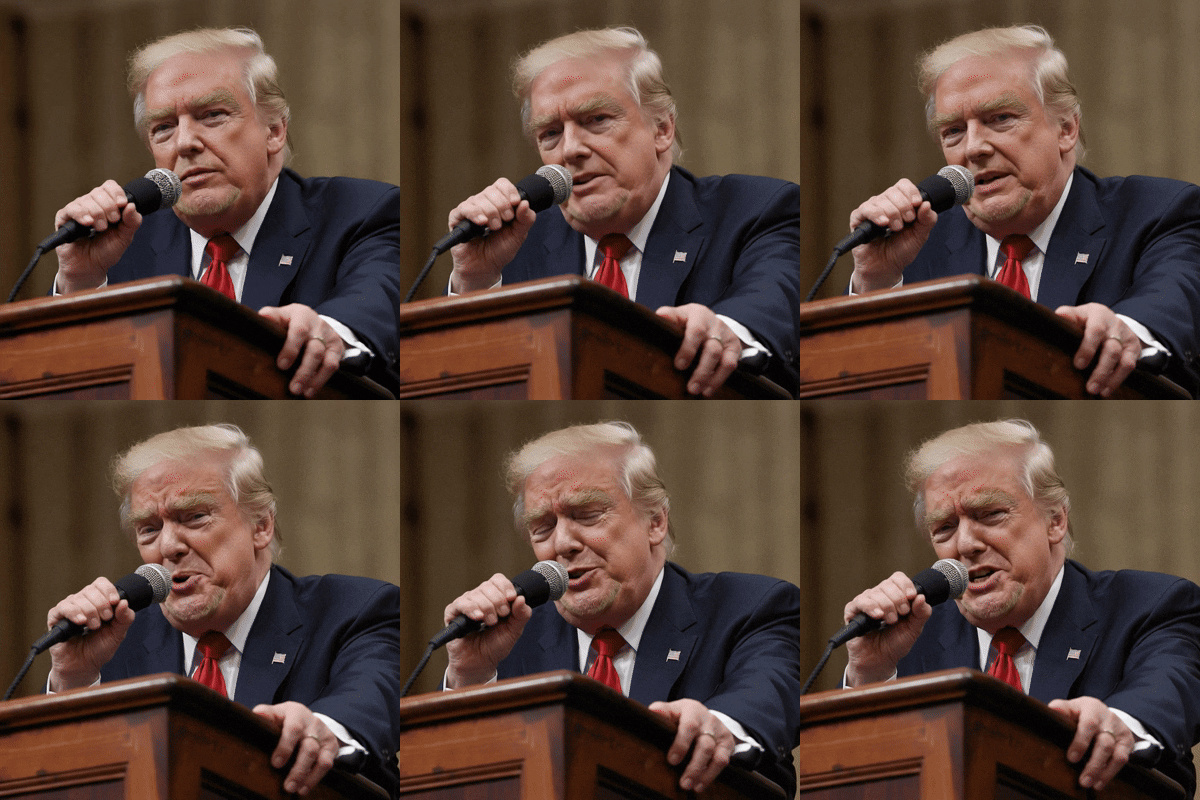
Donald Trump went on television Thursday evening to assure everyone that the situation was “under control” and that the “full faith and credit of the United States” remained sound. He looked like he’d aged five years in three days, not a good look for a man who was not wearing his age well. Markets interpreted his speech as confirmation that things were indeed spiraling completely out of control.
They were right.
THE WEEK THE MONEY DIED
The Federal Reserve announced an emergency Saturday session. They’d done this before during crises — 2008, 2020. Usually, some combination of rate cuts, liquidity injections, and stern reassurances would calm things down.
This time was different. The problem wasn’t a lack of liquidity. Nobody wanted dollars at any price. The Fed could print trillions more, but what good was that when the whole world had decided the paper itself was toxic?
Central banks in Japan, Europe, and China attempted to coordinate, issuing a joint statement that affirmed confidence in the dollar and pledged to maintain their reserves. It was like watching people rearrange deck chairs while the Titanic’s stern lifted out of the water. Within hours, all three countries quietly began dumping Treasury holdings anyway. Nobody wanted to be last.
By Monday, regular people were making runs on banks — not because they couldn’t get cash, but because they didn’t want cash. They wanted literally anything else. Supermarket shelves emptied as people converted worthless money into goods with actual value. It wasn’t hoarding; it was basic mathematics. Why hold dollars that would be worth half as much tomorrow?
The government announced capital controls. You couldn’t withdraw more than $200 from ATMs. Wire transfers were suspended. They closed the stock market “temporarily.” It was the financial equivalent of putting your fingers in your ears and shouting, “LA LA LA I CAN’T HEAR YOU.”
THE THINGS GOVERNMENTS DO
The emergency legislation was passed on a Thursday, two weeks into the crisis. The “Monetary Stability and Recovery Act” — someone in PR had worked overtime on that name.
The framework was simple: Return to a gold-backed currency. The Treasury would revalue its gold reserves at $50,000 per ounce (conveniently making their 8,000 tons worth enough to matter), issue new certificates, and Americans would exchange their old dollars for “New American Dollars” backed by actual metal.
The Chairman of the Fed delivered a somber address emphasizing the importance of “learning from past mistakes” and “restoring sound money principles.” It was almost moving, if you could forget that he’d spent the last decade explaining why gold standards were barbaric relics.
There was just one problem: Nobody believed them.
The government had broken every promise it ever made about money. The gold standard of the 1800s? Abandoned. Bretton Woods? Abandoned. “We’ll never exceed 2% inflation”? The punchline to a joke. Now they wanted everyone to trust that this time, they’d really, truly, pinky-swear follow the rules?
“Fool me once,” people muttered.
And then there was the other issue…
THE TEXAN AND THE BITCOIN
Her name was Maria Gonzalez, and she owned a taco truck in Austin.

When the government announced its new gold-backed currency, she shrugged and continued to accept Bitcoin.
She’d started taking it in 2023 when a customer offered. Why not? It was money; it settled instantly, no chargebacks like credit cards, and nobody could freeze her account. When the dollar collapsed, Bitcoin became not just convenient but necessary — the only thing that held value.
The federal government declared Bitcoin illegal under the new monetary law. Using it for transactions could result in fines, asset seizure, or even jail time. Maria Gonzalez, along with about 80 million other Americans, had a simple response:
“Come and take it.”
See, the government had a problem. They could say Bitcoin was illegal. They could write all the laws they wanted. But enforcing those laws required:
- Finding the transactions (good luck — peer to peer, encrypted)
- Identifying the parties (not easy when transactions look like random strings)
- Making arrests (sure, send armed agents to every town in America)
- Prosecuting millions of people (with what court system?)
- Doing all of this while the agents weren’t getting paid in money that anyone trusted
Oh, and one more thing: Unlike every other country where governments tried this, Americans had 400 million firearms and a cultural memory of telling King George where he could shove his taxes.
The first few attempts at enforcement went poorly. A team of federal agents showed up at a farmers’ market in Montana to arrest people for using Bitcoin. The farmers politely but firmly suggested that the agents leave. When the agents insisted on making arrests, approximately 40 armed citizens materialized from the surrounding area.
The agents left.
Similar scenes played out in Wyoming, Texas, New Hampshire, and eventually most places outside Washington, D.C. The government could control the capital and a few major cities. But controlling 330 million people spread across 3.8 million square miles when you couldn’t even pay your enforcers in real money?
That was math even bureaucrats could understand.
THE CASCADE
By autumn, a remarkable thing happened: America’s economy began to recover.
Not the official economy. That was still a disaster — unemployment at 30%, banks shuttered, stocks worth nothing. However, the real economy — people making things, buying things, and trading them — commerce came back to life.
They just did it in Bitcoin.
Coffee shops accepted it. Landlords requested it. Employers paid in it. Sure, it was technically illegal, but “illegal” is a meaningless word when enforcement is impossible. The government’s new gold-backed dollars? Those were for paying taxes (if the government could collect them) and not much else.
Then something interesting happened in international trade.
A German automaker wanted to sell cars in America. The US government stated that payment must be made in New American Dollars. The American dealers said, “We don’t have those; nobody uses those, we have Bitcoin.”
Germany had a choice: Accept Bitcoin or lose the American market. They accepted Bitcoin.
Same story with Japanese electronics. Korean semiconductors. Chinese manufacturers. Everyone wanted access to American consumers, and American consumers were using Bitcoin.
Within months, trading partners worldwide were accumulating Bitcoin not because they loved it, but because they needed it for commerce. And once they had it, their own citizens started asking: “Why are we using this paper money that keeps losing value when we could use this digital money that works better?”
Governments tried to stop it. China threatened
execution for Bitcoin use. Didn’t matter — people used it anyway, just more quietly. Europe imposed capital controls. People routed around them. Russia banned it entirely, then quietly started using it for oil sales because nobody trusted rubles.
The thing about bottom-up adoption is that it’s like water — it finds every crack, flows around every obstacle. You’d need perfect enforcement everywhere simultaneously. Nobody had that.
THE NEW ORDER (Such As It Was)
Five years after the collapse, central banks still had buildings, staff, and official titles. But their actual function had been reduced to something rather mundane: they were gold warehouses.
Literally, that’s it.
Countries still held gold reserves — partly out of tradition, partly as a hedge that nobody wanted to abandon entirely. The Federal Reserve had its vaults. The Bank of England had its vaults. They weighed bars, issued certificates of holdings, and published quarterly reports.
But trade? Settlement? The actual flow of global commerce? That occurred on the Bitcoin network, happening thousands of times per second.
Here’s why the difference mattered: Imagine Germany owes Japan $5 billion for electronics imports.
In the old world of gold settlement, you’d start by scheduling an armored transport — which meant coordinating security across international jurisdictions, arranging insurance, and booking space months in advance. Then came weeks of transit time as physical gold bars made their way across oceans and continents, vulnerable to theft, damage, or “accidental” rerouting. Once the gold finally arrived, receiving parties had to assay every single bar to verify it was actually gold and not tungsten cleverly wrapped in gold plating. Only after all that could you store it in vaults, which meant paying for security, insurance, and guards with guns. The entire process took three to six weeks and incurred millions in logistics costs.
Compare that to Bitcoin settlement: You sent the transaction. You waited ten minutes for network confirmation. You were done. The total cost was about fifty dollars in network fees.
The volume difference was staggering. The Bitcoin network settled more value in a single day than all central bank gold transfers combined settled in a year. It wasn’t even close.
A Japanese economist wrote a viral essay in 2028 called “The Museum Curators of Money.” Her thesis was simple: Central banks had become to finance what the Smithsonian was to natural history — places where you could see how things used to work, preserved carefully under glass, labeled with little placards.
“The Federal Reserve holds 8,000 tons of gold,” she wrote, “and processes about $2 billion in gold-backed settlements per month. The Bitcoin network processes $4 trillion per day. One is a museum exhibit. The other is the circulatory system of global commerce.”
THE ACTUAL SETTLEMENT LAYER
Walk into any port in Singapore, Rotterdam, or Los Angeles in 2030, and you’d see it clearly:
A shipment of Chinese electronics arrives in California. The American importer’s Bitcoin wallet automatically releases payment upon verification of the shipping manifest smart contract. The Chinese exporter receives Bitcoin 10 minutes later. No banks, no SWIFT codes, no correspondent banking, no 3-day settlement windows, no currency conversion, no fees beyond the mining cost.
The same day, an American grain exporter ships soybeans to Egypt. Payment happens before the ship leaves port — Bitcoin from Egyptian importer to American farmer, verified on the blockchain, irreversible, done.
By the end of that day, trillions in global trade had settled. Not a single central bank was involved in any of it.
WHAT THE WAREHOUSES ACTUALLY DID
The remaining role for institutions like the Fed was almost comically limited. They maintained gold vaults for countries still holding legacy reserves, essentially serving as security guards for inert metal. They issued authenticity certificates confirming that, indeed, this was genuine gold, not lead painted to resemble it. Occasionally, they facilitated large gold transfers between nations. However, this happened ten times per year globally, and each time required weeks of planning, whereas Bitcoin could do it in minutes. Mostly, they published statistics about gold reserves that fewer and fewer people bothered to read, and employed security guards to watch metal bars that never moved.
The Bank of England literally installed a museum wing where tourists could view the gold vaults. It was their primary source of revenue by 2032.
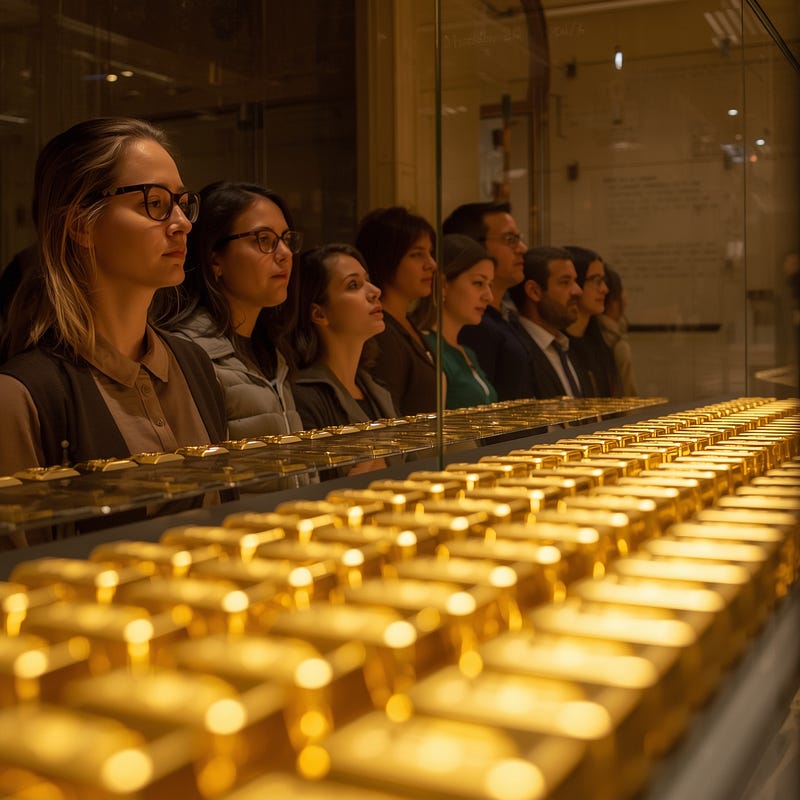
The Fed tried to stay relevant by publishing research papers about “optimal Bitcoin transaction fee markets” and “blockchain settlement efficiency.” It was like watching the horse-and-buggy association publish studies about internal combustion engines.
THE VOLUME TOLD THE STORY
By 2033, the numbers were undeniable. Daily Bitcoin settlement volume had reached $6 trillion. The annual central bank gold settlement limped along at $800 billion. Bitcoin was handling nearly three thousand times the volume, and that wasn’t even accounting for the speed difference — Bitcoin settled in minutes while gold took weeks.
And that Bitcoin number represented actual settlement — final, irreversible, complete. Not promises, not IOUs, not “we’ll settle in three days,” but cryptographic proof that value had moved from one party to another, verified by thousands of independent nodes, recorded immutably on a distributed ledger that no single entity controlled.
Gold still existed. Countries still held it. But calling those vaults “central banks” was like calling your garage a train station because you parked a vintage locomotive in there.

The actual monetary system — the living, breathing, functioning circulatory system of global commerce — ran on math, operated twenty-four hours a day every single day of the year, required no permission from any authority, and settled faster than you could order a pizza.
Central banks had become custodians of a museum piece. At the same time, the real economy happened at the speed of light on fiber optic cables, secured by cryptography, validated by distributed nodes, and accessible to anyone with an internet connection.
THE REAL IRONY
The chairman of the Federal Reserve gave his final press conference in 2034 before the institution formally dissolved. A reporter asked: “Do you regret the end of central banking?”
He paused, then smiled wearily. “We spent a century trying to stabilize money by giving smart people discretionary control. Turns out the only thing more stable than smart people making decisions is math that removes the decision entirely. We weren’t replaced by a better central bank. We were replaced by the absence of needing one.”
The next day, the Fed building was officially transferred to the Smithsonian.
The gold stayed in the basement, guarded and catalogued, a relic of an era when money required institutional trust instead of mathematical proof.
Above ground, billions of transactions happened per day, settling in minutes, costing pennies, requiring no permission, and involving no central authority whatsoever.
That was the new financial order: distributed, permissionless, and utterly indifferent to what any government thought about it.
EPILOGUE: THE MUSEUM
In 2035, they opened a museum in Washington D.C. called “The Federal Reserve: A History.”
You could walk through exhibits showing printing presses, old dollar bills, charts of M2 money supply. There was a interactive display where you could pretend to be a central banker, setting interest rates and watching the economy react. Kids loved it.
In the final room, there was a simple plaque:
“From 1913 to 2025, the Federal Reserve managed America’s money supply. The experiment ended when people decided mathematical certainty was preferable to institutional trust. Whether this was progress or regression remains debated.”
An old man stood reading it, remembering the chaos of the collapse, the fear, the uncertainty. His grandson tugged his sleeve.
“Grandpa, what’s a central bank?”
The old man smiled. “Something we used to need, back when we trusted governments more than math.”
They walked out into the sunlight, where the city hummed with commerce, trade, and life — all of it running on a system no single person controlled, no institution could manipulate, and no government could stop.
It wasn’t perfect. But then again, nothing ever is.
THE END
(Or perhaps, the beginning.)