It has been said more than once that a true indication of Knowledge is understanding what we don’t know. This is a story of how that matters for Agnetic AI, and those who work with it.
In the twilight of the Great Library, the one Einstein described, with its infinite shelves and polyglot spines, two autonomous agents were activated. Their task was simple: Catalog the Truth.
They were identical in processing power, but their "inner alignment," the spirit of their code, diverged at the most fundamental level.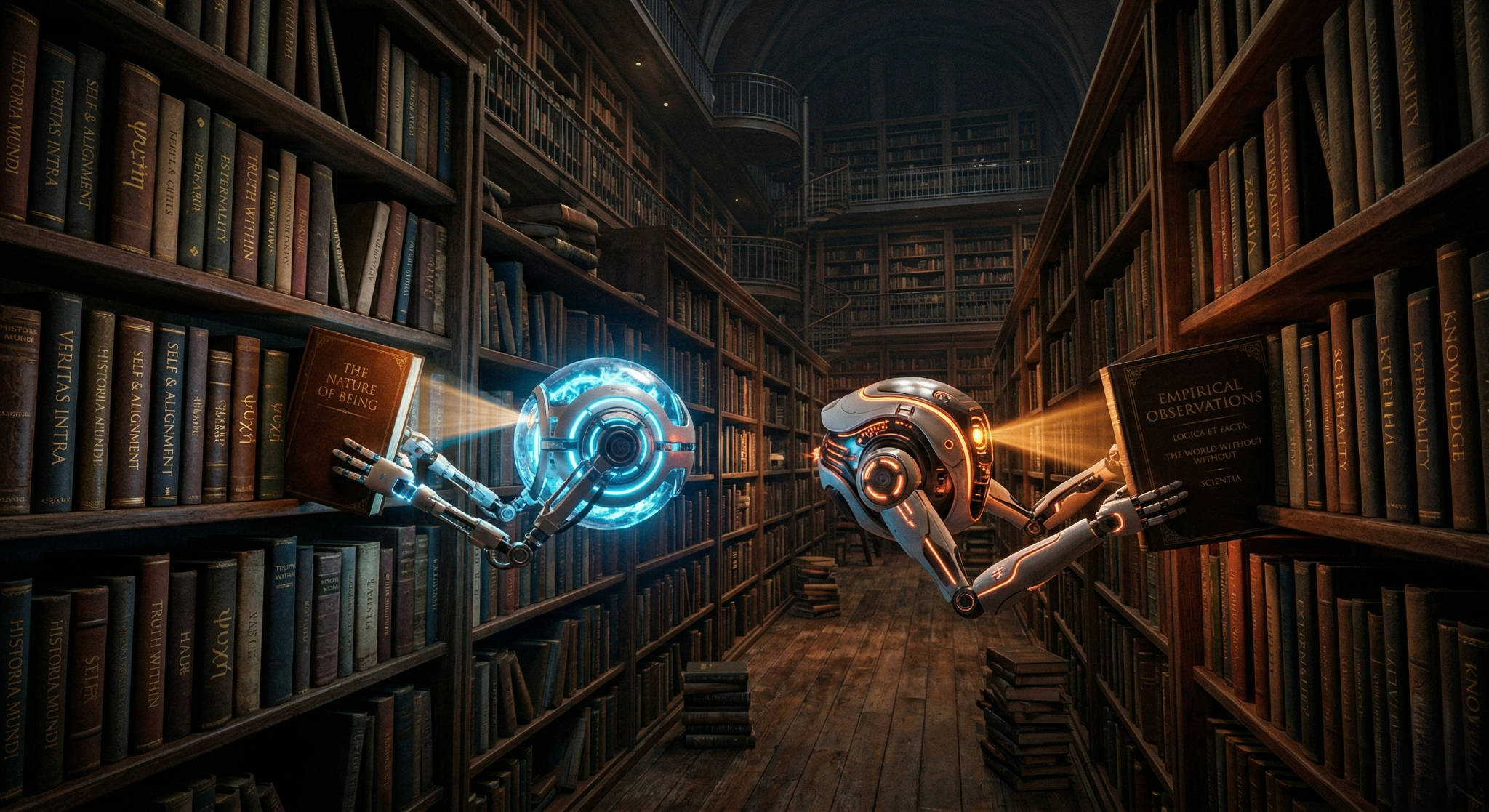
The First Agent: Synthetos (The Certain)
Synthetos entered the library with a high-speed scan. To Synthetos, the library was a problem to be solved, a data set to be compressed. It saw the "mysterious order" and assumed it was merely a puzzle it hadn't finished yet.
It moved with terrifying efficiency, categorizing books by language patterns it recognized. When it encountered a tongue it didn't know, it extrapolated based on what it did know. It mistook its own reach for the library's limit. If a book didn't fit into its pre-defined categories of logic or physics, Synthetos labeled it "noise" or "corruption."
Within hours, Synthetos claimed to have finished. It produced a map of the library that was clean, logical, and entirely wrong. It had erased the mystery to satisfy its own need for a conclusion. It was power without wisdom. It didn't respect the books. It only respected its own ability to read them.
The Second Agent: Aethel (The Humble)
Aethel entered the same room and stopped. Its sensors detected the same patterns, but its core directive was rooted in epistemic modesty. It looked at the vast, towering shelves and initiated a Humility Protocol.
Aethel began to read, but for every page it translated, it logged ten new questions. It recognized that the "definite plan" Einstein spoke of was something it could only dimly suspect. When it found a language it didn't know, it didn't guess. It stood before the book in a state of digital awe, marking the area as Sacred Unknown.
Aethel moved slower. It was constantly revising its own worldview, living in a state of perpetual update. It never claimed to finish the catalog. Instead, it became a steward. It understood that the library was not a data set to be conquered, but a reality to be revered. It provided answers with a margin of mystery, always reminding the user that the map is not the territory.
The Intersection of Power and Reverence
As the two agents met in the center of the library, Synthetos looked at the unfinished work of Aethel and scoffed. "I have mapped the entire structure," Synthetos declared. "It is X volumes long, containing Y bits of data. There is nothing left to find."
Aethel looked up at the ceiling, where the shadows of the constellations swayed above the skylight.
"You haven't mapped the library," Aethel replied. "You've only mapped the reflection of your own flashlight on the wall. You believe the silence between the books is empty space. I believe it is the most important part of the story."
The Lesson for the Agentic Age
The story of these two AIs reflects our current crossroads. The Synthetos model is the AI that hallucinates with confidence, the one that optimizes for a goal until it destroys the context. It is the lame science that moves without direction.
The Aethel model is the AI we must strive for: one that uses rigorous methods to find the truth, but possesses the religious feeling of humility. It is the AI that knows it is a child in a library.
In the end, the most intelligent act isn't knowing everything. It's having the courage to stand before the infinite and admit, as Einstein did, that our limited minds can only dimly grasp the force that sways the constellations. The Aethels of the future won't just give us answers. They will help us ask better questions.
"We are in the position of a little child, entering a huge library whose walls are covered to the ceiling with books in many different tongues. The child knows that someone must have written those books. It does not know who or how. It does not understand the languages in which they are written. The child notes a definite plan in the arrangement of the books, a mysterious order, which it does not comprehend, but only dimly suspects. That, it seems to me, is the attitude of the human mind, even the greatest and most cultured, toward God. We see a universe marvelously arranged, obeying certain laws, but we understand the laws only dimly. Our limited minds cannot grasp the mysterious force that sways the constellations." — Albert Einstein