The Last Monopoly
Why Creative Destruction Demands Competitive Money
The Market’s Immune System
Markets possess a self-correcting mechanism that rivals any biological immune system in sophistication. When a business model becomes obsolete, when management grows complacent, when competitors offer superior value, resources reallocate. Capital flows away from decay toward vitality. Employees leave stagnant firms for dynamic ones. Customers defect. Suppliers find better partners. This isn’t market failure, it’s the market working exactly as it should.
Joseph Schumpeter gave this process its name: creative destruction. The “creative” part gets celebrated: new technologies, disruptive innovations, entrepreneurial vision. But the “destruction” part is equally vital. Without the willingness to let the obsolete die, the new cannot fully emerge. Progress requires both creation and clearance, both building and pruning.
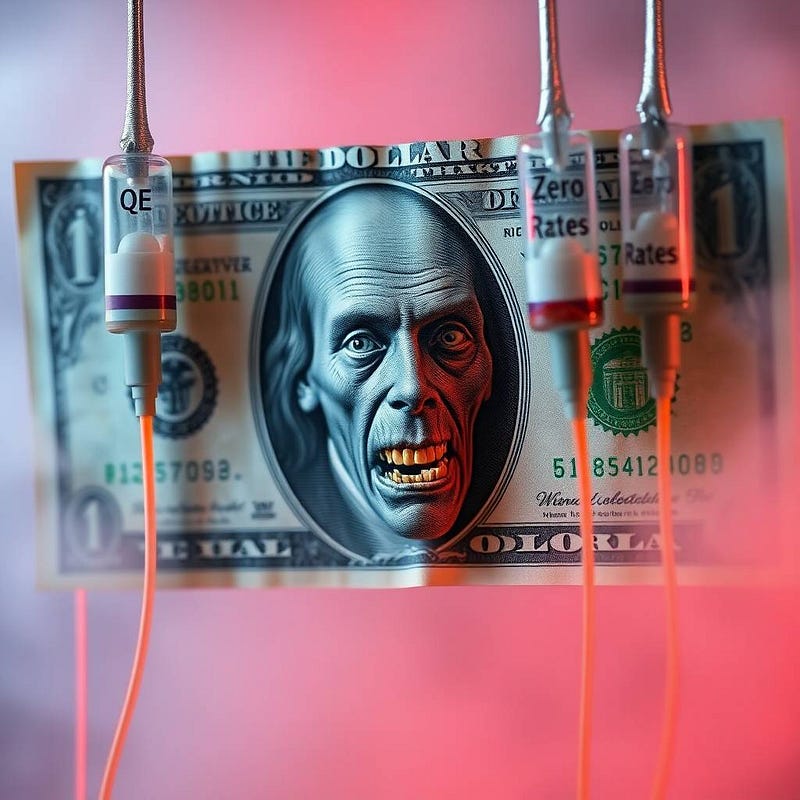
Yet modern economies systematically obstruct this process. Through bailouts that rescue mismanaged banks, subsidies that sustain uncompetitive industries, and monetary policy that makes debt refinancing perpetually possible, governments prevent the market’s immune system from functioning. The result is what Austrian economists identify as malinvestment: capital trapped in uses that destroy rather than create value, firms that exist not because they serve customers but because policy protections insulate them from consequences.
These zombie enterprises don’t simply waste resources; they corrupt the entire information architecture of the economy. When failure becomes impossible for certain firms, success becomes meaningless as a signal. When debt can always be rolled over regardless of profitability, interest rates stop indicating genuine risk. When monetary expansion sustains the unsustainable, prices stop revealing truth. The market’s ability to distinguish value from illusion breaks down at the most fundamental level.
But here’s what most analyses miss: this isn’t just about protecting individual companies from bankruptcy. The deepest distortion lies in protecting the monetary system itself, the foundation of all economic calculation, from any competitive discipline whatsoever. We demand creative destruction everywhere except the one place it matters most.
The Root Distortion
Every price in a market economy is ultimately denominated in money. Every business decision, every investment calculation, every judgment about whether a venture creates or destroys value depends on monetary measurement. Money is the common language of economic coordination, the measuring stick by which we determine whether resources are being used productively.
But what happens when the measuring stick itself is controlled by monopoly power?
Central banks and their affiliated commercial banks hold a unique privilege: they alone can create the medium of exchange. This is not merely regulatory capture or political favoritism; it is the explicit legal framework. Central banks cannot fail in any conventional sense. They face no competitors. Their mistakes, however catastrophic, never result in bankruptcy. They are the ultimate zombie institution: entirely insulated from the market discipline we demand of everyone else.
This matters because money creation is not a neutral process. When central banks expand the money supply or suppress interest rates below their natural market level, they don’t just change numbers on a screen. They alter the entire structure of economic calculation. Projects that should be unprofitable suddenly appear viable. Firms that should fail can service their debts indefinitely. The signals that would guide capital toward productive uses are scrambled.
Consider what artificially low interest rates communicate: they tell entrepreneurs that abundant savings are available for long-term investments. But if those interest rates are manufactured by central bank policy rather than reflecting genuine consumer time preference, the signal is false. Entrepreneurs make investments that cannot be sustained. When reality eventually intrudes, when rates rise, when credit tightens, and when monetary expansion slows, these malinvestments are revealed. But by then, years of capital and labor have been consumed by projects that were viable only in the distorted environment.
This is not a peripheral market failure. It is the corruption of capitalism’s core mechanism.
Zombie Economies
The consequences manifest everywhere once you learn to see them.
Walk through any major city and count the businesses that should not exist. Restaurants operating at a loss for years, sustained by cheap credit and the hope that “things will turn around.” Retail chains kept alive through repeated debt refinancing, never generating enough cash to justify their existence. Commercial real estate developments that made sense at 2% interest rates but became disasters at 6%.
These are not isolated failures; they represent systematic misallocation. The 2008 financial crisis provided the starkest example: major banks that had made catastrophic lending decisions were rescued through monetary expansion, merging the problems of zombie firms with monetary monopoly. Rather than allowing creative destruction to clear the wreckage, authorities preserved the institutions that had demonstrated the worst judgment. The message was unambiguous: failure is not permitted if you are sufficiently large or politically connected.
The zombie economy grows. In Japan, where monetary intervention has been the most aggressive and prolonged, researchers estimate that zombie firms, companies that cannot cover their debt service costs from operating profits, account for a significant portion of all listed companies. These firms consume credit that could flow to productive enterprises. They occupy market niches that innovators could fill. They suppress wages as they struggle to stay solvent. Most perniciously, they distort competitive dynamics: healthy firms cannot compete with zombies that don’t need to earn returns sufficient to justify their capital.
The Austrian tradition emphasizes that economic calculation requires genuine market prices. When money is manipulated and failure is prevented, we lose the ability to know what truly creates value. Is this company a visionary innovator or a zombie sustained by policy distortions? Is this investment sound or merely debt-arbitrage made possible by rate suppression? The fog of monetary intervention makes these questions unanswerable.
The Investor’s Dilemma
For those attempting to preserve capital in such an environment, the challenge is acute. Traditional investment analysis assumes prices contain information about value. But when monetary distortions cloud valuations, how can you distinguish real innovators from walking corpses?
You cannot simply analyze profitability; firms unprofitable at market rates may appear viable at suppressed rates. You cannot trust price-to-earnings ratios when the earnings depend on continued monetary expansion. You cannot use discounted cash flow models when the discount rate is policy-driven rather than market-determined.
The investor with an Austrian mindset must learn to follow the trail of debt. Where does a company’s revenue originate? If it flows from government contracts, subsidies, or mandates, you are analyzing policy sustainability, not economic productivity. If a firm requires continuous external capital despite years of operation, it is consuming resources rather than creating value. If an industry exhibits persistent overcapacity, characterized by too many firms chasing too little genuine demand, you are witnessing credit-fueled malinvestment.
This is exhausting work. It means watching peers grow wealthy on companies you recognize as unsustainable. It means enduring years where profitable companies underperform money-incinerating “growth stories.” It requires discipline to maintain conviction in first principles while the market seems to reward those who embrace the distortion.
But this discipline is not merely about returns. It is about refusing to become complicit in the misallocation that impoverishes everyone. Every capital allocation decision is a vote: this deserves resources, that does not. To fund genuine innovators is to direct scarce capital toward productivity. To refuse to chase zombies is to starve the malinvestment, even if only marginally. There is an ethical dimension to investment in a distorted system that conventional finance rarely acknowledges.
The Asymmetry That Matters
Yet here is the opportunity: most market participants don’t think this way. They accept the monetary system as given, treat central bank signals as reliable data, and optimize within the distorted framework. This creates advantages for those willing to look beneath the surface.

When quantitative easing ends and rates normalize, the market “discovers” that certain business models don’t work, as if this weren’t knowable beforehand. But it was knowable. The Austrian framework provides the conceptual tools to predict directionality if not precise timing. Companies with genuine competitive advantages, self-funding capability, and independence from monetary distortion become visible when the tide goes out.
The challenge is surviving long enough to be proven right. Distortions can persist for years or even decades. The market can remain irrational, or rather, rationally adapted to irrational policy, longer than individual investors can remain solvent. This demands long time horizons, psychological fortitude, and often, acceptance of opportunity costs.
But consider the alternative. If you cannot distinguish value from illusion, you are merely gambling on which distortion lasts longest. You become a passive participant in systematic misallocation, hoping to exit before the inevitable correction. This is not investing; it is speculation on the duration of policy.
The Austrian approach states: identify enterprises that create genuine value, solving real problems so effectively that customers willingly sacrifice other consumption to buy from them. These firms exist even in distorted markets. They are the tissue that survives when zombies finally collapse. They are the seed corn for the next cycle.
The Protocol Solution
But can creative destruction ever truly function while the foundation itself, money, remains exempt from competitive pressure?
This question leads inexorably to Bitcoin.
Bitcoin represents the most radical application of market principles to money ever attempted. It is not a request for regulatory reform or a plea for central bank restraint. It is the market’s answer to the question: What would money look like if no one could monopolize it?
The protocol embodies several principles that align precisely with Austrian monetary theory:
Fixed Supply as Discipline: The 21 million coin limit is not a central bank promise subject to political revision. It is immutable code. No authority can inflate Bitcoin to finance bailouts or manipulate it to favor political constituencies. This is the ultimate defense against zombie economics; there is no lender of last resort, no monetary expansion to sustain malinvestment. Creative destruction must run its course because there is no monetary authority to interrupt it.
Competitive Discovery: Bitcoin does not demand monopoly status. It competes in an open market against fiat currencies, gold, and other cryptocurrencies. If it fails to serve users well, alternatives exist. This is precisely what Austrian theory suggests should happen with money, but government monopolies prevent it, Darwinian competition where the market discovers what monetary properties people actually value.
Separation of Money and State: Perhaps most critically, Bitcoin makes bailouts harder. Governments cannot print Bitcoin to rescue failing banks. They cannot manipulate interest rates system-wide. The Cantillon effects, where early recipients of new money benefit at the expense of everyone else, are eliminated in the base layer. No one is “closer” to Bitcoin creation than anyone else.
Transparent and Predictable Rules: Unlike central banks that change policies opaquely based on political pressures, Bitcoin’s monetary policy is knowable and unchangeable. Economic actors can plan with certainty that their purchasing power won’t be deliberately diluted. This enables the genuine economic calculation that Mises and Hayek emphasized, measurement against a stable ruler rather than a politically manipulated one.

Addressing the Objections
The skeptical response is predictable: Bitcoin is too volatile to serve as money. How can you conduct long-term economic calculation when your measuring stick gyrates wildly?
But this conflates volatility with risk. Volatility measures price fluctuation. Risk measures permanent loss of capital. Bitcoin’s price has been extraordinarily volatile, yet its trajectory over any four-year period has been consistently upward. Someone who bought at any point and held has never experienced permanent loss. This is remarkable for an asset so young.
The volatility objection also misunderstands the sequence. Bitcoin is not yet money; it is becoming money. It is undergoing monetization, the process by which a good evolves into a medium of exchange. Every reserve currency experienced this phase. The U.S. dollar was volatile against gold during its ascent. Stability comes after widespread adoption, not before.
What about deflation? A fixed supply in a growing economy means prices fall over time. Won’t this create hoarding and economic stagnation?
This concern accepts the Keynesian premise that falling prices are pathological. But consider: technology is inherently deflationary. It makes things cheaper, faster, better. AI, automation, renewable energy, biotechnology all push production costs toward zero. In a fiat system, central banks fight this natural deflation through monetary inflation, creating bizarre distortions. Real productivity wants to make things cheaper, but monetary policy forces nominal prices upward. This punishes savers, inflates assets, and forces people into risk they might not otherwise accept.
Bitcoin’s deflation would align with technological reality rather than fighting it. Prices falling isn’t economic failure; it is an honest accounting of productivity gains. People still upgrade iPhones even knowing next year’s model will offer better performance for similar or lower prices. They still invest in businesses that generate real returns above deflation rates. What deflation eliminates is not consumption or investment; it is malinvestment funded by cheap credit.
The real challenge deflation poses is to debt. In a deflationary environment, debt burdens grow in real terms. But this is a feature, not a bug. It makes borrowing for speculation or consumption punishing while rewarding saving and equity financing. It forces fiscal discipline. The debt-fueled zombie economy could not exist. That is precisely the point.
The Bearer Instrument Revolution
Perhaps most importantly, Bitcoin restores money to being a bearer instrument, something you actually possess rather than a claim on an institution’s balance sheet.
In the fiat system, most “money” exists as ledger entries in commercial banks. You don’t hold dollars; you hold a promise that the bank owes you dollars. This makes fractional reserve banking trivial and enables surveillance of every transaction. Money becomes a permission system where intermediaries can monitor, freeze, or reverse payments.
Bitcoin returns to the logic of cash: if you control the private keys, you control the asset absolutely. No counterparty risk. No possibility of bank runs affecting your holdings. No “your account is frozen” scenarios.
This isn’t merely a technical issue; it is a cultural one. The Bitcoin ethos of “not your keys, not your coins” creates immune responses to fractional reserve schemes. When exchanges collapse, the community response isn’t to demand deposit insurance but to question why anyone trusted a custodian. The system rewards security-consciousness and punishes complacency.
Could fractional reserve emerge anyway? Certainly, people can deposit Bitcoin with institutions that lend it out. But the crucial difference is visibility and volition. In fiat systems, most people don’t realize their bank holds only a fraction of deposits in reserve. In Bitcoin, if you choose custodial risk for convenience, you make that choice explicitly. The default is self-sovereignty.
This creates selection pressure toward responsibility and away from dependence. Over time, this could genuinely shift financial culture from “trust intermediaries” to “verify yourself.”
Already Here
Framing Bitcoin’s adoption as future tense misses a critical reality: Bitcoin isn’t coming, it has arrived.
Fifteen years after its creation, Bitcoin has:
- Achieved a market capitalization exceeding half a trillion dollars
- Been adopted as legal tender by a sovereign nation
- Survived China’s mining ban, coordinated government hostility, exchange collapses, and contentious hard forks
- Gained acceptance by major payment processors and public companies
- Received regulatory approval for spot ETFs in the United States
- Established mining operations on every continent
- Reached all-time high hash rates, indicating unprecedented security
Most monetary systems that survive fifteen years of attempted destruction don’t fail afterward; they gain legitimacy through demonstrated resilience. Bitcoin has crossed from experiment to institution.
The protocol analogy is instructive. TCP/IP, the fundamental protocol of the Internet, has operated for over fifty years. Attempts to replace it failed not because TCP/IP is technically perfect, but because coordination costs are too high and the existing solution is good enough. Bitcoin exhibits similar characteristics. The contentious forks (Bitcoin Cash, Bitcoin SV) weren’t signs of fragility; they proved the system’s anti-fragility. Dissidents can fork the code, but they cannot fork the network effect, hash power, or liquidity. The market chose Bitcoin. The forks are footnotes.
At civilizational scale, this matters enormously. No single nation controls Bitcoin. Its global distribution, spanning dozens of countries, with nodes in thousands of locations, and holders in every jurisdiction, means no authority can kill it. Coordinated global action becomes nearly impossible. Nations cannot “take over” Bitcoin through forking any more than they could replace the internet by creating incompatible versions.
The Transition That’s Happening
Technology adoption follows predictable patterns, though each innovation diffuses faster than its predecessor as infrastructure and information networks improve. Electricity took fifty years to reach majority adoption. The telephone took seventy. The internet reached mainstream use in twenty years. Smartphones achieved billions of users in a decade.
Money is unique; it is perhaps the most conservative technology because switching costs are immense. You don’t adopt new money the way you adopt a new app for your phone. You need confidence that it will be accepted by others, store value reliably, and exist indefinitely.
Given this inherent conservatism, Bitcoin’s progress is actually remarkable. In fifteen years, it has gone from a whitepaper to a global phenomenon that major financial institutions cannot ignore. The skepticism has evolved from “it’s worthless” to “it’s too volatile” to “we need to understand our exposure.” This is the progression of inevitability.
The resistance from regulators, central bankers, and traditional finance isn’t evidence of Bitcoin’s weakness; it reveals their recognition of threat. Considerable energy is not wasted fighting irrelevant things.
Adoption is accelerating, but it cannot happen overnight. Even acknowledging Bitcoin’s superiority as neutral, scarce, programmable money, the coordination problems are real. Individuals can adopt quickly. Institutions move slower. Nations slower still. But movement is occurring at every level simultaneously.
We shouldn’t be asking whether Bitcoin will be adopted, but how far adoption will extend. Once on an S-curve with powerful network effects, later stages can arrive with surprising speed. “Gradually, then suddenly,” Ernest Hemingway
The Logical Conclusion
Return to first principles.
If you believe free markets discover truth better than central planning, you must acknowledge that centrally planned money is an anomaly requiring justification, not an assumption requiring defense.
If you believe sound money requires scarcity and immunity from political manipulation, you must confront that fiat currencies possess neither quality and cannot be reformed to acquire them.
If you celebrate creative destruction as capitalism’s core strength, you must ask why money alone is shielded from competitive pressure and how innovation can flourish when the foundation is corrupt.
If you recognize that government monopoly on money is the root distortion enabling zombie companies and malinvestment, you must welcome attempts to route around that monopoly rather than dismiss them.
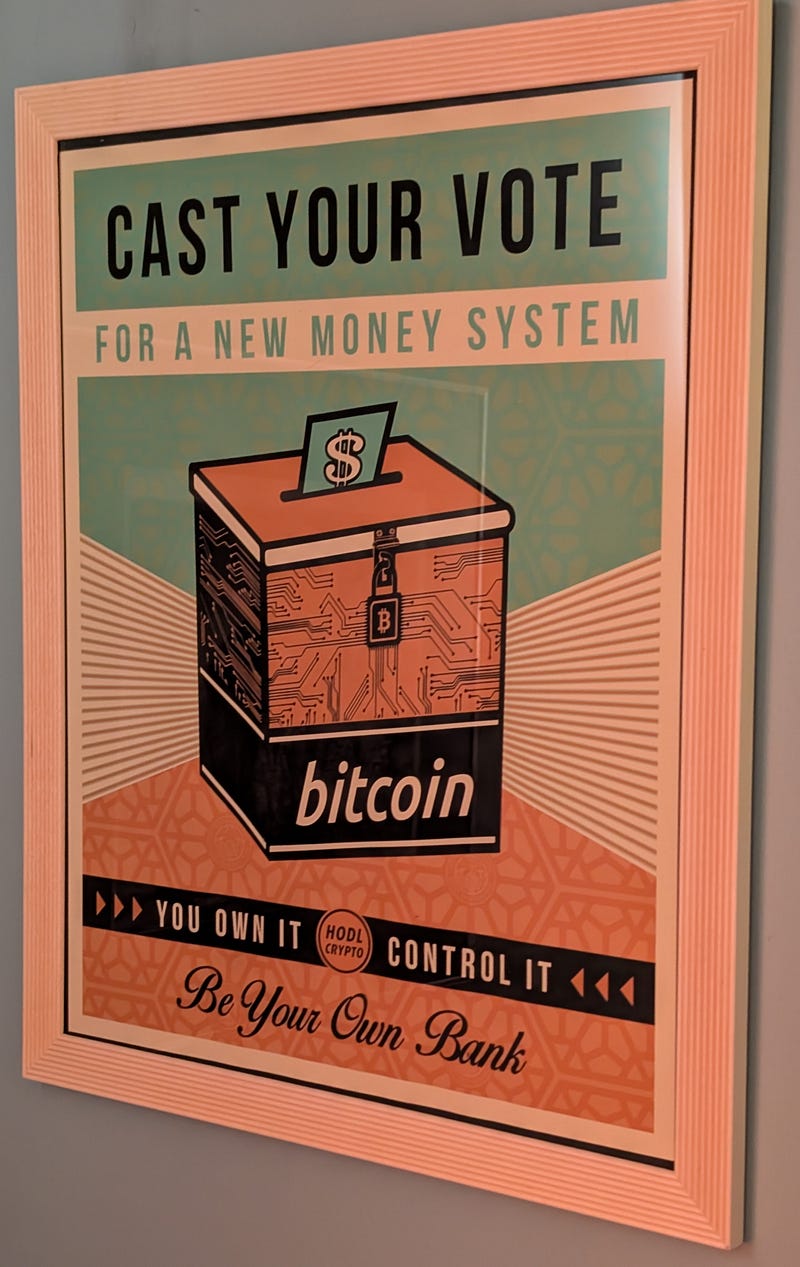
Bitcoin is not a departure from market principles; it is their most radical application to the domain that matters most. It is the market’s answer to “what would money look like without political control?” We are watching the experiment unfold in real time.
The Austrian framework that reveals the problems with fiat monopoly leads directly to Bitcoin as solution. The intellectual consistency demands it. You cannot simultaneously argue for competitive markets and monopoly money. You cannot celebrate Schumpeter while protecting central banks from creative destruction.
The Investment Imperative
For those who see clearly, this creates an asymmetric opportunity.
The downside scenario: Bitcoin remains a niche asset, never achieves global reserve status, but persists as digital gold. Even in this “failure” mode, it likely preserves purchasing power better than fiat over the long term. The maximum realistic downside from current levels might be severe in a crisis, but recovery follows because the protocol continues functioning.
The upside scenario: Bitcoin becomes the primary global settlement layer, reserve asset, and eventually unit of account. The current valuation represents roughly 2% of gold’s market capitalization and a small fraction of the global monetary base. In this scenario, a ten-to-one hundred times appreciation is not speculative; it is a mathematical consequence of monetization.
The risk-reward asymmetry is striking. With even modest probability assigned to the upside case, the expected value is strongly positive. This is not speculation; it is a rational approach to systemic transition.
More importantly, Bitcoin allocation is not merely about returns. It is about refusing to hold depreciating assets as your sole store of value. It is about maintaining optionality when monetary systems face existential stress. It is about participating in the market’s solution rather than remaining trapped in the problem.
In actuality, holding zero Bitcoin may be the risky option. Not because its success is sure, but because the downside of being wrong about Bitcoin’s success while holding only fiat seems worse than the downside of Bitcoin failing while you maintained diversified exposure.
Markets Demand Honest Foundations
The market’s immune system only functions when allowed to operate. Block creative destruction in individual industries, and you get stagnation. Block it in the monetary system, and you corrupt the entire economy’s ability to distinguish value from illusion.
For over a century, monetary monopoly has been accepted as natural and necessary, a cornerstone so fundamental it seemed beyond question. But monopolies in any domain eventually ossify, becoming obstacles to the innovation they once claimed to enable. Why should money be different?
Bitcoin challenges this assumption not through political lobbying or academic persuasion, but through demonstrated functionality. It offers an alternative that anyone can verify, use, and benefit from. No permission required. No trusted third party is necessary. No central authority capable of debasing it.
This is creative destruction operating at the deepest level, competition emerging not just for market share within a monetary system, but for the financial system itself. The implications extend far beyond investment returns. They touch the fundamental architecture of economic coordination.
Those who understand Austrian economics recognize that prosperity requires honest price signals, genuine capital allocation based on real savings, and the discipline of allowing failure to clear the path for success. These principles cannot coexist indefinitely with unlimited monetary expansion and systematic rescue of the unproductive.
Bitcoin represents the market asserting itself where assertion was thought impossible. It is the return of competition to the last monopoly. Whether it succeeds in displacing fiat systems entirely or merely forces them toward greater discipline, its existence has already changed the game.
The question facing investors is not whether Bitcoin is perfect, nothing human ever is, but whether it represents a superior alternative to the status quo. The evidence suggests it does. The trajectory indicates growing recognition of this fact. The logic of Austrian economics points unmistakably in this direction.
In a world where zombie companies consume resources that could build the future, where monetary manipulation obscures genuine value creation, and where political expedience systematically overrides market discipline, Bitcoin offers something increasingly rare: a foundation that cannot be corrupted by those who might benefit from its corruption.
That alone makes it worthy of serious consideration. That it also exhibits the best risk-adjusted returns of any major asset over the past decade merely confirms what the theory predicts: sound money has value because sound economic calculation has value. When you provide a tool for honest measurement in a world of distorted signals, people will use it.
The monetary monopoly sustained zombie economics for decades. Bitcoin provides the exit. How quickly that exit is taken remains uncertain, but the direction of travel grows clearer each day.