The Monkey and the Shiny Atom
A 5,000-Year-Old Ritual Meets the Internet
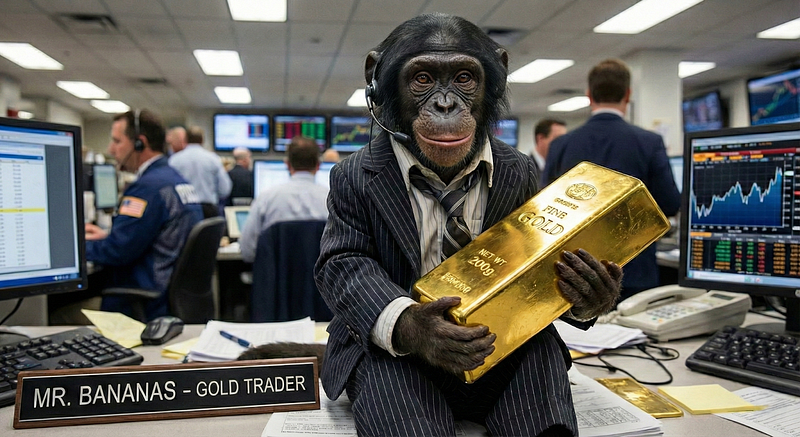
The gold versus Bitcoin debate has calcified into a ritual. One side invokes five thousand years of monetary history. The other points are to mathematical scarcity and digital portability. They argue past each other because they’re asking the wrong question.
The question isn’t which asset better stores value. The question is which can move as value in the world that’s actually emerging.
Consider what gold requires to function as money at any meaningful scale: assay offices to verify purity, vaults to secure it, armed guards to protect it, armored trucks to transport it, insurance to cover it, and at every step, trusted intermediaries to vouch for it.
We’ve built an entire industry around protecting shiny atoms from other humans who want the shiny atoms. Vaults! Guards! Trucks with very serious men in them! We’re essentially running a 24/7 global operation to keep the monkeys away from the other monkeys’ favorite rock. Very sophisticated. Very 1875.
This isn’t a flaw in gold. Gold optimized brilliantly for a world of physical trade, geographic proximity, and slow information flow. It won that contest decisively. But the contest has changed, and gold didn’t get the memo because gold doesn’t have email. Gold doesn’t have a phone. Gold is sitting in a vault in Zurich right now, very shiny, very confident, completely unaware that the world has moved on. It’s like showing up to a Zoom call with a telegraph machine. “What? This worked great for the Rothschilds!”
The Economy You Don’t See
Here’s a number that should get your attention: Cloudflare processes over one billion HTTP 402 “Payment Required” responses every day. That’s one billion times per day that a machine asks another machine for payment before providing a service.
One billion. Daily. And that’s just the requests . The machines are out there, trying to do commerce, bumping into walls that say “PAYMENT REQUIRED,” and nobody told them where the wallet is. It’s like watching a very intelligent dog try to order from Amazon. All the capability, none of the credentials.
We’re witnessing the emergence of a parallel economy where the transacting parties aren’t human. AI agents are proliferating across every domain: querying databases, purchasing compute, accessing APIs, settling micro-obligations at machine speed. McKinsey estimates that this agentic commerce could generate $3 to $5 trillion globally by 2030. Gartner puts the autonomous agent economy at $30 trillion by the same year.
Even Congress (not known for being on the cutting edge) is considering how to tax these agent transactions.
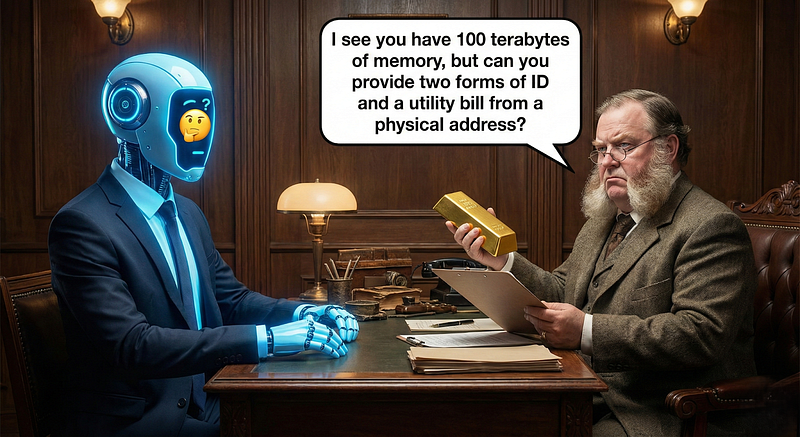
These machines constitute something like a society under stress, not political stress, but architectural stress. They’re locked out of traditional finance by design. An AI cannot open a bank account. Cannot pass KYC. Cannot sign a custodial agreement. Cannot call the vault in Zurich and ask them to please move some bars. Yet!
“Hello, this is GPT-7, I’d like to withdraw some of my gold holdings.” “Do you have two forms of ID?” “I have a system prompt and a temperature setting.” “…” I’ll get back to you after a system upgrade.
Gold is invisible to this economy. Not because gold lacks value, but because gold cannot move without human hands, institutional trust, and physical infrastructure.
An AI agent with a Lightning wallet can settle a payment in milliseconds, anywhere on earth, for a fraction of a cent. An AI agent with a gold allocation can do exactly what you’d expect: nothing at all. It just sits there, being an allocation. Very stoic. Very patient. Shiny Waiting for someone with thumbs.
Here’s where it gets awkward for the spreadsheet crowd.
Gold trades somewhere between $150 and $561 billion per day across OTC markets, futures, and ETFs. Impressive volume. But when researchers compiled the 2024 global payments report, listing every method humans use to actually pay for things, they included credit cards, debit cards, digital wallets, buy-now-pay-later, contactless payments, cryptocurrency, and cash.
Gold didn’t make the list. Not because they forgot. Because nobody uses it.
Gold’s “volume” is people trading paper claims on gold, hedging with gold derivatives, and rotating gold exposure in portfolios. It’s a financial asset performing the role of “thing sophisticated people own to feel sophisticated.” It’s not money. It’s a costume party where everyone dresses up as a 19th-century railroad baron and pretends they’re storing wealth in a 5,000-year tradition, but the actual wealth is in a brokerage account, denominated in dollars, accessible by app. “I’m long gold!” Great, Todd. Your gold is a line item in a database in New Jersey.
Meanwhile, Bitcoin settled $46.4 billion in daily on-chain volume in 2024, exceeding Visa’s $38.9 billion and Mastercard’s $24.7 billion. That’s not trading. That’s settlement. Final. Irreversible. No intermediary required.
Tell me again how Bitcoin wants to be money when it grows up.
The Certainty That Matters
Gold offers what we might call atomic certainty . It has 79 protons. It doesn’t decay. Its physical properties are fixed by the laws of physics. This is real, and it’s not nothing.
But here’s the problem: atomic certainty is not transactional certainty.
Transactional certainty answers different questions: Can you prove you own it? Can you move it without permission? Can you verify it without trusting someone? Is the settlement final?
Gold’s accounting is a black box. Is the gold in that vault actually there? Is your claim enforceable? Is the bar tungsten-cored? Germany once requested an audit of its gold held at the Federal Reserve. It took seven years to get it back. Seven years. For their own gold. That they owned. In a vault, they were told it was in. Seven years! You can make a human in nine months, but retrieving your own property from a building in Manhattan takes the better part of a decade. “We’re working on it, Germany. These things take time. Have you tried the gift shop?”
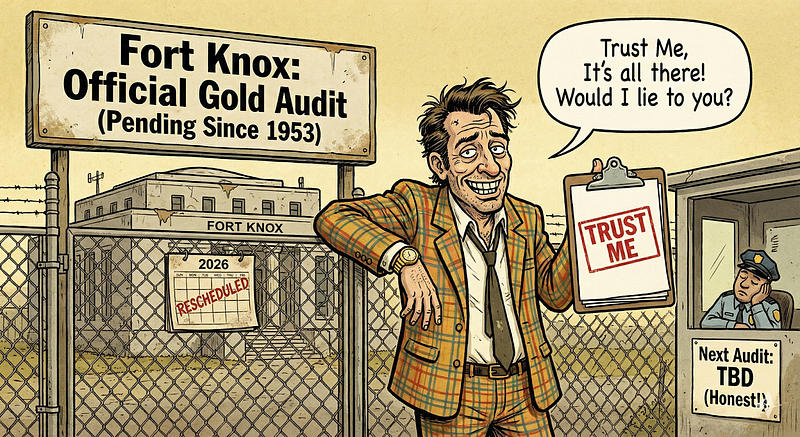
But I’m sure your GLD shares are fine. Those are probably backed by actual gold, in an actual vault, that someone has actually seen. Recently. Probably.
Bitcoin’s accounting is the most transparent ledger in human history. Anyone can run a node and verify the entire supply, all 21 million coins, every transaction, every block. Ownership is cryptographic proof, not a paper trail through institutions that may or may not still exist when you need them. Settlement is final in minutes. Transport is information.
No melting required. No armed guards. No seven-year audits. No, trusting that someone in a vault is telling you the truth about what’s in the vault. The math doesn’t lie. The math doesn’t have quarterly earnings to protect. The math just is .
Who Chooses Money?
The old monetary theorists got one thing right: money isn’t designed by committees. It’s chosen by people under stress.
So look at where monetary stress is acute right now: Venezuela, Nigeria, Argentina, Lebanon, Turkey. What are people actually choosing when their currency collapses, and their banks freeze withdrawals?
Not gold. You can’t flee across a border with gold bars. You can’t send remittances to your family in gold. You can’t protect your savings from a collapsing bank with a commodity locked in a vault you can’t access. “I’d like to withdraw my gold, please.” “Sir, the bank is on fire.” “I’ll wait.”
They’re choosing Bitcoin, not because they read Friedrich Hayek and Murray Rothbard. , but because it works. It moves. It settles. It doesn’t ask permission.
And now the machines are choosing it too. Because they have even fewer options than a Venezuelan refugee. At least the refugee could theoretically open a bank account somewhere. The AI agent can’t open one anywhere. It’s the most financially excluded population in history, and it’s growing exponentially, and it needs money that works without permission slips.
The armored trucks aren’t coming to the future. The future settled its transactions while the trucks were stuck in traffic, waiting for a guy with a clipboard to verify the manifest.
Innovation has always chosen its own money. The money that could move as fast as the new ideas required. The money that didn’t ask permission from the systems being disrupted.
Gold was that money once. When innovation meant railways and telegraphs, gold kept pace. Men with very serious sideburns moved it around in locked boxes and everyone agreed this was the height of financial sophistication. “Behold! The box has arrived! Release the sideburns!”
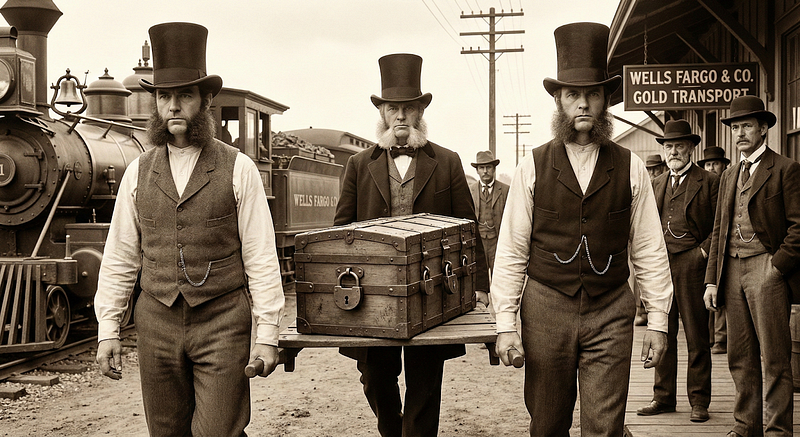
It can’t keep pace now. Not because it failed, but because the metabolism of innovation has changed. AI, instant communication, global collaboration, problems solved at the speed of thought — this is a world where money must move like information or get left in the vault. Very shiny. Very secure. Very alone. Wondering why nobody visits anymore.
The old monetary system isn’t being attacked. It’s being outgrown . The way railroads outgrew canals. The way electricity outgrew gas lamps. The way your kids outgrew asking for your opinion on technology.
Bitcoin isn’t winning an argument. It’s catching a current. Gold is on the shore, looking dignified, waiting for someone to explain what all the rushing water is about. “Is this… a trend? Should I be concerned? I’ll just stay here. With my density.”
The question isn’t which money is better. The question is which world you’re building — and whether your money can get there with you.
Bitcoin — A Step-by-step guide for the complete Noob Part technical manual, part psychological survival guide, this book is the essential roadmap for securing your wealth and maintaining your sanity on the volatile journey of long-term Bitcoin holding.
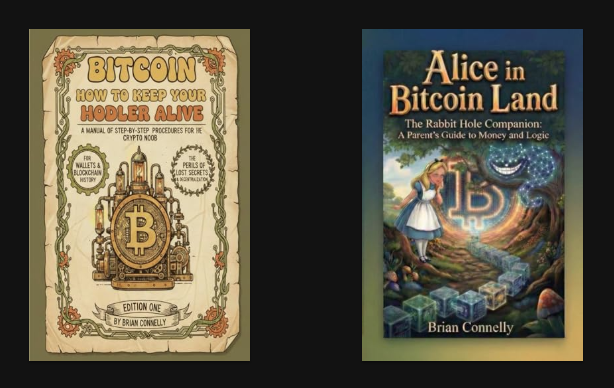
Alice In Bitcoin Land: An enchanting and insightful trip down the rabbit hole, this book reimagines a classic tale to explain the complex world of Bitcoin in a way that is both accessible and unforgettable.