The Apocalypse is Scheduled for Thursday.
On May 19, 2026, the President of the United States signed two executive orders. Everyone is talking about one of them.
The one getting the coverage is the fintech integration order. Open the Fed's rails to digital asset companies. Streamline bank charters. Accelerate the glorious merger of legacy banking with the emerging crypto economy. Bitcoin Magazine is thrilled. The Blockchain Association called it a defining moment. CNBC ran the segment between two pharmaceutical ads and a car commercial. You saw it.
The other one was signed the same afternoon. Quietly. No segment. No ticker tape.
It is called "Restoring Integrity to America's Financial System." Which, if you have been paying attention to how Washington names things, should make the hair on the back of your neck stand up. They named the Patriot Act the Patriot Act. They called the bank bailouts the Troubled Asset Relief Program. When these people start talking about integrity and restoration, check your wallet. Both of them.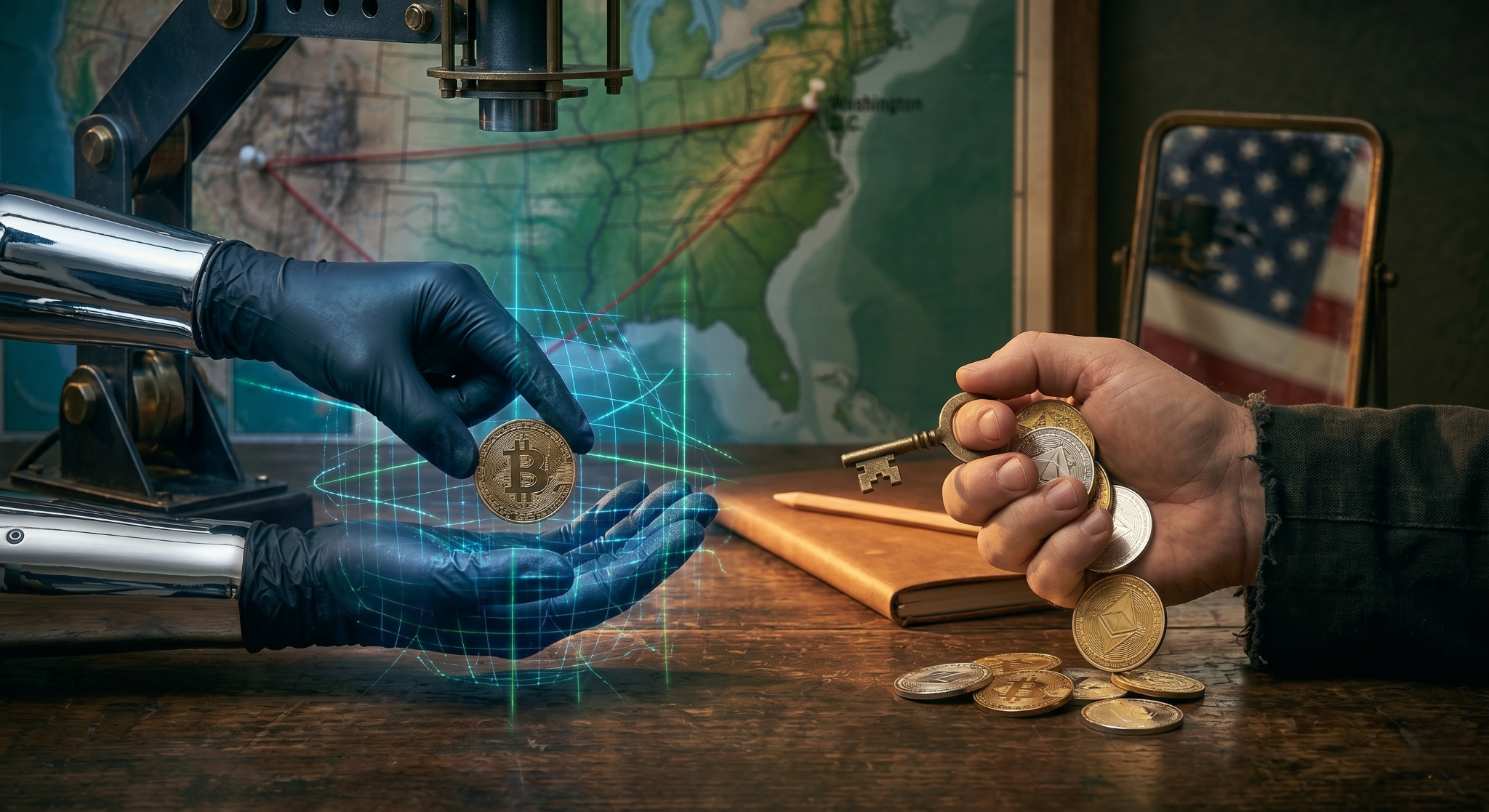
Here is what the quiet order actually does. The Treasury Department gets 60 days to identify red flags for financial crime. Ninety days to revise Bank Secrecy Act rules. And here is the phrase doing the real work in that document, four words that nobody on financial Twitter is discussing: "ultimate beneficial owners" of accounts.
Not the corporate name. Not the custodian. Not the exchange. The human being with the keys.
Sit with that for a minute. Take your time. I'll wait.
Thomas Jefferson, in a letter to John Taylor in 1816, wrote this: "I sincerely believe that banking establishments are more dangerous than standing armies, and that the principle of spending money to be paid by posterity under the name of funding is but swindling futurity on a large scale."
Banking establishments. More dangerous than standing armies. This from a man who had seen standing armies. This from a man who had, in fact, helped start a war against one.
There is another quote that travels under Jefferson's name. Historians cannot pin it to a specific letter or document, and I am not going to pretend otherwise because I have a reputation to keep and so did he. But somebody wrote it. Somebody who was paying attention. It goes like this: "If the American people ever allow private banks to control the issue of their currency, first by inflation, then by deflation, the banks and corporations that will grow up around them will deprive the people of all property until their children wake up homeless on the continent their fathers conquered."
Jefferson may not have written those exact words.
But I am going to tell you something he absolutely could not have imagined. Last Fourth of July, a package of burgers at Costco cost $15. This year, same burgers, same holiday, same Costco: $49. My kids cannot buy a house. Your kids probably cannot either. Gas prices are at record highs. The grocery store has started feeling like a shakedown. The continent is the same one. The homelessness is not a metaphor anymore, it is a housing market.
Somebody was right about this. At this point it does not much matter who.
Jefferson's verified line about banking establishments being more dangerous than standing armies is 210 years old. Last month, a four-star admiral told the United States Senate that Bitcoin is a power projection tool equivalent to military force. The wheel has come all the way around. Banks started the problem. Digital money might be part of the answer. And the government is now trying to figure out how to control both simultaneously.
Which brings us back to the quiet executive order nobody is talking about.
Let me tell you what a magic trick looks like from the audience's perspective. You watch the hand with the coin. That is the hand they want you watching. The flourish, the patter, the reveal. The other hand is where the trick actually happens.
The fintech integration order is the hand with the coin.
Look at it. It is genuinely interesting. Open the Federal Reserve's payment rails to crypto companies. Streamline the approval process for bank charters. Give fintech firms the same plumbing the big banks have hoarded since before most of their customers were born. Real stuff. Meaningful stuff. The industry has been waiting for this for a decade.
But while you are watching that hand, the other one is quietly measuring the frame of every door they just offered to open.
The Bank Secrecy Act revision does not ban anything today. It does not confiscate anything today. What it does is build the reporting architecture that makes the next step administratively simple whenever the political will exists to take it. First, exchanges collect more identification. Then withdrawals above certain thresholds get flagged. Then unusual patterns of withdrawals become compliance concerns. Then the question of who owns the wallet those coins went to becomes a condition of service. Then self-custody without identity disclosure becomes, in practice, a marker of suspicious behavior.
No single step is the step. The accumulation of steps is the point. This is how it always works. This is how it has always worked. They never announce the endgame. They build the infrastructure and let you figure it out later, preferably after it is too late to matter.
I want to tell you where I have been on this, because I think the timeline is relevant.
In November 2023 I wrote that Bitcoin's proof-of-work was more than a financial mechanism. That it was infrastructure for power projection in cyberspace. Jason Lowery was making this argument and most of the financial press was treating it like a fascinating hobby horse ridden by an interesting Space Force officer. Last month, Admiral Samuel Paparo, the commander of U.S. Indo-Pacific Command, used Lowery's exact phrase in front of the Senate Armed Services Committee and disclosed that his command is running a Bitcoin node. Iran demanded Bitcoin payment for passage through the Strait of Hormuz the same week.
Hobby horse no more.
Six months ago I wrote about the golden share mechanism. How the government took operational control of U.S. Steel without paying a single dollar for it. How the same mechanism could theoretically be applied to companies holding large Bitcoin reserves. No compensation. No equity purchase. Just control, dressed up in national security language and signed on a Tuesday.
Nobody has applied a golden share to a Bitcoin company yet. Give it time. Every regulatory chokepoint that would make it possible is currently being built. Charter applications. Banking licenses. Fed rail access. Each one is a door the government can put conditions on. Each condition is a form of the golden share in practice if not in name.
And now the identity infrastructure is being tightened around self-custody at the edges.
Three years of dots. Same picture every time I step back and look at it.
I want to be straight with you about what I am not saying, because this stuff attracts a certain kind of reader who wants to hear that the apocalypse is scheduled for Thursday. It was postponed for a week!
I am not saying Bitcoin is finished. I am not saying the government is coming for your hardware wallet next week. I am not saying the fintech order is pure theater. It is not. Real doors are opening. Real infrastructure is being built for real innovation and some of it will genuinely help ordinary people access financial tools that were previously reserved for people with the right zip code and the right last name.
What I am saying is that the frame of "Bitcoin wins because governments are adopting it" is dangerously incomplete. Governments are adopting it and building the surveillance architecture around it at the same time. Those are not contradictory moves. They are the same move. They are what governments do with things they have decided are too important to leave in the hands of individuals.
Gold owners learned this lesson in 1933 when Franklin Roosevelt signed Executive Order 6102. Turn in your gold at $20.67 an ounce. Not because gold was worthless. Because it was too important for individuals to hold freely. The valuation was the justification. The strategic importance was the case for confiscation. You could not even use the words "my gold" without understanding they had become provisional.
Could that happen to Bitcoin? The fixed supply, the decentralized network, the proof-of-work security make it genuinely different from gold in ways that matter enormously. Self-custody is a real protection that did not exist for gold holders in 1933. Your keys, your coins is not a bumper sticker. It is a meaningful technical and legal distinction.
But the time to understand the protection you have is before someone starts testing it. Not after. And right now, on May 19, 2026, they are building the testing apparatus.
Jefferson said banking establishments are more dangerous than standing armies. He was not talking about the interest rate on your savings account. He was talking about who controls the money supply controls the people. Every other form of control follows from that one.
Bitcoin was invented to solve exactly that problem. The question now, in 2026, with two executive orders and a four-star admiral and $49 burgers at Costco, is whether the solution survives the government's decision that it is too important to leave unsupervised.
Two executive orders. One afternoon. One hand opens the door.
The other hand is measuring the frame.
Pay attention to both hands. And for the love of everything Jefferson held dear, hold your own keys.
Brian Connelly writes about Bitcoin, monetary history, and the human story behind the technology at brianconnelly.com.