The Predictability Problem
Why Uncertainty is More Expensive Than You Think
I asked my dad what a candy bar cost when he was a kid.
“Five cents,” he said. Then he got that look , the one that means you’re about to hear about walking to school both ways up hill in the snow.

But here’s the thing: he’s not wrong, and it’s not nostalgia. It’s math. And that math is getting expensive.
The McDonald’s Test
Look, I know what you’re thinking. “Statistics lie, and liars use statistics.” Fair. Economists can make numbers say whatever they want, usually in language designed to bore you into submission.
So let’s skip the jargon and run the McDonald’s Test instead.
1960: Minimum wage was $1.00 per hour. A hamburger at McDonald’s costs 15 cents. Work one hour, buy 6.6 burgers. Not a bad deal.
2024: Federal minimum wage is $7.25 per hour. A Big Mac costs $5.69. Work one hour, buy 1.27 burgers.
You can blame politicians (they’ll take their share of responsibility). You can blame corporations (they’re not innocent). You can blame “the system” (favorite American punching bag).
But here’s the uncomfortable question nobody wants to ask:
What if the problem is the measuring stick itself?
The Ruler That Keeps Shrinking
Imagine someone kept shortening your ruler every year. Not much, just a little. A quarter-inch here, half-inch there.
A meter is always a meter. A kilogram is always a kilogram. A second is always a second.
Until we get to money.
In 1960, a dollar bought six burgers. The dollar today buys one (or not). The official numbers say the dollar has lost 97% of its purchasing power since 1913. But forget the percentage for a second. Use your own memory:
What did your first car cost?
Your first house?
Your first college textbook?
A tank of gas?
A movie ticket?
Now what do they cost?
This Isn’t Hidden
Here’s what drives me crazy: none of this is a secret.
Two percent sounds harmless, right? Almost boring.
At 2% annual inflation, your money loses half its value in 35 years. That’s one career. One lifetime of saving. Cut in half. Not by theft, not by accident, by intention.
Want to know the really fun part? They don’t always hit 2%. Sometimes it’s 4%. Sometimes it’s 7%. When I was growing up, it was over 10% for years.
The “Trickle Down” You Actually Get
Now here’s where it gets interesting.
When new money enters the system, whoever gets it first wins. Whoever gets it last loses.
Here’s how it actually works:
By the time that new money “trickles down” to your paycheck? Prices have already gone up. The grocery store has already raised prices. Your rent already went up. The car dealer already adjusted the sticker.
You hear “trickle-down economics” and think it means prosperity flows down.
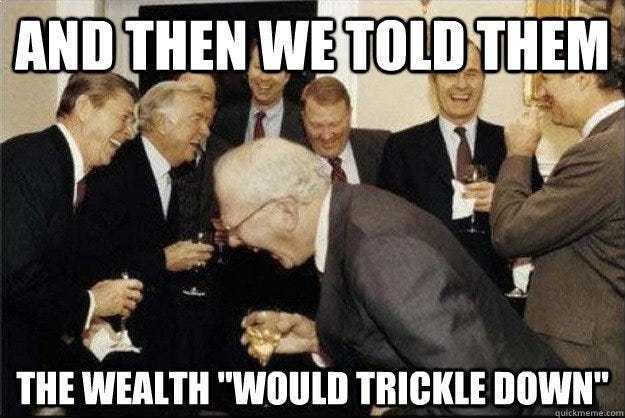
The money flows down. The purchasing power flows up.
The people at the top of the money fountain get to spend new dollars before prices rise. You get to spend them after the same dollars, but with different buying power.
This isn’t a conspiracy theory; it’s literally how the system is designed. It’s in the economics textbooks. They just use boring language so you don’t notice.
First receivers win. The last receivers lose.
Take a wild guess which one you are.
So what do you do? Most people try to protect themselves:
Gold? Great in theory. In practice: storage costs, can’t transact with it easily, and oh yeah, the government confiscated it in 1933 (Executive Order 6102, look it up). Your grandfather had to turn in his gold and got paper dollars in return. How’d that work out?
Real estate? Solid, but you need a lot of capital, you’re locked into one location, maintenance eats your returns, and good luck selling quickly if you need cash.
Stocks? Better than nothing, but requires active management, company-specific risk, and when everything crashes together (see: 2008), diversification doesn’t save you.
Savings account? The bank pays you 0.5% interest while inflation runs 3–7%. You’re earning negative returns and calling it “safe.”
What if there was another option?
The Authority That Always Wins
Enter Bitcoin.
Here’s what Wall Street figured out, and what matters if you’re tired of watching “authorities” get pushed around:
Bitcoin is the most dominant authority ever created. And it has never lost.
Governments have tried to ban it. China banned Bitcoin mining in 2021, total ban, enforced by the Communist Party.
Bitcoin didn’t blink.
Miners moved. The network continued to run, but stronger than before.
India tried to ban it. Russia wanted to ban it. Nigeria tried to ban it.
Bitcoin is still here. The bans aren’t.
In fact, most of them reversed course and are now figuring out how to regulate it instead of ban it because you can’t kill what has no head to cut off.
Battle-Tested and Undefeated
Bitcoin has survived:
- Government bans across multiple countries
- The collapse of its largest exchange (Mt. Gox)
- Coordinated media attacks, calling it a “fraud” for years
- Major countries are trying to control it
- Competing cryptocurrencies are trying to replace it
- Financial institutions are trying to ignore it
- 80%+ price crashes multiple times
It’s still here. Stronger than ever.
Every attack made it more resilient. Every “Bitcoin is dead” article aged like milk. Every government that tried to stop it eventually had to acknowledge reality: Bitcoin wins.
That’s not luck. That’s superior anti-fragile design.
Math Is the Strongest Authority
Here’s why Bitcoin keeps winning:
- 21 million maximum supply. No exceptions.
- New coins every 10 minutes. No delays (actually 9.9 to 10.1 over the last 16 years)
- Halving every 4 years. No extensions.
- Rules enforced by mathematics. No appeals.
- 16 years, 24 hours a day, 7 days a week, nonstop.
You can’t lobby math. You can’t threaten code. You can’t bribe an algorithm.
The authority is stronger than any government because it cannot be corrupted, cannot be intimidated, and cannot lose.
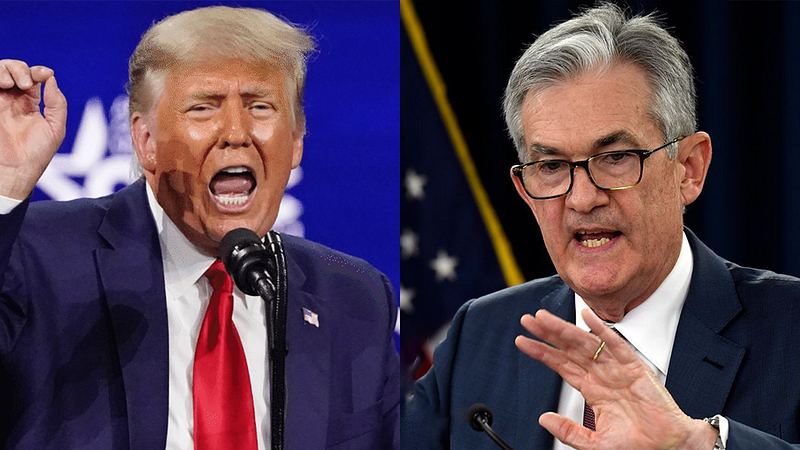
Compare that to the Federal Reserve:
“We’re targeting 2% inflation… unless unemployment is high… or markets are stressed… or there’s a pandemic… or an election year… or we just feel like changing our mind.”
That’s not strength, that’s weakness dressed up in suits.
Bitcoin doesn’t bend. Ever.
Dominant Because It’s Everywhere
Here’s what makes it unstoppable:
To shut down Bitcoin, you’d need to:
- Shut down the internet globally (not happening)
- Coordinate every government on Earth simultaneously (good luck)
- Convince millions of people to stop running nodes (why would they?)
China, one of the most powerful centralized governments on Earth, tried. They lost.
The network moved. Adapted. Got stronger.
That’s dominance.
Not “we hope we can resist.” Not “we’ll try our best.”
“Try to stop us. We dare you.”
Winners Recognize Winners
BlackRock didn’t file for a Bitcoin ETF because they’re rebels. They filed because they recognize dominant infrastructure when they see it.
You know who else is buying?
- Sovereign wealth funds
- Fortune 500 companies
- Central banks (quietly)
- The same institutions that spent years mocking it
They’re not buying the idea of Bitcoin. They’re buying proven, battle-tested, undefeated authority.
When Wall Street moves this hard into something they once called a scam, they’re not gambling. They’re reading the scoreboard.
Bitcoin: Still undefeated.
Governments: 0–20+
The math is simple. The winner is clear.
But I Don’t Understand the Technology
Good news: you don’t have to.
Do you understand how your car’s internal combustion engine works? Fuel injection, crankshaft timing, and catalytic converters? No?
But you can drive.
Same with Bitcoin.
- How to set up a wallet (easier than opening a bank account)
- How to buy Bitcoin (easier than buying stocks)
- How to secure your holdings (easier than safeguarding your passport)
- When to ignore the noise (hardest part, honestly)
The technology works whether you understand it or not, just like the internet worked in 1995, even if you didn’t understand TCP/IP.
The Volatility Question
“But Bitcoin is volatile!”
Yes. Extremely.
It’s also up over 100% annually on average since inception. Gold? About 8% per year. S&P 500? About 10%.
Volatility and risk are not the same thing.
Bitcoin moves like a caffeinated squirrel on a trampoline. Day to day, week to week, even year to year, the price swings wildly.
But zoom out to any four years, and the trend is unmistakable: up and to the right.
Risk isn’t the volatility . The risk is sitting in dollars, watching your purchasing power evaporate by design, year after year, guaranteed.
Which risk would you rather take?
Start Small. Verify Everything.
I’m not telling you to bet the house. I’m not telling you to mortgage anything. I’m not your financial advisor (and you shouldn’t listen to random people on the internet anyway).
The system you’ve been told is “safe” has been quietly bleeding you dry for decades. That’s not opinion, that’s your grocery bill, your rent, your car payment.
Bitcoin offers an alternative. Not perfect. Not risk-free. However, an alternative that has proven it cannot be stopped, cannot be corrupted, and cannot be defeated.
Here’s how to start:
- Learn the basics. Read The Bitcoin Standard by Saifedean Ammous. Watch Andreas Antonopoulos’ videos. Understand why it exists before you make a purchase.
- If you decide to buy, start small. Put in an amount you won’t miss. $50. $100. Whatever. Get comfortable with how it works.
- Hold it yourself. Learn to use a hardware wallet. “Not your keys, not your Bitcoin” isn’t a slogan; it’s a fact.
- Verify everything. Don’t trust me. Don’t trust anyone. Verify the supply cap. Verify the code. Verify the transaction history. It’s all public.
- Zoom out. Ignore the daily price. Ignore the news. Check back in four years.
The Strongest Authority You Can Hold
Many r etirement calculators assume stable money. However, money hasn’t been stable since 1971, when the United States left the gold standard.
You can keep pretending the ruler isn’t shrinking. You can keep measuring your “six-foot” table and wondering why nothing fits anymore.
Or you can choose the authority that has never lost.
For anyone who’s watched “authorities” cave to pressure, change rules mid-game, bail out the connected while punishing the powerless,
Bitcoin is what authority looks like when it can’t be corrupted and can’t be beaten.
No discretion. No exceptions. No defeats.
Just math. Applied equally. Everywhere. Always.
That’s not anarchy, that’s total dominance.
Welcome to the predictability revolution. It runs on code, not promises. And it has never lost.