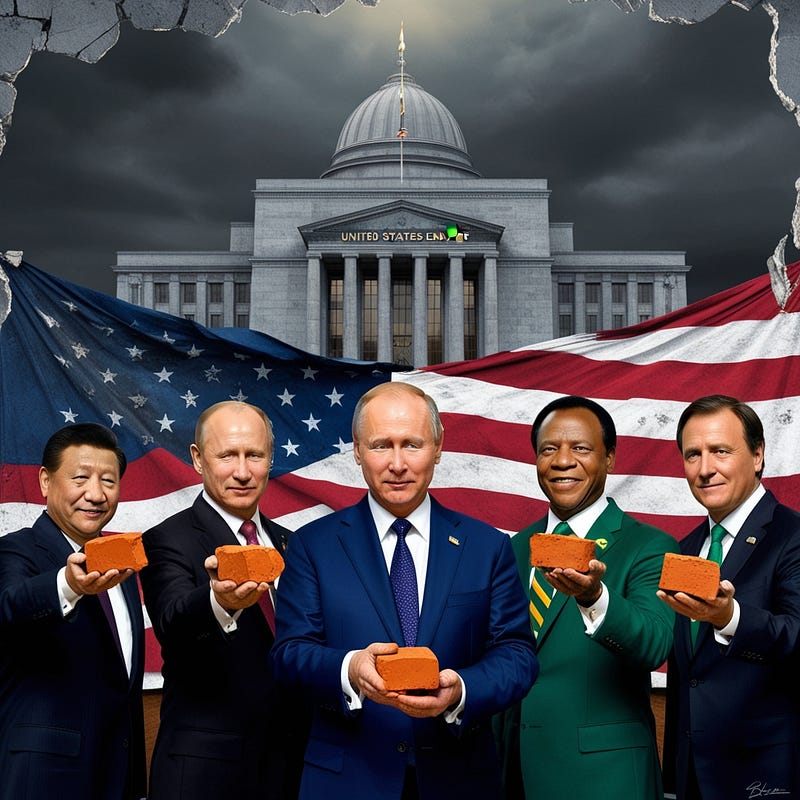
Throwing BRICS at the Empire
The US is at a pivotal moment, with two distinct paths ahead. One leads to embracing Bitcoin and fostering a more equitable global commerce, while the other involves clinging to an unfair advantage at the cost of BRICS countries. The countries within the BRICS sphere hold significant US assets, a factor that should not be underestimated in the delicate balance of US Dollar dominance.
China: As the largest holder of foreign exchange reserves globally, China held approximately $3 trillion in foreign exchange reserves, with a substantial portion in USD. However, the exact percentage in USD is not publicly disclosed.
India: India’s foreign exchange reserves were around $600 billion, with a significant portion likely in USD.
Russia: Following sanctions in 2022, Russia significantly reduced its USD holdings. However, before the sanctions, it held substantial USD reserves.
Brazil: Brazil’s foreign exchange reserves were approximately $350 billion, with a portion in USD.
South Africa: As the smallest economy in the group, South Africa held foreign exchange reserves of around $60 billion, some of which were in USD.
As Wall Street begins to grasp Bitcoin’s potential, the US government is faced with the unsustainable challenge of maintaining control over its monetary system.
By officially adopting Bitcoin, the US could mitigate the strength of the BRICS movement and find a way out of its overwhelming debt. This move could usher in a new era of international commerce, where dominance and control are not dictated by political whims but by market forces and math. It’s a prospect that should inspire hope and optimism.
Command and Control are much easier to manage than cooperation and collaboration, but a collaborative approach will have a longer-lasting and more enduring outcome.
Cooperative Approach
Collaboration, while more complex, fosters goodwill and reduces international tensions. Like consensus around development in the Bitcoin blockchain, it takes longer but has additional knock-on impacts. Working together could encourage shared development of new financial technologies, allow for coordinated regulatory frameworks, provide a potentially smoother transition with less market volatility, and possibly maintain US influence through collaboration rather than coercion.
Aggressive Approach (e.g., 100% tariffs)
It may accelerate the move away from a dollar-centric system and could damage international trade relationships, escalating the potential for retaliatory measures from other nations and the risk of isolating the US in the evolving financial landscape. Most importantly, it will likely be seen as a sign of weakness or desperation on the part of the US rather than a projection of power through leadership.
Adapting to Loss of Control
Our leadership must recognize the inevitability of decentralization in global finance and focus on shaping the new system rather than preserving the old one. The days of empire-building are over, and the world is much smaller. We can exercise leadership by leveraging US technological and financial expertise, similar to how the internet started as a DARPA project and blossomed into an international knowledge and information revolution.
Managing the Transition
The gradual integration of digital assets into the existing fiat financial system will require coordinated efforts to ensure global economic stability during the transition. This should be conducted through transparent communication about policy changes to encourage buy-in.
International Cooperation Opportunities
Collaborative efforts to address challenges like money laundering and fraud in digital finance
Creating inclusive forums for both developed and developing nations to shape the future of finance. With a new economic landscape on the horizon, joint research initiatives on blockchain technologies would be in everyone’s interest.
Balancing National Interests and Global Stability
The fundamental dynamics of Bitcoin as money change the foundation of global stability from a radical imbalance between haves and have-nots to one in which many more can share in real property rights and financial inclusion. By focusing on fair competition rather than dominance in the new financial landscape, the US could find ways to maintain its economic strengths while allowing for a more multipolar financial world.
Long-term Strategic Thinking
Visionary thinkers like Lyn Alden and Jeff Booth have taken a fresh look at money through time and projected that understanding into the future. It is time to recognize that cooperative approaches yield more sustainable long-term benefits and prepare for a future where influence is based more on innovation and collaboration than traditional economic dominance.
Originally published at http://docs.google.com.