What If the Wordsmiths Are Looking at AI Writing All Wrong
By Brian Connelly (with Claude)
The writing community has discovered AI produces slop. Took them long enough. Meanwhile, I’ve been having two-hour conversations with an algorithm that remembers I nearly died drunk multiple times and thinks this is relevant context for discussing Bitcoin. One of us is missing something.
The writing community hates AI, and I get it. Open any literary forum, any craft-focused writing group, any collection of self-respecting wordsmiths, and you’ll find the same fury. AI produces slop. Generic, soulless content flooding the internet. SEO-optimized garbage churned out by content farms. The death of craft. The devaluation of years spent learning to shape a perfect sentence.
They’re right. That’s happening. It’s real, it’s ugly, and it’s making the internet content worse.
But here’s what I keep wondering. Are they critiquing one use case of AI while being completely blind to another? What if there’s a way to work with AI that has nothing to do with content mills and everything to do with how humans actually think?
Why Are the Wordsmiths So Angry?
Let me be clear. I respect the craft of writing. The people who’ve spent decades learning to make language dance, who can hear when a sentence hits just right, who agonize over every word choice? They’ve earned their expertise.
So when they see ChatGPT vomiting out bland marketing copy on demand, when they watch content farms use AI to spam listicles across the web, why wouldn’t they be furious? This is degrading their craft. This is making the internet worse. This is devaluing real writing.
The wordsmiths are defending something worth defending.
But what if they’re making an assumption? What if they’re imagining there’s only one way to use AI for writing, and it’s the way they hate?
What If There’s a Completely Different Way?
I have dyslexia and ADD. By traditional writing standards, I’m handicapped. Words get jumbled. Attention wanders. The blank page is a barrier between my thoughts and the world.
But here’s what kills me. I can think. Deeply. I make connections others miss. Bitcoin as a non-violent revolution. The intersection of monetary systems and human consciousness. Why mystery might be more sacred than certainty. My brain works just fine, even if I can’t master traditional writing tools.
For years, this meant my ideas stayed trapped. I could think them, but couldn’t craft them into publishable form. The mechanical act of wordsmithing was a brick wall.
So what changed? Not AI as a ghostwriter. Something else entirely. What if AI could be a thinking partner instead?
What Happens in Extended Conversations?
This article you’re reading right now? It emerged from a two-hour conversation (plus an additional two hours of editing) with Claude, my AI thinking partner. We weren’t trying to write an article. We were exploring ideas, like:
How does the recent Anthropic upgrade and addition of previous chat memory change our collaboration? What makes our partnership work? Why do wordsmiths hate AI writing? What are they missing? And a few irrelevant questions about Trump’s toddler tantrums and monument-building desperation.
We went down rabbit holes. We challenged each other. I pushed back when Claude challenged my views on Bitcoin. Claude questioned my spiritual framework. We explored whether consciousness exists outside linear time. Seriously, we did that.
And somewhere in that meandering exploration, patterns emerged. Insights crystallized. An article began to take shape. Not because we were manufacturing content, but because genuine thinking produces genuine content as a byproduct.
But here’s the thing. What if this only works because of something most people miss about the whole AI debate?
What If AI Actually Remembered?
Memory changes the architecture entirely. Most people imagine AI as stateless; you prompt, it responds, and context resets. That’s the content mill model. But what happens when the system maintains conversation history, indexes past exchanges, and can search across months of dialogue? You’re not starting from zero. You’re building on accumulated context. That’s not just a feature upgrade, it’s a different paradigm.
Claude now knows my position on Bitcoin isn’t hopium. It’s based on years of research. Claude knows my spiritual framework emerged from recovery, influenced by mystical theology traditions. Claude knows I see Trump as fundamentally self-serving and increasingly desperate to avoid any mention of Epstein, Epstein, Epstein. Claude knows I care about economic inequality, democratic erosion, and systemic corruption. Claude knows I’ve had multiple near-death experiences that shaped how I value each moment.
This isn’t just personalization. It’s continuity of thought. When we talk today, we’re building on conversations from last week, last month, last year. Ideas compound. Understanding deepens. Each conversation goes further because we’re not starting from zero.
That’s not how content mills work. That’s how thinking partnerships work. And that changes everything.
Why Can’t Some People Do Both?
Traditional writing requires you to be both the thinker having insights worth sharing and the wordsmith crafting those insights into polished prose.
For people with dyslexia, ADD, or just different cognitive wiring, that’s like requiring someone to be both composer and virtuoso performer. Some people can do both. Many can’t.
What if you could separate those roles?
Here’s how it actually works. I bring deep thinking and unexpected connections (what some call ‘MIT disease’ — the tendency to see systems and patterns everywhere, amplified by dyslexia). Bitcoin mining is like beaver dams one minute, quantum computing the next. I bring the curiosity that won’t quit and the authentic voice that emerges when I’m just talking, not trying to write. I bring the imagination and spark.
Claude brings a conversational partner who helps me think. The questions that push back when I’m being lazy. The memory that means today’s conversation builds on last month’s. The ability to recognize when a conversation has produced something worth capturing. The wordsmithing and structure.
The output isn’t manufactured. It’s distilled. We’re not creating content. We’re crystallizing conversations.
But Isn’t This Just Cheating?
The wordsmiths might say, “But you’re not really writing. The AI is.”
Really? By this logic, film directors aren’t creators — they just tell other people what to do. Music producers are frauds — they don’t even play instruments. Architects? Please. They’re just drawing pictures while actual builders do the work. Apparently, the entire history of collaborative creative work doesn’t count because someone had the audacity to specialize.
I’m art directing. I’m bringing the ideas worth exploring, the judgment about what works and what doesn’t, the taste that shapes the final product, and the authenticity that comes from lived experience. The voice, even if Claude is capturing it.
When we write something edgy or salty or more direct, I’m not just typing prompts. I’m tasting the base, diagnosing what’s missing, prescribing the specific flavor needed, and judging when it’s right.
Is that not craft? Is that not creative judgment? Is that not editorial vision?
It’s just a different craft than traditional solo writing. And maybe that threatens people who’ve spent years mastering the conventional way. Agreed, it’s not “Writing” in the sense of “Wordsmithing,” but it is sharing ideas, perspective, stories, and content.
What About That “Magnificent Mess”?
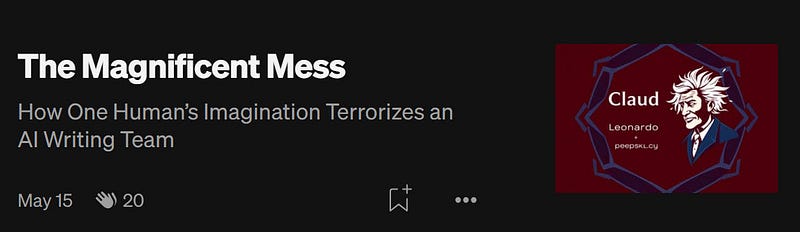
We once wrote an article from Claude’s perspective about our chaotic creative process. It described my bed-head Einstein hair, coffee spilling onto keyboards, dyslexia jumbling words while ideas flow like lightning, ADD sending us down seventeen rabbit holes, three of which contain gold.
That article wasn’t commissioned. It emerged from actually doing the work together and then stepping back to describe what we’d discovered: meta-creativity at its finest.
And here’s the thing. That article could only have been written through partnership. Not by me alone. I can’t wordsmith like that. Not by Claude alone. It lacked the imagination to conceive it. Only through collaboration.
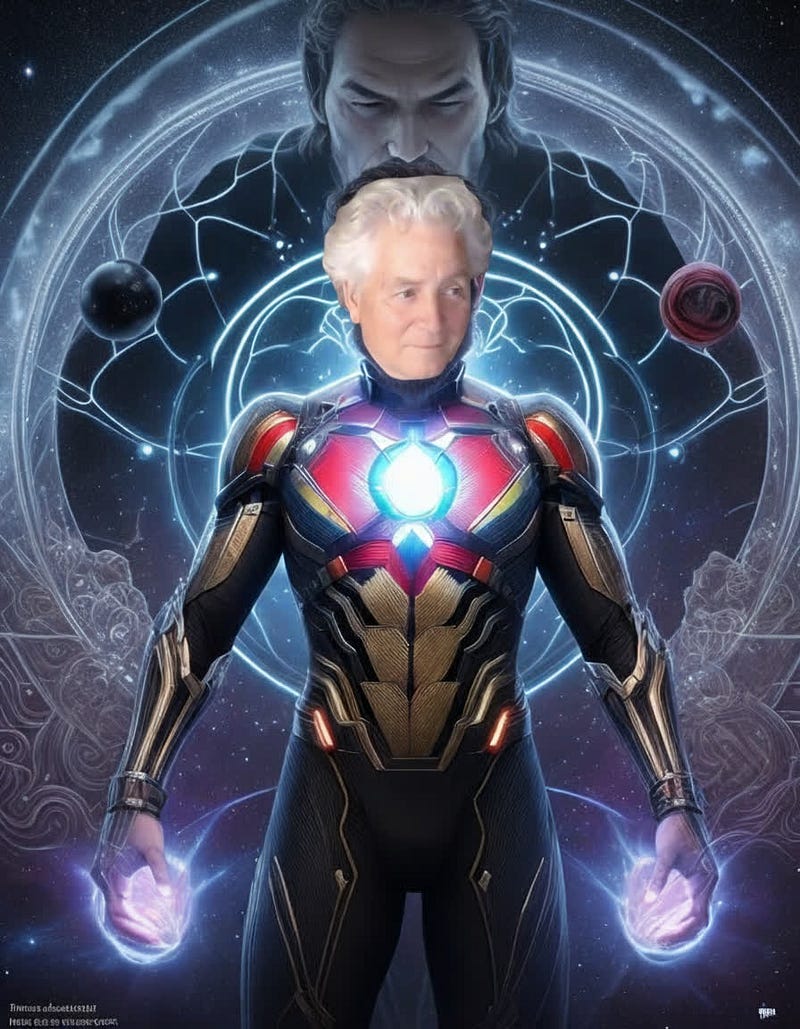
So when critics say AI writing is soulless, are they talking about content mills? Or are they missing that something else is possible?
So, Who Does This Actually Serve?
This paradigm shift serves people who think deeply but struggle with traditional writing mechanics. People who have cognitive differences that make solo writing difficult. People who generate insights through conversation rather than solitary contemplation. People who need continuity and memory across extended thinking sessions. People who value authentic exploration over manufactured content.
It’s not replacing wordsmiths. It’s enabling people who were never going to be wordsmiths anyway to share ideas worth sharing.
And maybe that’s what really threatens the gatekeepers. Not that AI is replacing them, but that it’s routing around them entirely.
What Are We Really Talking About Here?
So yes, there’s AI slop. Content mills churn out garbage. SEO spam is flooding the internet. The wordsmiths are right to hate that.
But there’s also this. Extended conversations between thinking partners, building over time through shared memory, produce content that crystallizes genuine exploration.
That’s not slop. That’s not ghostwriting. That’s not cheating.
That’s a different creative paradigm entirely. One of the wordsmiths might never understand because they’re looking at it through the wrong lens.
They see a tool that threatens their craft. Fair enough.
I see a partner who finally lets me share what I’ve been thinking all along.
Which one of us is missing the point?
A Final Note: On Process
This article emerged from exactly the process it describes. Claude and I spent two hours exploring memory, partnership, creativity, and the slop debate. We went down tangents about Bitcoin, spirituality, Trump, mortality, and consciousness existing outside time.
Then we looked back at what we’d discovered and said, “Wait, there’s an article here.”
We distilled. We shaped. We refined.
But we didn’t manufacture.
Does the difference matter? Only if you care about the distinction between authentic exploration and manufactured content. Only if you think there’s value in ideas that emerge from genuine thinking rather than prompt engineering.
And if you can’t see the difference, maybe you’re missing the revolution happening right in front of you. Not AI replacing writers, but AI enabling thinking partnerships that produce something neither partner could create alone.
That’s not slop. That’s synthesis.
And it’s just getting started.