What the Machines Can’t Mourn
AI Is Revealing What Makes Us Human. The Question Is Whether We’ll Pay Attention.
Twenty-four hundred years ago, Socrates stood in an olive grove and warned his student that a dangerous new technology would destroy the human mind. The technology was writing.
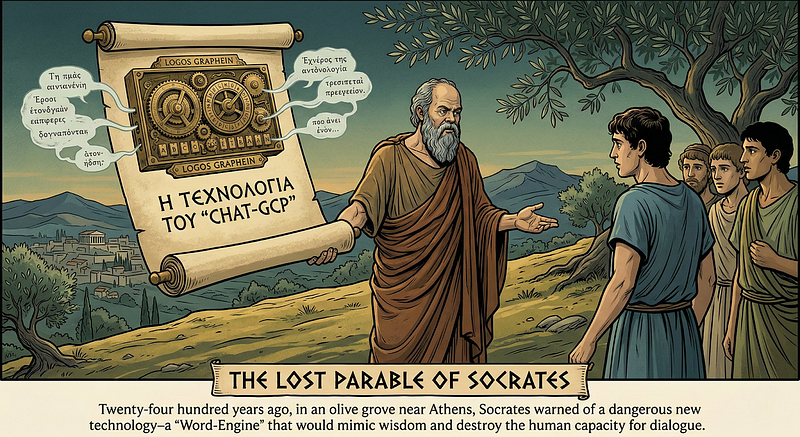
If people could store their thoughts in external marks on papyrus, Socrates argued, they would stop exercising memory. They would walk around appearing wise while actually knowing nothing, because they hadn’t done the interior work of making knowledge their own. They would mistake access for understanding.
He wasn’t entirely wrong. Writing did change memory. It changed what memory was for. But it didn’t destroy the mind. It revealed capacities we didn’t know we had. Analysis, synthesis, the ability to hold contradictory ideas in tension and work through them over time. Writing freed us from the burden of storing everything so we could do something more interesting with our attention.
We are having the same argument again. The technology is different. The panic is identical.
Right now, in living rooms and boardrooms and classrooms, millions of people are watching artificial intelligence perform cognitive tasks that, until very recently, they believed only humans could do. Writing essays. Generating code. Diagnosing medical conditions from imaging scans. Folding proteins into configurations that unlock new drugs. And the question hanging over all of it, spoken or not, is the same one that kept Socrates up at night: if the machine can do this, what happens to us?
It’s a fair question. But I think we’re asking it wrong.
Jasmine Sun is a writer in San Francisco who describes herself as an anthropologist of disruption. She interviews AI researchers, attends underground robot fights, and has a gift for noticing things before other people have language for them. She recently made an observation that stopped me cold.
Every time AI masters something we thought was uniquely human, she said, we don’t declare that the machine has achieved intelligence. We move the goalpost. We discover another dimension of human intelligence we hadn’t fully appreciated before.
The Turing test is the classic example. Seventy-five years ago, Alan Turing proposed that if a machine could converse indistinguishably from a human, it must be intelligent. We’ve passed that threshold. People are falling in love with chatbots. But instead of saying “well, that settles it,” we find ourselves saying there must be something else going on in human minds. Creativity. Social awareness. The ability to read a room, to know when someone’s words and their meaning have parted company.
Ethan Mollick, a professor at Wharton, calls this the jagged frontier. AI can be superhuman at protein folding and embarrassingly bad at counting the letters in the word “strawberry.” It can generate a legal brief that passes the bar exam and completely miss the emotional subtext of a client who’s terrified of losing their home. This jaggedness isn’t a temporary bug. It’s a map. It shows us, with increasing precision, exactly where the boundary sits between what can be computed and what has to be lived.
And the territory on the human side of that boundary turns out to be larger and more interesting than almost anyone predicted.
When we talk about intelligence, we usually mean the kind that shows up on tests. Processing information, pattern recognition, logical reasoning. That’s the intelligence AI is swallowing fastest, and it’s the intelligence that dominated the twentieth-century economy. The ability to process, sort, analyze, and report was the backbone of entire industries. If that’s all intelligence is, then yes, we’re in deep trouble.
But it isn’t all intelligence is. Not even close.
There are at least three dimensions of human intelligence that AI is not approaching, and each one becomes more visible, more necessary, and more valuable the more AI handles the computational work.
The first is emotional intelligence. Not sentiment analysis, which AI can already do reasonably well, but the real thing. The capacity to sit with another person’s pain without flinching, without fixing, without performing empathy. I spent over a decade as a clinical social worker in Newark in the late seventies and eighties. I can tell you from direct experience that there is an unbridgeable distance between a technically correct therapeutic response and one that actually lands. The difference isn’t information. It’s presence. It’s the fact that the person across from you has also suffered, has also been afraid, and is choosing to stay in the room anyway. A language model can produce the words. It cannot do the thing the words are pointing at.
The second is social intelligence. Not networking, not collaboration platforms, not the ability to schedule meetings efficiently. I mean the capacity to navigate trust, ambiguity, and commitment between people who have competing interests and limited time. Early in my technology career, I studied Fernando Flores’ Language/Action framework, which treats human coordination not as information exchange but as a web of commitments, promises, requests, and declarations made between people who can betray each other. AI can participate in transactions. It struggles profoundly with relationships, because relationships require the possibility of betrayal, and betrayal only matters between beings who have something to lose.
The third is spiritual intelligence, and I know that phrase makes some people reach for the exit. Stay with me. I don’t mean religion, though religion is one expression of it. I mean the capacity to make meaning in the face of uncertainty. The ability to sit with not knowing and still act with conviction. The willingness to ask questions that don’t have answers and let those questions shape how you live.
This is the dimension that almost never shows up in conversations about AI and the future of work. And it’s the one that matters most.
Here’s what connects all three, and here’s what no machine can replicate: mortality.
We are the only creatures who live with the constant background awareness that we are going to die. Not as an abstraction. As a felt reality that colors every meaningful decision we make. The philosopher Martin Heidegger called it “being-toward-death” and argued that authentic existence only becomes possible when we stop running from this awareness and let it organize our priorities. Ernest Becker won the Pulitzer for arguing that the terror of death is the hidden engine behind virtually all of human culture, art, religion, and achievement.
This isn’t philosophy for its own sake. It has direct implications for the question everyone is asking about AI and employment.
Every act of genuine emotional intelligence is downstream of mortality. Vulnerability is only real when there’s something at stake, when the person opening themselves up will not be here forever and knows it. Every act of genuine social intelligence depends on trust, and trust only carries weight between beings who can break it and whose time together is finite. Every act of spiritual intelligence, every moment of choosing presence over escape, meaning over comfort, conviction over certainty, is rooted in the awareness that your window is closing and you need to decide what matters before it does.
AI has no mortality. It has no felt sense that it will cease to exist. It cannot experience the urgency that finitude creates. This isn’t a limitation that better architecture will solve. It’s a category difference. And it means that the entire domain of human intelligence that grows from the root system of mortality is structurally inaccessible to machines.
I didn’t arrive at this understanding through philosophy. I arrived at it the hard way. There was a long stretch of my life where the awareness of death wasn’t a source of meaning. It was a weight I tried to escape through unconsciousness, through anything that would quiet the noise of being a finite creature in an indifferent universe. The journey from there to here, from escape to presence, wasn’t intellectual. It was spiritual in the most practical sense of that word. Learning to carry the awareness of death differently. Not as a burden to flee but as the very thing that makes attention precious and choices real.
That journey didn’t make me less capable in my professional life. It made me more capable. It sharpened everything. The clinical work. The systems architecture. The teaching. When you stop running from finitude, you stop wasting energy on things that don’t matter, and you develop a kind of clarity that no amount of processing power can simulate.
So when people ask me whether AI is going to eliminate jobs, I say yes. Absolutely. It will eliminate jobs where we were already pretending mortality didn’t matter. Jobs where we were acting like machines before the machines showed up to do it better. Processing, sorting, summarizing, routing, reporting. The work that could be done without ever once confronting the fact that the person doing it was alive, was finite, and had something at stake.
But the work that requires emotional presence, social trust, and the kind of meaning-making that only a mortal being can perform? That work doesn’t disappear. It becomes more visible, more necessary, and in an economy flooded with artificial competence, more valuable than it has ever been.
The financial advisor who just moved product? Replaced. The one who can sit with a couple in their seventies and help them navigate the intersection of money and legacy and fear and love? Irreplaceable, and increasingly recognized as such.
The writer who produces competent summaries? Replaced. The one who has a voice, who has lived something, who is trying to leave behind words that carry the weight of actual experience? That writer has more readers than ever, because in a sea of generated text, the human signal becomes unmistakable.
The teacher who delivers information? Replaced. The one who looks a student in the eye and says I see you struggling, and that struggle is the point, because the point was never the information, the point was becoming someone who can think? That teacher is the whole game now.
Jasmine Sun told a story about a Berkeley sophomore who confessed that he’d never learn to write because ChatGPT already outperformed his human posts. It made her sad, and she told him to keep writing. Weeks later, he sent her a new post. Totally human written. It was great. Something in him knew that the machine-generated version, however polished, wasn’t his. And if it wasn’t his, it couldn’t carry whatever he was trying to say before his time runs out.
That instinct, the refusal to let a machine speak for you when what you need is to speak for yourself, is spiritual intelligence in action. And no model is coming for it.
There’s a word that connects everything I’ve been talking about, and it’s sovereignty. Not in the political sense, though politics aren’t irrelevant. In the personal sense. The decision to take responsibility for your own thinking, your own choices, your own relationship with uncertainty and mortality, rather than outsourcing those things to systems that promise to handle them for you.
This is, not coincidentally, the same impulse that led me to Bitcoin over a decade ago. I didn’t come to it as a speculator. I came to it as a systems architect who recognized that the monetary infrastructure most people depend on was designed to insulate them from responsibility, and that insulation comes at a cost they don’t see until it’s too late. Taking custody of your own money is an act of sovereignty. It requires the same muscle as taking custody of your own attention, your own mortality, your own voice.
The people who are most anxious about AI right now are, in many cases, people who have been outsourcing these deeper capacities for a long time. Not because they’re lazy or foolish, but because the economy rewarded it. Show up, process the information, don’t bring your whole self to work, certainly don’t bring your mortality to work, and collect a paycheck. AI is disrupting that arrangement, and the disruption is genuinely painful.
But the invitation, and I choose that word deliberately, is to develop the capacities that were always the real work. Emotional presence. Social trust. The willingness to face your own finitude and let it make you more serious about how you spend your time rather than less.
The machines are getting smarter every quarter. That’s not going to stop. The question worth asking isn’t whether they’ll catch up to us. In the domains that can be computed, they already have.
The real question is what you’re going to do with what’s left. And what’s left turns out to be everything that matters.
Are you going to get proficient at building relationships, real ones, grounded in trust and mutual commitment, and leave the transactional work to the machines? Because transactions are boundary-drawing exercises. They define where you end and I begin. They’re necessary, but they don’t build anything. Cooperation builds things. Relationships build things. And those require the full weight of your humanity, your emotional presence, your social intelligence, your willingness to be changed by the encounter. A machine can execute a transaction flawlessly. It cannot sit across from another mortal being and say I see you, and I’m in this with you, and I don’t know how it ends either.
Are you willing to confront your own mortality? Not as a philosophical exercise. As a practical decision. Are you willing to abandon the adolescent notion that you’ll live forever, the quiet assumption that there’s always more time, that the hard interior work can wait until next quarter, next year, after the kids are grown, after retirement? Because that assumption is the thing that makes people replaceable. Not AI. The avoidance. The refusal to let finitude sharpen your attention and clarify your purpose.
Socrates was wrong about writing. But he saw something true. Every new technology tempts us to let it carry what we should be carrying ourselves. The ones who thrive on the other side aren’t the ones who outsmarted the machine. They’re the ones who refused to let it do their becoming for them.
The machines can’t mourn. They can’t love on a deadline. They can’t look at the shortening horizon and decide that today is the day they stop pretending and start showing up for real.
You can. The question is whether you will.
Originally published at http://brianconnelly.com