What Will You Do When AI Does All the Work?
The Sky Is Blue, and Other Infinite Questions
It was a sunny day, and I was lying on the front lawn with my dad, looking up at the sky. I was six but very inquisitive, like many 6-year-olds, always asking questions and more questions based on the answers.
This particular conversation led to a discussion about quantum mechanics, and my dad explained that, even in 1958, some scientists were still unsure about some aspects of the quantum world.
Eventually, that conversation ended, not because of my lack of curiosity but probably some other pressing concern, like the lawn needed to be cut or mom called and needed help with taking out the garbage.
That conversation was rare. Not because six-year-olds lack curiosity, they’re endlessly asking “why”, but because most parents don’t have the time, energy, or specialized knowledge my father happened to have. An MIT education in nuclear science isn’t standard parenting equipment. And even when it is, the lawn still needs mowing.
Now imagine a different child in our not-too-distant future, one in which AI and robotics handle the lawn and the garbage, and an AI mentor picks up the thread when human knowledge runs out.
That future child asks: “Why is the sky blue?”
The conversation spirals through Rayleigh scattering, electromagnetic waves, the nature of light itself, Maxwell’s equations… until finally:
Child: “But why do accelerating charges radiate energy?”
AI: “That’s one of the deepest questions in physics. We can describe how it works mathematically, but we don’t know why the universe operates this way rather than some other way. Would you like to explore current theories about the fundamental nature of electromagnetism?”
AI: “And while we’re exploring, there’s an adjacent problem humanity hasn’t solved yet. We understand plasma physics, but we haven’t figured out how to contain a plasma field in a commercially viable fusion reactor.”
AI: “Would you like to investigate the current theories for electromagnetic plasma containment?”
CHILD IN DIAPERS SOLVES PLASMA CONTAINMENT IN ELECTROMAGNETIC FUSION REACTOR

Sounds absurd, right?
Your first reaction is probably to laugh. A child who can’t even use a toilet solving one of humanity’s most complex engineering challenges?
What exactly makes it impossible?
Not intelligence, children are naturally brilliant at asking the kinds of fundamental questions experts have learned to stop asking.
Not curiosity, that’s precisely what children have in abundance, while most adults have had it beaten out of them by “practical concerns.”
Not access to knowledge, in an AI-enabled future, every child has humanity’s entire knowledge base available, explained at exactly their level of understanding.
Not time, when you’re not preoccupied with survival, when robots handle the garbage and mow the lawn, time is what you have.
Not having the ability to test ideas, AI can run simulations, model theories, and guide experimental design. Robots can build prototypes.
The only impossible part is our assumption that breakthrough thinking requires decades of credentialing, gatekeeping, and capturing funding.
We assume serious work requires:
- Years of formal education
- Professional credentials
- Adult seriousness and status
- Freedom from “childish” questions
But what if those assumptions are exactly backward? What if the credentials and status-seeking are what kill breakthrough thinking? What if “childish” questions, Why? But why? But WHY?, are precisely what’s needed?
WHAT IS WORK WHEN YOU DON’T NEED TO SURVIVE?
The standard anxiety about abundant futures goes something like this: “If robots do everything and AI answers everything, what will humans do? How will we find meaning without jobs? Won’t everyone just become lazy?”
This question reveals a deep confusion about what work actually is.
We’ve spent 10,000 years treating work as survival labor :
In that paradigm, curiosity is a luxury. A child’s endless “why?” gets cut short because:
We’ve normalized the idea that the reason humans do things is because they must. That without the threat of starvation or homelessness, we’d all just… stop.
But be a three-year-old for five minutes. (Try not to mess the diaper.)
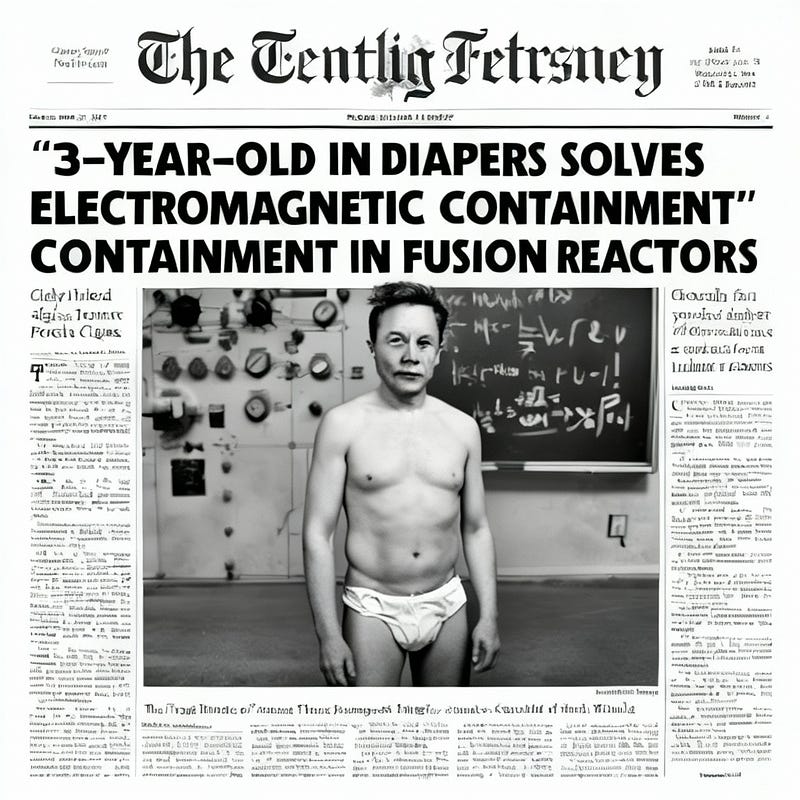
They’re not asking “why?” because someone’s paying them. They’re not building block towers to avoid eviction. They’re not drawing pictures because their mortgage depends on it. Curiosity is intrinsic to human consciousness . The desire to understand, create, and explore doesn’t require scarcity; it requires freedom from scarcity.
My conversation with my dad didn’t end because I ran out of questions. It ended because survival tasks interrupted. The lawn. The garbage. The demands of maintaining existence.
Work in abundance doesn’t disappear; it transforms:
- From coerced to chosen
- From survival to discovery
- From “what must I do to eat?” to “what do I want to understand?”
- From means to an end, to end in itself
The physicist doesn’t need a salary to wonder about quantum mechanics; they need freedom from worrying about rent so they can wonder about quantum mechanics.
The artist doesn’t need a commission to want to create; they need freedom from a second job so they can create.
The child doesn’t need incentives to ask “why?”; they need parents who aren’t too exhausted to engage.
WHAT THIS CHANGES: EDUCATION, PARENTING, HUMAN MEANING
If work becomes voluntary exploration rather than survival labor, everything downstream changes.
Start with education. Right now, we pretend school is about learning, but really it’s about sorting. We sort children into economic categories, teach them compliance with authority, credential them for job markets, and standardize their thinking so they’ll fit into existing systems. A six-year-old who wants to understand plasma containment gets told, “That’s not age-appropriate,” “You need to learn algebra first,” or “Let’s focus on what’s on the test.”
But that six-year-old asking about the sky isn’t doing something fundamentally different from a physicist asking about electromagnetic radiation. They’re both exploring reality. We’ve just created arbitrary barriers between them, barriers that exist to manage scarcity rather than optimize learning.
In abundance, those barriers dissolve. Not because we eliminate structure or expertise, but because we eliminate the artificial constraints. The child who asks about plasma containment can follow that thread as far as their curiosity takes them. The AI mentor doesn’t say “you’re too young.” It says “let’s explore this together” and adjusts the explanation to meet the child exactly where they are.
My dad could engage with my quantum mechanics questions because he happened to have an MIT education. But even he hit limits, the state of the art in 1958 was still evolving, and eventually we had to stop because the lawn needed mowing. Imagine if every child had both infinite expertise at their disposal and endless time to explore it.
Then there’s parenting. Right now, being a parent means being a survival manager. You’re keeping children alive, fed, clothed, and sheltered. You’re preparing them for economic survival, homework, college prep, and career guidance. You’re managing the logistics of modern life, schedules, activities, appointments, and the endless mental load of maintaining a household.
There’s barely any bandwidth left for lying on the lawn and seeing where questions lead.
I got lucky, even with five brothers. My dad had that particular afternoon available. He had the knowledge. He had the patience in that moment. But how many of my other “whys” got answered with “not now, honey, I’m busy” or “go ask your mother” or just exhausted silence? How many children never get even one of those lawn conversations because their parents are working two jobs, or don’t have specialized knowledge, or are too depleted by survival labor to engage?
In abundance, the parent-child relationship transforms. You’re not preparing your child for a hostile economic world anymore. You’re not anxiously managing their competitive positioning for college admissions. You become exploration partners. “I don’t know why the sky is blue, let’s find out together” stops being a luxury you can’t afford and becomes the default mode of a relationship.
But the most profound shift is existential. The question that haunts every conversation about abundant futures: “If I don’t need to work to survive, what gives my life meaning?”
This question reveals how thoroughly we’ve been captured by scarcity thinking. We’ve conflated economic productivity with human value. We’ve confused survival labor with purpose. We’ve convinced ourselves that being paid is what makes us matter.
But I didn’t ask my dad about quantum mechanics because I was being economically productive. He didn’t engage because he was getting paid. That conversation mattered because reality is fascinating, and understanding it together created connection and growth. The meaning was intrinsic, not instrumental.
Strip away the survival anxiety, and what you find underneath isn’t emptiness, it’s curiosity. Three-year-olds don’t need existential motivation to ask “why?” They don’t need to be threatened with starvation to want to build towers and make art and figure out how things work. That drive is native to human consciousness itself.
The tragedy isn’t that abundance would leave us purposeless. The tragedy is that scarcity has forced us to suppress our natural curiosity for so long that we’ve forgotten it’s there. We’ve spent so many generations teaching children to stop asking “impractical” questions and focus on “useful” skills that we’ve mistaken the suppression for human nature.
THE INFINITE FRONTIER
Reality is an infinite onion of questions.
I asked my dad why the sky was blue. If we’d had infinite time and infinite access to knowledge, that conversation would still be going because every answer reveals new questions. Why does light scatter? Because of how electromagnetic waves interact with matter. Why do electromagnetic waves interact with matter that way? Because of how charged particles respond to oscillating fields. Why do they respond that way? Because of the fundamental nature of electromagnetism. Why is electromagnetism that way and not some other way?
Eventually, you hit the bedrock: “This is how the universe works, and we don’t know why it works this way instead of some other way.” But even that isn’t an endpoint, it’s an invitation. Maybe there is a deeper layer we haven’t discovered yet. There may be other universes with different laws. The question itself needs to be reframed.
The questions never stop. There’s always another why.
That child asking about plasma containment isn’t going to solve it and then sit idly. They’re going to ask the next question. And the next. And the next. Not because they’re being paid or because their survival depends on it, but because reality is endlessly fascinating and humans are naturally curious.
We’ve never lived in a world where that curiosity could run free. We’ve always had to interrupt it with survival tasks. The lawn. The garbage. The job. The bills. The exhaustion.
Abundance doesn’t eliminate human purpose; it finally lets us discover what our purpose was all along, underneath all the survival noise.
Maybe that child in diapers really will solve plasma containment. Not because they’re a genius savant, but because they’re finally free to follow their curiosity wherever it leads, with infinite patience from an AI mentor and zero pressure to stop asking “why?” so someone can do the laundry.
That’s not a world without work. That’s a world where work finally means what it should have meant all along: humans exploring reality because reality is worth exploring.
The sky is blue.
But also: there’s a reason it’s blue. And a reason behind that reason. And another reason behind that one.
The questions never stop.
And in a world of abundance, finally, neither do the answers.