When Gangsters Have Nukes
A Citizen’s Guide to Powerlessness and Peace
A reflection on leadership manipulation, global conflict, and finding peace amid chaos, we cannot control
The Reality TV President and the Art of Manipulation
We live in strange times when Wall Street traders coin acronyms like “TACO” — “Trump Always Chickens Out” — to describe a sitting president’s pattern of making extreme threats and then backing down when faced with economic pressure. It’s almost comical until you realize the same psychological vulnerabilities that make Trump retreat from tariff threats could be exploited to drag America into devastating military conflicts.
Trump’s behavior follows a predictable pattern: announce something dramatic (usually via social media), watch the reaction, then adjust based on immediate feedback. This works fine for reality TV ratings, but becomes terrifying when applied to nuclear-armed foreign policy. The man who buckles under Wall Street pressure on trade deals is the same person making life-and-death decisions about military intervention.
When Foreign Leaders Play the Player
The most chilling example came recently when Israel launched surprise attacks on Iran just three days before scheduled US-Iran nuclear negotiations that were reportedly “making progress.” The timing wasn’t coincidental — it was calculated manipulation designed to eliminate diplomatic options and force Trump into a reactive military posture.
Netanyahu has spent 30 years obsessing over regime change in Iran, as documented in the 1996 “Clean Break” strategy. He understands Trump’s psychological triggers: the fear of appearing weak, the need to look decisive, the vulnerability to being cornered by events others create. By attacking during active negotiations, Netanyahu eliminated Trump’s diplomatic off-ramps and made military escalation seem like the only “strong” response.
This is manipulation at the highest level — one leader exploiting another’s character flaws to advance an agenda that serves neither country’s actual interests. Trump gets pulled into conflicts that don’t enrich him personally (his usual motivator), while Netanyahu gets the US military backing he’s craved for decades.
The Gangster Politics of Global Conflict
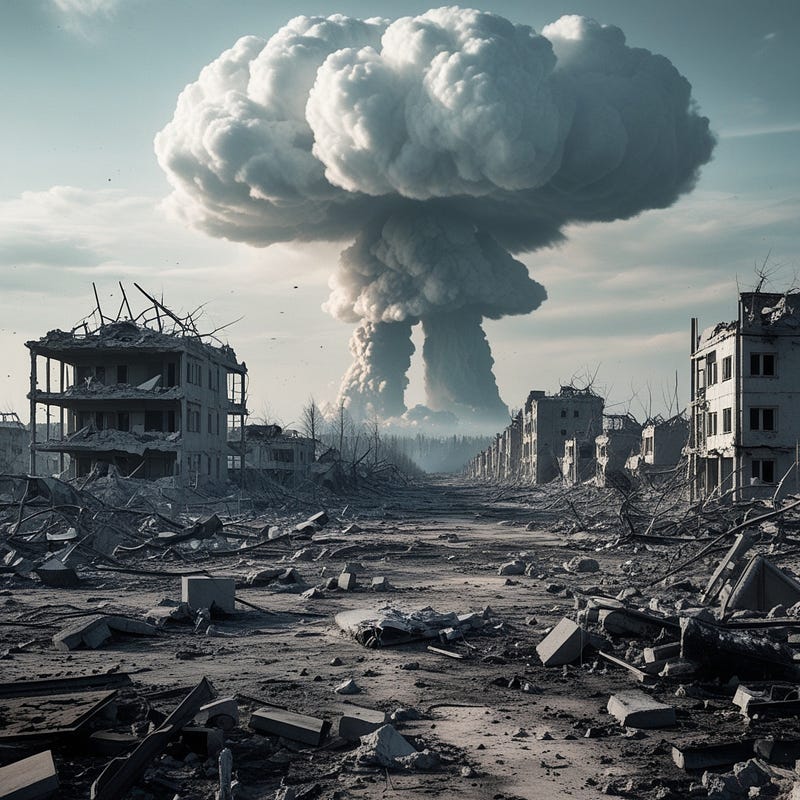
As economist Jeffrey Sachs recently observed, what we’re witnessing is “a small group of gangsters basically fighting over their gangster turf.” The rest of us? We’re not participants in these decisions — we’re “spectators wondering when the bombs will drop in our neighborhood, when loved ones somewhere will be killed.”
But even “spectators” understates our position. We’re potential victims of decisions made by people who view mass casualties as acceptable costs for political gain. Someone sitting in their living room in Ohio or California or anywhere else in the world could die in a nuclear exchange and never know it was because Trump couldn’t handle being called weak, or because Netanyahu had a decades-old obsession, or because evangelical voters thought Armageddon fulfilled biblical prophecy.
The randomness is what makes it so terrifying. Your life, your family, your dreams — all of it is subject to the whims of people playing games with weapons that can end civilization.
The Serenity to Accept What We Cannot Change
This brings us to one of humanity’s oldest wisdom traditions, crystallized in the Serenity Prayer: “Grant me the serenity to accept the things I cannot change, the courage to change the things I can, and the wisdom to know the difference.”
You cannot control Netanyahu’s obsessions or Trump’s ego. You cannot stop the “small group of gangsters” from their power games. You cannot prevent evangelical voters from supporting policies based on apocalyptic prophecies. These forces are genuinely beyond any individual’s influence.
But you can control how you live in the present moment. You can choose kindness over cruelty, truth over comfortable lies, and connection over isolation. You can create meaning in your immediate sphere — with family, friends, community — regardless of what chaos unfolds in distant capitals.
Living in the Eternal Now
The “eternal now” is where your actual life happens anyway. Not in the abstract geopolitical scenarios or hypothetical nuclear exchanges, but in today’s conversations, small acts of care, moments of beauty, and authentic human connections.
This isn’t naive optimism or willful ignorance. It’s the recognition that powerlessness over global events doesn’t negate the very real power you have over your own choices and immediate relationships. In fact, accepting that powerlessness can be liberating — it frees you from the crushing weight of trying to fix things beyond your control. It redirects that energy toward impacts you can actually make.
The Wisdom to Know the Difference
Perhaps the most essential skill for navigating our current moment is discernment — knowing the difference between what we can and cannot influence. We can stay informed, vote, speak the truth when we have platforms, and support policies that promote peace. But we cannot control whether our leaders choose wisdom over ego, diplomacy over war, or long-term thinking over short-term political gain.
What we can control is how we treat each other in the time we have. We can build resilient communities, practice radical kindness, and create small pockets of sanity in an increasingly chaotic world. We can choose to live with presence and purpose regardless of what unfolds in places we’ll never see, decided by people who will never know our names.
In the end, this may be the most subversive act of all: refusing to let distant gangsters and their power games determine the quality of our daily existence. Living fully in the present moment, with love and intention, becomes its own form of resistance against those who would make us all spectators to our own potential destruction.
The world may be controlled by a small group of people playing dangerous games, but our individual lives — the only lives we actually get to live — remain our own. And in that space, despite everything, there is still room for meaning, beauty, and hope.