In July of 2009, Amazon reached into people's Kindles overnight and deleted their copies of 1984.
I want you to sit with that. Somewhere there was a guy who paid for a book about a government that memory-holes inconvenient text, fell asleep reading it, and woke up to find it had been memory-holed. He didn't lend it out. He didn't lose it. It was on the nightstand. And it was gone, because a licensing problem in Seattle reached across the country and took it off the nightstand.
Amazon refunded him. Very generous. That's the part that gets me. They gave him his money back like the transaction had been a misunderstanding, which, to be fair, it had been. Just not his.
Because here's the thing nobody wants to say out loud. He never owned that book. There was a button. The button said Buy. He pushed the button, money left his account, and a word appeared in his head that was not true. He had rented a permission. The permission had an expiration date nobody bothered to print on it, and the date turned out to be Thursday.
They gave you a word so you'd stop asking
This is what language is for now. Not communication. Sedation.
They can't sell you a rental, because rentals feel temporary and temporary makes you nervous, and nervous people read the terms. So they built a button that says Buy and a page that says My Library and a little icon of a bookshelf, and now you've got a bookshelf-flavored feeling about a database entry in a building in Virginia that you have never seen and could not find.
Your music is a permission. Your movies are a permission. That software you paid four hundred dollars for is a permission, and it phones home once a month like a parole officer. Your photos are a permission. Twenty years of your children's faces, sitting on somebody else's hard drive, and the only thing standing between you and losing all of it is that a company in California continues to feel like being in that business.
We got so used to this we stopped having a word for the other thing. There used to be a word. The word was have.
The oldest permission slip in the building
Now here's where I have to be honest, because I sell books.
Six of them. My name's on them. And the thing I believed I owned, the copyright, the property, the thing my publisher's contract treats as sacred and eternal, is a permission slip that Parliament wrote in 1710. That's it. That's the whole provenance. A room full of Englishmen in wigs decided that a stationer could have a monopoly for fourteen years, and three hundred years later I get to feel violated when a machine reads my book.
It was a good arrangement. It worked. It built the publishing industry, the record industry, and about eleven years of my own income. But it was never a law of nature. It was a bargain, and it held for exactly as long as catching violators was cheaper than the money the monopoly brought in.
That equation just broke. Not because information wants to be free, which is a bumper sticker written by somebody who never made payroll. It broke because the infringement is now smeared across a few hundred billion numbers in a matrix, in a jurisdiction that doesn't return calls, and nobody can point at the page. 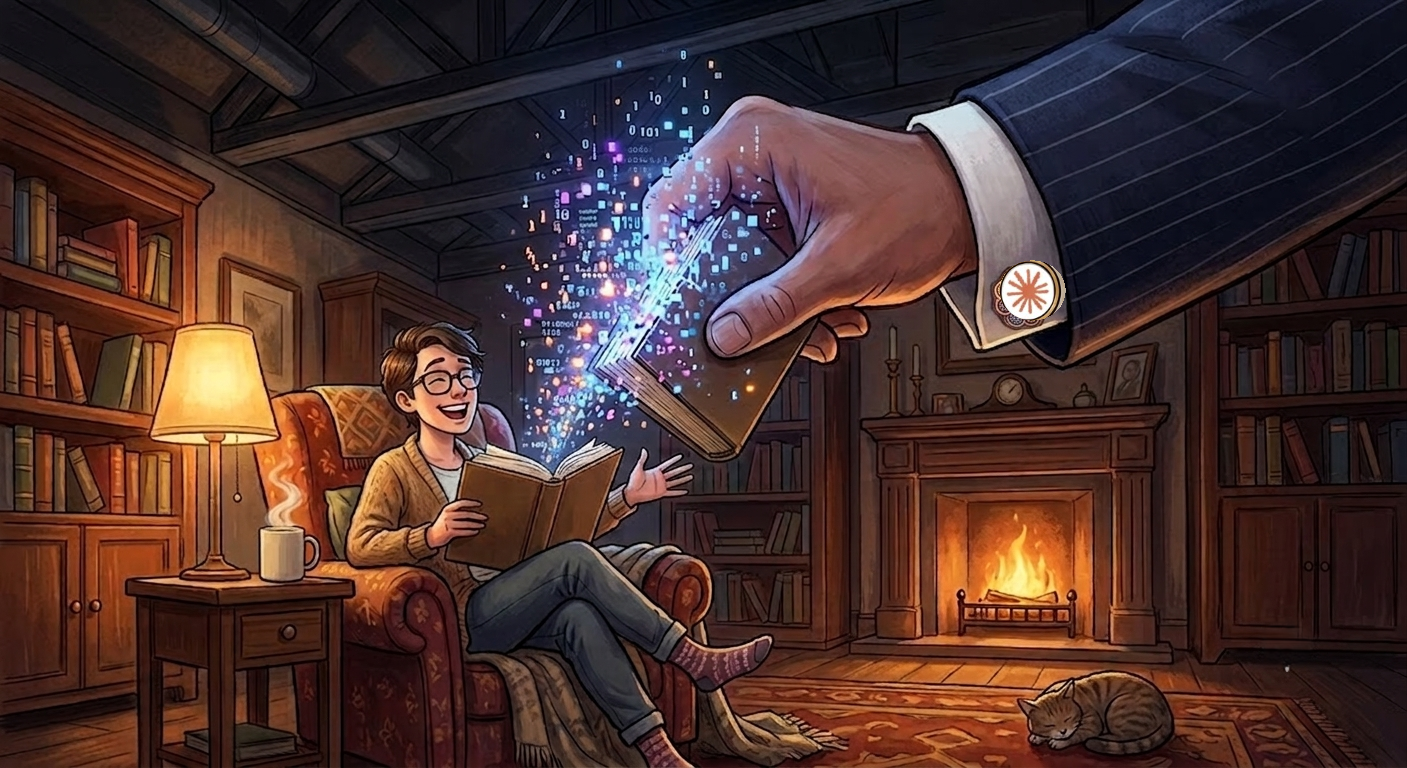 You can still enforce a drug patent. Forty companies on earth can make the molecule, they have factories, factories have addresses, and addresses have customs agents. You cannot enforce a permission on a thing that has no address.
So the writers are in court right now, furious, and I understand it in my bones, and they are going to find out what the guy with the Kindle found out. They didn't have a possession. They had a permission, and the people who issued it are quietly deciding not to renew.
The permission you're standing on right now
You want to know how big this goes.
Take out a dollar. Look at it. You don't own that either. You hold a claim on a system, and the system has a lever in it, and the lever is not connected to anything you get to vote on.
Here's the tell. Everybody in this country walked into a grocery store over the last four years and left with less food than their money used to buy, and in that same stretch the stock market went up like it had been shot out of a cannon. Same country. Same money. Same four years. One of those two groups got the new money first, and one got it last and paid the higher prices, and I'll let you work out which one you were in based on how you feel at the register.
And nobody voted for it. That's the part that should keep you up. There was no bill. There was no ballot line that said "Proposition 4: Would you like your savings to be about nine percent smaller? Yes or no." We started the largest military buildup in that region since 2003, went to war with Iran in February, and not one dollar of it came out of a tax anybody was asked to approve. You can be for that war or against it, I don't care today, that's a different argument. Ask the narrow question. Who was asked?
Nobody was asked. Because if they had to ask, they'd have to tax, and if they had to tax, you'd notice. Inflation is the only tax in the world you can levy on a man who never got a form.
And if you think holding it in an institution keeps you clear of all this, go look up Executive Order 6102. April of 1933. Gold. They didn't sneak it. They published it. Corporations exist at the pleasure of the state, and a balance at an exchange is a permission with a friendly logo on it.
Two things that don't ask
So that's the whole century, really. Everything you thought you had was a permission, and the permissions are getting called in.
Except two things arrived, and they arrived without asking anybody, and neither of them can be un-invented.
One of them is a protocol that runs anywhere there's electricity and one stubborn person. The other is an AI model, and I have to stop here for a second, because almost everybody has the wrong picture in their head.
People think AI is a place. A website. A box you type into and a nice voice comes back. It isn't a place. It's a file.
That's the whole mystery. The thing doing the talking is one enormous file sitting on a drive, the same way a movie sits on a drive, except this one is forty or eighty gigabytes of nothing but numbers. Billions of numbers. The website is just somebody else's computer with the file already open. When you hear people say "the weights," they mean the file. When you hear "open weights," it means the outfit that spent a billion dollars producing that file went and put it on the internet where anybody could download it. No password. No account. No takebacks.
And once a file is in enough places, it stops mattering who approves of it. That isn't a political opinion. That's arithmetic.
On the twelfth of June, a Friday, Anthropic shut off access to two of its best models to comply with an export control order. Eighteen days. Came back the first of July. And here's the whole argument in one sentence: the people renting access had a bad Friday, and the man in Lagos who already had the file on his own drive never found out anything had happened.
Same technology. Two completely different relationships to it. One of them survives a Friday.
Now the part I'm not going to lie to you about
Permission is better. Almost always.
It's cheaper, it's faster, it works on your phone, and when you screw up, somebody fixes it. Lose your password, they mail you a link. Lose your keys, you lose everything, and there's no link, and there's no number to call, and there's a guy in Wales who has spent a decade trying to get a landfill excavated for exactly this reason.
The file you run on your own machine is slower and dumber than the one they run on theirs. Self-custody means a house fire is now a financial event. Most people do not want to be their own bank, and they are not being stupid. They're taking a trade that works ninety-nine times and fails once, and the once is the whole thing.
I'm not telling you which side to be on. I'm telling you to know which one you're holding. That's it. That's the entire sermon. Most people can't answer that question about a single asset they own, and the answer is available, and it takes about a minute.
Still not sure? Ask your uncle Terry, you know the guy with 4 bookshelves of leather bound volumes and a 400 rack of CDs he burned in June of 2000.
Also, one of these keeps itself and one doesn't
I keep hearing these two treated as the same story. They're not.
Bitcoin regenerates. China banned mining in 2021, more than half the hashrate went dark inside a month, and it was back within a year, and nobody organized that. No committee, no fund, no summit. It came back because running the thing pays the person running it. That's a commons with a pulse.
The files have no pulse. Nobody gets paid to release the next one. Nobody gets paid to keep copies of last year's alive. Those files are on the internet because a company in Hangzhou decided, once, on a Tuesday, that giving away a billion dollars of work served some purpose of its own. That was a gift. Gifts are lovely and gifts are revocable, and the archive a whole generation is about to build its livelihood on is currently somebody's side project.
So download the ones you'd miss and put them on something you own. A drive on your desk. It costs eighty dollars. Learn to run one at home even though it's worse, because a worse one that answers on Friday beats a better one that doesn't.
The common good used to mean what they hand you. A check, a road, a program, a promise, all of it arriving at the pleasure of people you'll never meet and financed by a tax you never approved.
It means something else now. The common good is whatever you can hold without asking.
Holding is a verb. Nobody's going to do it for you.