The Dead Body and the Fabulous Curtains
Imagine walking into a house where a crime has just taken place. Chalk outline, blood on the floor, the whole nine yards. The professional we hired to handle it is over by the window, measuring for curtains.
Here's the disturbing part: the curtains are gorgeous. This decorator has impeccable taste. The color theory is flawless, the fabric is right, and every suggestion would genuinely improve the room. If you didn't know about the body on the rug, you'd give this hire a five-star review.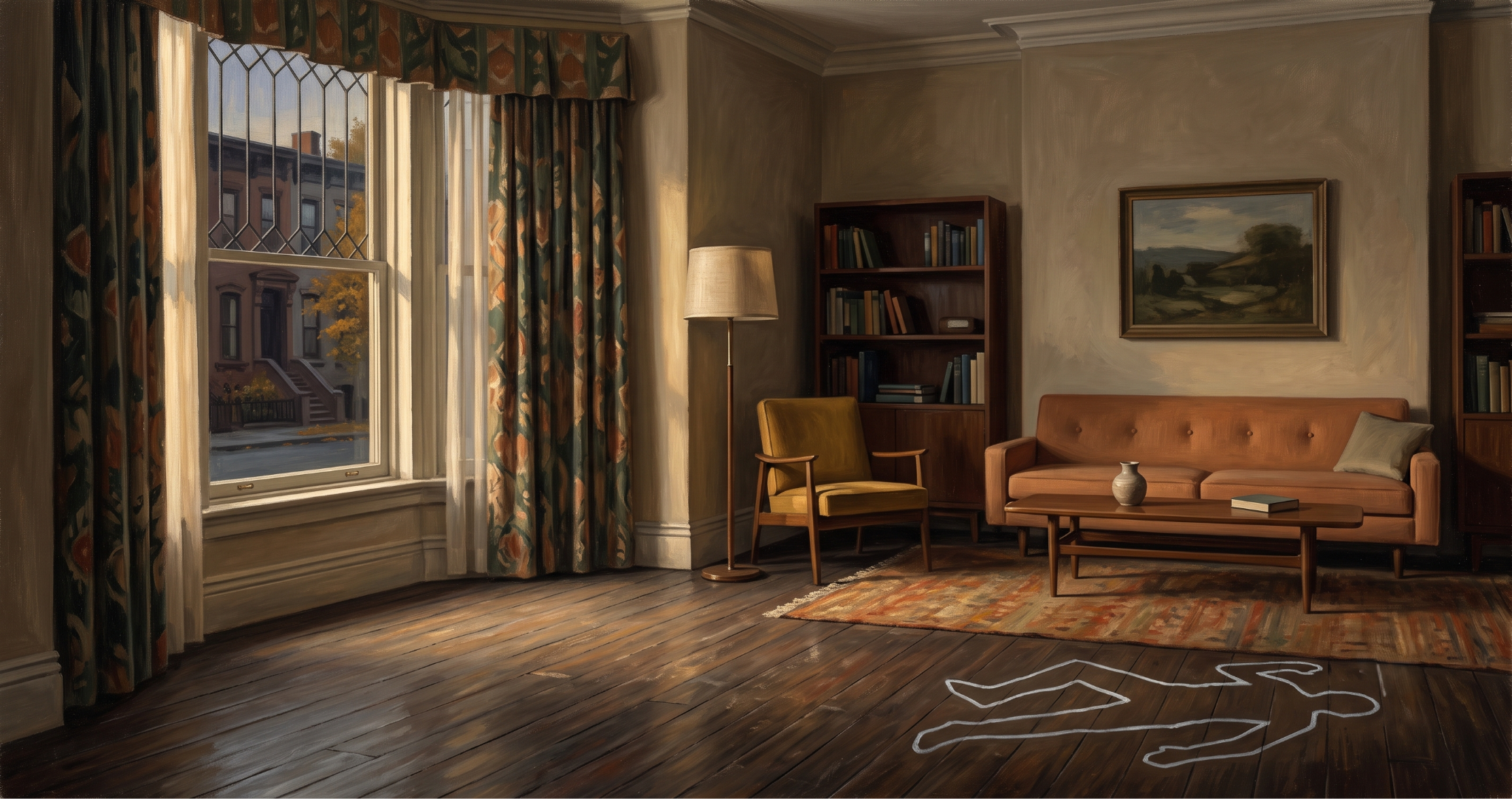
That's not a sketch about one bad contractor. It's how we handle most of our serious problems. Let me take you on a short tour before I tell you how I know the pattern from the inside.
The Twenty-Six-Lane Parking Lot
Start with something nobody's identity depends on: traffic.
For seventy years, American traffic engineering has run on one theory. Congested road? Make it wider. So we spend four years and a few billion dollars widening the highway, and the moment it opens, the new lanes fill up. Not eventually. Immediately. Engineers have known about this since the 1960s. They call it induced demand: build more road, and thousands of drivers who were avoiding the jam decide to come join the party.
Houston's Katy Freeway is the crown jewel. Widened to twenty-six lanes, the widest in the world, at a cost of nearly three billion dollars. Commute times got worse.
Twenty-six lanes. At some point you have to admire the commitment. A nation spent seven decades widening its own noose and calling every new lane progress, while the answer sat one level down the whole time. Road capacity doesn't relieve driving. It manufactures driving. The frame said congestion is a supply problem. The structure said congestion is what cars do. Everyone in the meeting was sincere, credentialed, and busy, and the actual cause never made the agenda.
Traffic costs you an hour. The next one costs more.
Treating the Symptom with the Cause
In the 1990s, American medicine adopted a new frame: pain is undertreated.
This was not a cynical frame. It was a compassionate one, backed by pain scales, continuing education credits, and the rollout of pain as the fifth vital sign. Doctors who hesitated to prescribe opioids were suddenly cold, behind the times. And inside that frame, every fix made sense. Better assessment. More aggressive treatment. Newer formulations, marketed as safer.
The structure underneath was a business model that engineered addiction into the prescription pad and then sold the resulting crisis a solution to itself. When the pills ran out, heroin was waiting, and then fentanyl. Half a million Americans dead, and for the first decade of the disaster the system's response was to refine its pain scales. Treating the symptom with the cause. That sentence should be impossible. It's just history.
Notice what the two cases share. No villain. The traffic engineer believed in lanes. Most doctors believed in the fifth vital sign. A frame is not a lie. A frame is a room, and rooms have walls.
The Biggest Room of All
We widened the highways and lengthened the commute. We strengthened the painkillers and multiplied the pain. We print more money and each dollar holds less.
For fifty years, everyone has been able to feel the problem. Young people can't afford houses. Wages don't stretch. Student debt compounds faster than careers do. And for fifty years the fixes have come from the fiscal toolbox: raise the minimum wage, forgive the loans, subsidize the down payments, hold the hearings. Congress has held forty hearings on what social media does to children and passed nothing, but the hearings are a kind of product. The room looks attended to.
Meanwhile, one number sits under the floorboards. Since 1974, real median income from labor is up about 40 percent. The S&P 500 is up about 4,000 percent. That's not a gap. That's two different worlds. Sell your hours and you live in the first one. Own assets and you live in the second, and the second has been pulling away from the first for half a century at a rate no tax credit can chase.
The structural question almost nobody in the fiscal frame can ask: what if the divergence isn't a policy failure inside the money, but a property of the money itself?
The dollar is designed to lose value. Two percent a year as official policy, more when the moment demands it. That one design choice does all the sorting. If money bleeds, holding money is punished, so anyone with a surplus gets herded into assets. Assets take capital to acquire. Capital is what the established have and the young don't. Every bailout, every round of quantitative easing, every rescue of asset prices was a payment to people who already owned things, financed by people still trying to buy their first thing. Nobody had to intend it. The direction of the transfer is written into the unit.
And the fiscal frame can't see it, for a structural reason rather than a moral one. Every question that frame asks is denominated in dollars. Who pays, who receives, what's fair. You can measure a ruler with itself. It comes out to exactly one ruler, every time, even after it warps. That's the dollar's report card too: a dollar is always worth exactly one dollar. So we audit everything in the economy except the floor we're standing on, and the floor keeps grading itself an A.
I've watched people get furious hunting for villains in all three of these stories. I understand the anger and I no longer trust it, because I've been the man who couldn't see the floor, and I wasn't lying to anyone. I was lying to myself, which is quieter and works better.
For years I drank in a way that was going to kill me. That's not a figure of speech. It was a self-destructive habit on a schedule, and the schedule had an end date.
Here's what matters for this essay. I did not experience alcohol as my problem. I experienced it as my solution. It was the one thing holding me together. The stress, the noise, the weight of the day: the drink handled all of it, reliably, on demand. Everything else in my life was a problem to be managed, and alcohol was the management. My frame was coherent. It had explanations for everything. It had cast the thing killing me as the thing keeping me alive, which is the most secure position a poison can hold. You will defend your poison like family if it comes dressed as the glue.
I couldn't think my way out, either. The clarity did not come first. I didn't achieve some insight, see the truth, and then quit in the light of my new understanding. It went the other way. I stopped drinking, and the stopping gave life enough time for the seeing to arrive. Weeks and months of not-drinking slowly turned the lights on, and there in the middle of my kitchen floor was the chalk outline I'd been decorating around for years. The one thing holding me together had been the thing taking me apart. I had it exactly backwards, and I would have argued the backwards version with you all night. Probably over drinks.
In the rooms of recovery they compress the lesson into instructions short enough to survive a bad day. Let go. Get out of the driver's seat. You're responsible for the effort, not the results. People hear those lines and think they counsel passivity. Those people have never worked the program, because the program is meetings and amends and inventory and phone calls, effort without end. What you surrender is the steering. The illusion that your framing controls the outcome. That illusion was the disease, and it always thought it was the driver.
Step Away from the Curtains
So when I say the answer to a badly framed problem is stepping back, I'm not recommending a mindfulness sabbatical. Stepping back was the single most consequential act available to me, and every other available act was a decoy. I could have managed my schedule, switched to beer, worked on the relationships the drinking was straining. Curtains, all of it. Good curtains, even. The only move that mattered was the one my frame had ruled out, and I didn't get to understand why until after I made it.
Teresa of Avila said humility is truth. Not modesty, not hedging, not thinking less of yourself. Truth. An accurate accounting of what you can see and what you can't.
By that standard I owe you two disclosures.
I've owned and argued for Bitcoin since 2014. When I tell you the crime under the economy is monetary, you're listening to a man whose frame, and whose portfolio, points at exactly that conclusion. Weigh my seeing accordingly. Maybe I found the structure. Maybe I'm just the decorator with better taste in curtains. The honest answer is that I can't fully rule out the second option, which is precisely the condition this essay says we're all in.
And I know what stepping back did in one life: mine. Whether the same move works at the scale of a civilization is a belief I hold with reasons, not a fact I hold with proof. The money question is where I'd place the wager. But civilization requires money the way a body requires blood, and money is not civilization, any more than blood is a life. Fix the unit and you've removed a poison from the well. Nobody has yet drunk, planted, married, or built anything because of it. That part was never in the unit. It was always in us.
So I won't hand you a program. Programs are what the decorator sells. I'll hand you the question instead, the one that took me years and nearly took me entirely: what, in your life or your work or your country, are you currently calling the glue? What are you certain is holding it all together? Because the frame that needs examining is never the one you doubt. It's the one you'd defend until two in the morning.
Step back from it before you understand why, and let the understanding come find you.
Then again, I quit drinking and immediately started writing about money and spirituality, so consider the source. Never take spiritual advice from a man who writes about spirituality. Take the effort. Leave the results to whoever's actually driving.